Burrata, mozzarella and stracciatella are among Italy’s culinary pleasures. These fresh cheese are simple and beautifully made, proving that outstanding ingredients need very little to please.
Whenever I travel through Italy, I make the most of every opportunity to eat these fresh cheeses.
During a recent visit to Venice and Trieste I enjoyed as much mozzarella, burrata and stracciatella as I could, accompanied by magnificent summer tomatoes that were at their seasonal best.
Fortunately, we now have those fresh cheeses in Australia, but maybe some makers are not as good as they could be.
Three Fresh Cheeses, Three Different Experiences
Fresh mozzarella, whether made from cow’s milk (fior di latte) or buffalo milk (mozzarella di bufala), has become widely available outside Italy. Burrata, however, remained relatively unknown for many years, although it has now become one of the most sought-after cheeses on restaurant menus around the world.
The reason is easy to understand. Burrata offers the delicate freshness of mozzarella with an indulgent creamy centre that transforms even the simplest dish into something memorable.
What is Stracciatella?
Stracciatella is the luscious filling found inside traditional burrata. It is made by combining finely shredded strands of fresh mozzarella with rich cream, creating a soft, almost spoonable cheese.
Its name comes from the Italian verb stracciare, meaning “to tear” or “to shred,” referring to the torn strands of mozzarella curd that are folded through the cream.
It is delicious served on its own with crusty bread, but inside burrata it becomes something even more irresistible.
Burrata: Puglia’s Creamy TreaT
Burrata originates in Puglia, the region of southern Italy famous for its olive groves, beautiful coastline and handmade orecchiette pasta.
The outer shell is made from stretched mozzarella curd, while the centre is filled with creamy stracciatella. As soon as you cut through the delicate casing, the creamy filling gently spills onto the plate.
It is one of those foods that never fails to impress.
The name burrata comes from burro—the Italian word for butter—a reference to its rich, buttery texture. Traditionally, some versions were filled with fresh cream rather than stracciatella, making the connection even more obvious.
Freshness Matters
Like all fresh cheeses, burrata is best eaten as soon as possible after it is made—ideally within 24 hours.
It is usually sold immersed in lightly salted whey or water, which helps preserve its freshness and delicate texture. Unlike aged cheeses, burrata is all about freshness, softness and clean dairy flavours.
Two traditional styles of burrata—the classic round burrata and the hand-tied version, both filled with creamy stracciatella.
Burrata with knot on top
Both burrate delicious and both enveloping the creamy filling.
Burrata with a sealed sphereHeirloom tomatoesHeirloom tomatoes
Burrata and Tomato Salad
When beautiful tomatoes are in season, burrata needs almost nothing else.
Combine ripe heirloom tomatoes with sweet cherry tomatoes, fragrant basil leaves, a drizzle of exceptional extra virgin olive oil and perhaps a few slices of mild red onion. Finish with flaky sea salt and freshly ground black pepper.
The combination is extraordinary: the sweetness and gentle acidity of the tomatoes, the perfume of basil, the richness of the creamy cheese and the peppery fruitiness of the olive oil create perfect balance.
An Italian Meal in Paris
I purchased ingredients and assembled this salad in Paris.
Burrata salad I made in Paris
The tomatoes, basil and red onion came from markets around the Mediterranean, while the burrata itself was Italian.
Italian Burrata bought in Paris
It was a reminder that wonderful cooking is often less about complicated recipes and more about choosing excellent ingredients and allowing each one to speak for itself.
Sometimes the simplest meals are the most memorable.
the friends made it for expressed that the mild acidity of tomatoes, basil, super-duper good quality extra virgin olive oil was ecstasy.
PESCE CRUDO,RAW FISH IN SICILY, AND THE ISLAND’S FISH MARKETS
Eating raw fish- pesce crudo – is a serious business in Sicily – of course, it is also cooked in many ways.
Pesce Crudo in Sicily
Pesce crudo has long been part of Sicily’s coastal food culture. Fresh fish is treasured on the island and enjoyed in countless ways—grilled, baked, fried, stewed and, increasingly, served raw.
Today, raw seafood appears on menus throughout Sicily, but traditionally it was rarely eaten completely untreated. Instead, it was first marinated in fresh lemon juice before being dressed with extra virgin olive oil. This simple preparation is known as condito in Italian or cunzato in Sicilian, allowing the freshness of the fish to remain the star.
One of the best examples is fresh anchovies. After being cleaned, filleted and trimmed, they are left to marinate in lemon juice for several hours. The acidity of the lemon gently changes the texture of the flesh, a process often described as “cooking” the fish without heat.
In Sicily, these marinated anchovies are sometimes called anchive cotti d’a lumia—anchovies “cooked by the lemon”. Once drained, they need little more than a generous drizzle of excellent extra virgin olive oil to become a perfect antipasto.
Fresh sardines
Beyond Tuna and Swordfish
For generations, tuna and swordfish were the fish most commonly served raw in Sicily, particularly as appetisers. Today, however, Sicilian chefs are embracing a much wider range of seafood.
Influenced by international cuisines and contemporary dining trends, they prepare many varieties of local fish and shellfish as pesce crudo. Yet the philosophy remains unmistakably Sicilian: start with exceptionally fresh seafood and treat it with restraint.
Writing About Sicilian Pesce Crudo
I was commissioned to write an article on Sicily’s pesce crudo for Great British Chefs, a food multimedia company that publishes recipes and other culinary content via its website. Great British Chefs has expanded into Italy with Great Italian Chefs, and the article published on their website is titled PESCE CRUDO.
No matter how beautifully the fish is presented, it all begins with extraordinary ingredients.
Palermo Fish market, swordfish and tuna are among the treasures of Sicily’s fish markets
Sicily’s Fish Markets
One of my greatest pleasures in Sicily is wandering through its fish markets. They are lively, colourful places where fishermen, fishmongers, chefs and local shoppers gather each morning in search of the day’s catch.
Although there are excellent fish markets throughout the island, the famous market beside Piazza del Duomo in Catania is one of Sicily’s finest. The sounds of vendors calling to customers, the scent of the sea and the dazzling displays of seafood create an unforgettable experience.
The stalls are filled with remarkable variety—from octopus, squid, cuttlefish and shellfish to sea urchins, edible seaweeds and the celebrated gamberi rossi (Sicilian red prawns). Buckets teem with live seafood, shells glisten in the sunlight and every display reflects the freshness that Sicilian cooks insist upon.
Swordfish and tuna remain the undisputed centrepieces. Whole swordfish are often displayed upright, their long bills pointing skyward, while enormous tuna are expertly broken down before customers’ eyes. Every cut is carefully displayed, reflecting the Sicilian respect for using the whole fish and providing unmistakable proof of its freshness.
Whether you enjoy pesce crudo in a seaside restaurant or prepare it yourself at home, Sicily reminds us that outstanding seafood needs very little embellishment. Freshness, good olive oil, lemon and restraint are often all that is required.
The famous fish market in Catania, where Sicily’s freshest seafood arrives each morning.
I have always enjoyed fish markets in Sicily.
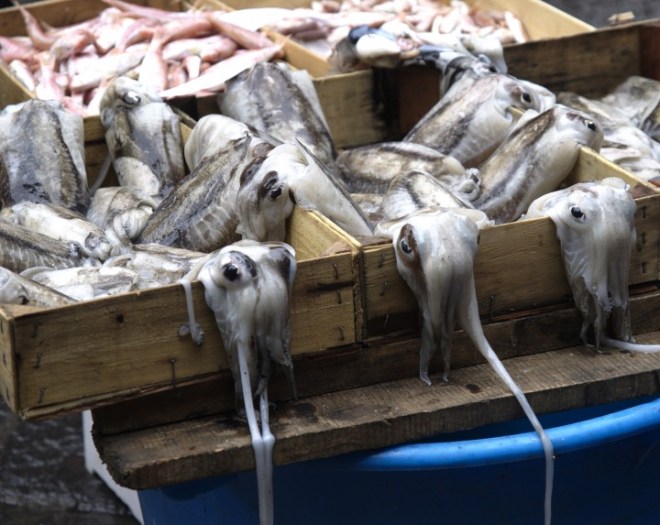
Fresh Squid as sold in Markets in Sicily
This is a small segment from the article PESCE CRUDO:
Walking through the fish markets in Sicily is always a joy; the hustle and bustle of locals seeking out the best produce among the colourful stalls and traders is what makes the island such a charming place. There is more than one fish market in Catania, but the principal market in the southwest of the Cathedral Square is one of the largest in Sicily. However, wherever you are on the island will never be too far from fresh fish.
Sicily’s fish markets have vast, colourful, varied displays of exotic specimens such as sea urchins and edible algae to the more conventional octopus, squid, tuna and swordfish. Small, live fish swim circles in buckets of sea water, snails crawl about and all types of shellfish, especially the gamberi rossi (red prawns of Sicily), look dazzling. You know the fish is fresh – their shells and scales glisten in the sun.
Swordfish and tuna, the traditional staples of Sicilian cuisine, are the centrepieces of the market stalls. They are often displayed whole, the swordfish bill like a spear thrusting upwards. At other times, their massive round carcasses lie like a trunk on the fishmonger’sbench, while the tuna is sliced vertically and horizontally before being filleted along the length of its spine, while all its parts are laid out, testifying to its freshness.
The photos in this article were taken over my numerous trips to Sicily (Thank you also to Bob Evans and Angela Tolley). Some of these photos are in my book Sicilian Seafood Cooking.
Catania Fish MarketFish can be presented in an elegant manner.
Chillies are called peperoncini in Italian and are at their best in Autumn.
I am enthusiastic about fresh seasonal produce and get active.
These chillies were grown by friends in their garden in Adelaide and I decided to make a chili paste for them.
Harissa
I have been making Harissa for a very long time since one of my Sicilian relatives who lives in Augusta introduced me to it about thirty five years ago. Augusta is in south eastern Sicily and is an important Sicilian and Italian naval base and trading port. Giacomo is a mechanical naval engineer and was often called out to work on naval vessels in the gulf, some vessels were from Tunisia, Algeria and Libya and he was introduced to this hot chilli paste through his contacts. There are many recipes for this paste and it is an important condiment in Middle Eastern Cuisine.
Some make Harissa with dry chillies, some with fresh chillies and some with roasted chillies. I usually use cumin and caraway seeds and garlic when I make it.
I use Harissa in many ways and always to accompany cuscus.
Salsa Romesco
I also like to make Salsa Romesco , a condiment popular around Barcelona in north-eastern Spain. Like when making harissa there are many variations to recipes but this condiment is commonly made with red peppers, garlic, tomatoes, white bread and almonds. Sometimes I have roasted the peppers and added some roasted chillies as well.
Crema di Peperoncino
Crema di Peperoncino is a chilli paste that is very popular in Calabria. It is usually made with fresh chillies , salt, garlic and olive oil. I thought that would combine my experiences for making Harissa and Romesco and make a roasted chili paste. No spices, just chillies, salt, garlic and extra virgin olive oil – Crema di peperoncini.
Isn’t that what cooking is all about?
I kept is very simple, and hot tasting.
I could have made a milder paste by adding some ordinary red peppers but I decided to just keep the Crema di pepperoncino hot, hot. hot….And it was. I used the other red peppers in a salad.
The photos demonstrate what I did.
Ripe red chillies
Use any type of red chillies that you have.
A different type of red chilli
INGREDIENTS
Red chillies, garlic to taste, 3-4 tablespoons extra virgin olive oil, teaspoon of salt (preservative), more extra virgin olive oil to place on top.
Charred chillies
Process
Grill/ Roast the chillies on high heat. Turn once until blackened and charred all over. Do the same with unpeeled garlic cloves.
Charred garlic cloves
Allow to cool.
Remove the skins and seeds – you can leave some seeds if you would like it hotter!
Blend all the ingredients together.
Place the food in a sterilised jar and top with a layer of oil to seal. Store the jar in the refrigerator and replace a layer of oil on top each time you remove a portion to prevent mould.
An antipasto of grilled summer vegetables and a scoop of salads are one of the simplest and most satisfying meals. When eggplants and peppers are abundant in summer and autumn, there is little that can rival a generous platter of beautifully grilled seasonal vegetables dressed with excellent extra virgin olive oil or some of the sauces I have listed below.
They are equally at home as a light starter, part of an antipasto spread or alongside grilled meat, fish or cheese as part of the main meal.
Grilled vegetables are a classic Italian antipasto, especially when summer eggplants, zucchini and peppers are at their best
Choose the Best Seasonal Vegetables
Eggplants and peppers are favourites, but zucchini deserve a place on the platter too. Depending on the season, I also like to include asparagus, broccolini or green beans. Even leftover cooked vegetables from the previous evening can be transformed into something special.
The vegetables can be cooked over a barbecue, on a grill plate or in the oven. The important thing is to cook them until they are tender and lightly charred, bringing out their natural sweetness.
Once grilled, all they need is a drizzle of good-quality extra virgin olive oil, finely chopped garlic, fresh parsley and perhaps a squeeze of lemon juice.
Charring peppers on the BBQ
The vegetables can be grilled on a BBQ or Grill press or in the oven.
Grilling eggplants the Grill Press
Vegetables – Add Freshness and Crunch
One of the pleasures of a grilled vegetable platter is that it can be different every time.
For contrast, add finely sliced celery, fennel, cucumber or even crisp apple. Tomatoes, spring onions and fresh basil also work beautifully. These fresh ingredients add colour, texture and brightness while the olive oil ties everything together with its fragrance and richness.
Recently, I noticed the same idea in two different restaurants. Both served grilled vegetables with generous dollops of Romesco sauce on the side.
One dish featured grilled asparagus topped with crisp fried breadcrumbs. The other showcased grilled eggplant, cooked until soft and then roughly mashed rather than served in slices. The creamy eggplant paired beautifully with the smoky, nutty Romesco.
A slice of rustic bread was all that was needed to scoop up the vegetables and every last spoonful of the sauce.
And, of course, another drizzle of excellent extra virgin olive oil completed the dish.
Summer tomatoes and basil
SALSA ROMESCO (Romesco Sauce with Roasted Peppers, Tomatoes and Almonds)
Romesco is a rich, smoky sauce that pairs beautifully with grilled vegetables, seafood and meats. This version combines roasted peppers, tomatoes, garlic and almonds, resulting in a sauce that is full of flavour and wonderfully versatile.
Char-grill or barbecue the peppers whole until the skins are blackened. Peel away the skins, remove the seeds and tear the flesh into strips. If using fresh tomatoes, cut them into large pieces and grill them alongside the peppers. Roast or grill the garlic until soft.
Blend the roasted vegetables with the almonds and the remaining ingredients until you achieve the texture you prefer—either smooth or slightly coarse.
Romesco Sauce with Hazelnuts
Hazelnuts are a traditional alternative to almonds and give the sauce a richer, deeper flavour. In this version, all of the vegetables are roasted in the oven rather than grilled.
Use the same ingredients as the recipe above, substituting hazelnuts for the almonds.
Place the tomatoes, peppers and a whole head of garlic in a lightly oiled roasting tray and roast in a preheated 190°C oven. Remove each vegetable as it becomes tender: the tomatoes will take about 10 minutes, while the peppers and garlic will need approximately 30–40 minutes. Once cooled, peel the peppers and garlic, then blend with the remaining ingredients to your preferred consistency.
Labneh and Coeur à la Crème may come from different culinary traditions, but they have one thing in common—they transform simple yoghurt into an elegant dessert.
Labneh, the Middle Eastern strained yoghurt cheese, has become a permanent fixture in my refrigerator. It is wonderfully versatile: delicious as part of a savoury meal, spread on bread or served with olive oil and herbs, but equally at home in desserts where its fresh, slightly tangy flavour balances sweetness beautifully.
One of my favourite ways to use it is in Coeur à la Crème, the classic French dessert whose name translates as heart of cream. Traditionally made with fresh cream cheese and cream, it is equally delicious prepared with homemade labneh, giving it a lighter texture and a delicate yoghurt flavour.
Homemade labneh is simply Greek yoghurt strained until thick, creamy and spreadable.
Labneh – A Staple in My Kitchen
When I first began making labneh many years ago, it was still relatively unfamiliar outside Middle Eastern communities. Today it has become much more widely appreciated, reflecting the way Australia’s multicultural food culture has embraced ingredients from around the world.
Ten years ago I would have said that Italians would not have known about Labneh, but Italian cooks have also discovered labneh, although it is more commonly served as a savoury dish dressed simply with extra virgin olive oil and herbs or spices such as mint, parsley, fennel seeds or paprika.
In Australia because of our multi-cultural population we are more familiar with Labneh and with the spices we use.
Labneh, served as a savoury dish dressed simply with extra virgin olive oil and herbs , a herb dressing or sprinkled with spices such as mint, parsley, fennel seeds or paprika
I enjoy Labneh both in savoury dishes, but I particularly like using it in desserts.
Making Homemade Labneh
Labneh is simply Greek yoghurt that has been strained until much of the whey has drained away, producing a soft cheese with a consistency somewhere between thick yoghurt and cream cheese.
For the best results I buy full-fat Greek-style yoghurt with no added sugar or flavourings. I look for labels such as pot set, live and active cultures, organic or biodynamic. Good yoghurt produces good labneh.
Ingredients
1 kg full-fat Greek-style yoghurt
Muslin (cheesecloth)
Colander
Bowl
Method
Line a colander with a single layer of muslin and place it over a bowl.
Spoon the yoghurt into the muslin, cover and refrigerate for 6–8 hours, or overnight if you prefer a firmer texture.
The whey will slowly drain into the bowl below. Different yoghurts release different amounts of liquid depending on their water content. From 1 kg of yoghurt I generally obtain around 820 g of labneh.
Store the finished labneh wrapped in the muslin in an airtight container in the refrigerator for up to one week. It will continue to firm slightly as it drains.
After several hours of draining, the yoghurt transforms into rich, silky labneh
Coeur à la Crème
This simple dessert combines the freshness of labneh with cream cheese, ricotta or cream to create a smooth, luxurious filling.
Ingredients
700 g labneh
250 g cream cheese or ricotta, or 200 ml double cream
100 g pure icing sugar or honey (adjust to taste)
Seeds of 1 vanilla bean, or good-quality vanilla extract
Finely grated zest of 1 lemon
Method
Place all the ingredients into a mixing bowl.
Mix briefly by hand, then beat with an electric mixer until smooth and creamy. Taste and adjust the sweetness if necessary.
A traditional Coeur à la Crème mould is heart-shaped with a perforated base that allows any remaining liquid to drain. If you do not own one, a heart-shaped cake tin lined with muslin works well. You may simply need to pour off the drained liquid occasionally. See Photos below.
Line the mould with muslin, spoon in the mixture and smooth the surface.
Cover and refrigerate for at least 4 hours, or overnight.
To serve, invert onto a serving plate and carefully remove the muslin.
Fresh seasonal fruit, poached fruit or fruit lightly macerated with a splash of liqueur all make excellent accompaniments.
Blood Orange Topping
Blood oranges are one of my favourite winter fruits, and their vibrant colour makes a beautiful contrast to the creamy white dessert.
Ingredients
4 blood oranges
3 tablespoons honey
2–4 tablespoons orange liqueur (I used Cointreau)
Fresh mint (optional)
Method
Working over a bowl to catch the juice, remove all peel and pith from the oranges. Cut between the membranes to release the segments.
Heat the honey with 1 tablespoon of water until lightly caramelised.
Add the orange segments and reserved juice and cook gently for 4–5 minutes.
Stir in the orange liqueur and allow the fruit to cool completely before chilling.
Serve the chilled oranges around the Coeur à la Crème and garnish with fresh mint if desired.
This is an elegant dessert that looks impressive yet is surprisingly easy to prepare. Better still, it can be made a day ahead, leaving only the fruit to finish before serving.
MOLDS
Coeur à la Crème mold
Coeur a la crème is made in a heart shaped special mold with a perforated bottom that allows the mixture to drain and compact properly.
A heart shaped baking tin lined with muslin will also keep draining but you will need to remove the liquid more often.
Carne Aglassata is one of Sicily’s classic braised meat dishes. Cooked slowly with an abundance of onions, the onions gradually collapse into a rich, velvety sauce that reduces to coat the meat with a beautiful glossy glaze.
The name aglassata comes from the French word glacer (to glaze), a reminder of the French influence on Sicilian cooking. Once the sauce has reduced, it clings to the meat with a silky sheen, giving the dish both its appearance and its name.
Carne Aglassata – ox tongue slowly braised with onions until the sauce becomes rich, glossy and full of flavour.
A Dish from the Monsù Kitchens
Carne Aglassata is closely associated with Palermo and the refined cooking of the Monsù—from the French monsieur. These French and French-trained cooks worked in the households of Sicily’s aristocratic families during the eighteenth and nineteenth centuries.
Some Monsù were French; others came from Piedmont, a region heavily influenced by France at the time. They blended French culinary techniques with Sicilian ingredients, producing elaborate dishes that became an important part of Sicily’s gastronomic history. Many of these sumptuous meals are vividly described in Il Gattopardo (The Leopard) by Giuseppe Tomasi di Lampedusa, a novel that captures Sicily during the years of the Risorgimento.
Yet Carne Aglassata remains surprisingly simple at heart. Its success depends not on expensive ingredients but on two essentials—meat and plenty of onions—slowly transformed into something remarkably rich and satisfying.
My Father’s Version: Tongue Instead of Beef
Traditionally, Carne Aglassata is prepared with yearling beef, often girello (silverside or eye of round). My father’s version as made by his family in Ragusa, was often made with ox tongue (lingua).
I’ve never understood why he began cooking it only after our family migrated to Australia. While we lived in Sicily he rarely cooked, yet once we settled here, Sunday mornings often began with the gentle aroma of onions, herbs and tongue slowly simmering on the stove.
Lunch followed a familiar pattern. Most of the onion sauce was tossed through rigatoni or penne, while the sliced tongue was served afterwards as the main course, dressed with the remaining sauce. Occasionally he added peas during the final stage of cooking, and sometimes pieces of tongue found their way into the pasta as well.
Good quality pasta
It was a simple family meal, but one that remains among my strongest food memories.
Slow Cooking Makes the Difference
Traditionally the dish is cooked with lard, which gives the finished sauce its characteristic gloss. I now use mostly extra virgin olive oil, adding just a tablespoon of lard at the end to achieve the same silky finish.
Because ox tongue contains a fair amount of fat, I prefer to cook it a day ahead. After an overnight rest in the refrigerator, the solidified fat can be lifted away easily before reheating the sauce. I also trim away the thicker back section of the tongue, which is generally fattier.
The result is a lighter dish without sacrificing flavour.
Lard I keep in the fridge and I collect this after roasting pork.
INGREDIENTS
1 ox tongue
4 large onions, thinly sliced
1 glass dry white wine
2 sprigs rosemary
6–8 sage leaves
Salt and freshly ground black pepper
About ½ cup extra virgin olive oil and lard combined (or use all olive oil if preferred)
Preparing the Tongue
Wash the tongue thoroughly, scrubbing it well with a vegetable or clean kitchen brush.
Place it in a saucepan, cover with cold water and bring to the boil. Simmer for about 30 minutes, or until the outer skin turns white.
Drain immediately and peel away the thick outer skin while the tongue is still hot. It should come away quite easily.
Peeled ox tongue
Method
Choose a saucepan that will comfortably hold the tongue without requiring excessive water.
Place the sliced onions in the pan with the olive oil, rosemary, sage, salt and pepper. Sit the peeled tongue on top and add just enough water to almost cover it.
Cover and cook gently over low heat for about 2 hours.
Add the white wine and continue cooking, covered, for a further 30 minutes, or until the tongue is very tender.
Refrigerate the saucepan overnight.
The next day, remove and discard the solidified fat. Lift out the tongue and set it aside.
Boil the onion sauce over medium-high heat until it thickens to a rich, glossy consistency. Stir in about 1 tablespoon of lard if using.
Slice the tongue and return it to the sauce just long enough to heat through.
The tongue has been sliced and covered with the onion sauce
Serve the onion sauce with pasta as a first course, followed by the sliced tongue as the main dish, or simply serve everything together.
Any leftover tongue is also excellent pressed and served cold.
Variations
Some Sicilian cooks add fresh peas during the final stages of cooking. Others include slices of tongue in the pasta sauce, making the first course even more substantial.
However you serve it, the true star of Carne Aglassata is the sweet, slow-cooked onion sauce that gives the dish its distinctive glaze.
Carne Aglassata is a classic Sicilian braise where ox tongue slowly cooks with onions until they become a rich, glossy sauce perfect for pasta and meat.
The background for many of Sicily’s most celebrated sweets, including cassata and marzipan, were refined in convent kitchens. From Palermo’s Martorana to monasteries in Catania and Agrigento, nuns developed elaborate almond and ricotta desserts for religious feasts and aristocratic patrons, leaving a lasting legacy in Sicilian pastry traditions.
In this post I wish to provide more information about the important role of nuns in Sicilian Convents.
18th-19th century basilica in Noto – Benedictine nuns lived in a cloistered convent next to the basilica.Ricotta, as is still sold in some parts of Sicily.
Convent Traditions: Nuns and the Art of Sicilian Sweets
The refinement of many Sicilian desserts owes much to the nuns of the island’s convents, particularly from the late Middle Ages through the 18th and 19th centuries. Within the cloistered life of these religious communities, convent kitchens became places of remarkable culinary creativity. Nuns prepared elaborate sweets for major religious celebrations — especially Easter, Christmas and the feasts of patron saints — and over time developed a reputation for producing some of the most refined pastries in Sicily.
Many convents supported themselves financially through the sale of sweets made within their walls. These desserts were often sold through small windows or ruote(turning wooden wheels) that allowed goods to be passed outside without the nuns breaking their enclosure. The sweets soon became sought after by local aristocratic families and wealthy households, who ordered them for weddings, baptisms and feast days.
The ingredients used reflected Sicily’s agricultural wealth and its Arab culinary legacy: almonds, sugar, citrus peel, candied fruits and ricotta. Almond paste, known as pasta realeor marzipan, was especially important.
One of the most famous examples comes from Palermo, where the Benedictine nuns of the Convent of Santa Maria dell’Ammiraglio, commonly known asLa Martorana, became renowned for shaping coloured marzipan into extraordinarily realistic fruits and vegetables. These sweets, called frutta martorana, were originally prepared for the Feast of All Saints but later became one of Sicily’s most recognisable confectionery traditions.
In Catania, convent pastry traditions also flourished. The Benedictine nuns of the Monastero dei Benedettini di San Nicolò l’Arena, one of the largest Benedictine monasteries in Europe, were known for preparing elaborate sweets for religious festivals and aristocratic patrons. Catania’s rich convent pastry tradition later contributed to famous desserts such as minne di Sant’Agata, small ricotta-filled cakes created in honour of the city’s patron saint.
Further south, in Agrigento, the nuns of convents such as the Monastero di Santo Spiritobecame celebrated for their almond-based sweets. Their pastries, including delicate almond biscuits and marzipan confections, were closely linked to local almond cultivation and to the Arab-influenced techniques that had shaped Sicilian confectionery for centuries.
Convent kitchens also played an important role in refining the appearance of cassata Siciliana. Through careful layering of sponge cake, sweetened ricotta and candied fruits, and by covering the cake with marzipan and icing, the nuns helped transform what may once have been a simpler ricotta dessert into the richly decorated cassata associated with Sicilian celebrations today.
Although many convents have since closed, their influence remains deeply embedded in Sicily’s pastry traditions. Numerous classic sweets — including cassata, marzipan fruits and other almond-based confections — still carry the unmistakable legacy of convent pastry making, where devotion, patience and artistry were expressed through sugar and almonds.
The contribution of the monsù
The pastry traditions of Sicilian convents later intersected with the work of the monsù, the French-trained chefs employed in aristocratic households from the eighteenth century onwards. While the nuns preserved and developed many almond- and ricotta-based sweets within convent kitchens, the monsù refined and elaborated these traditions, introducing greater technical sophistication and decorative flourish that helped shape the elaborate cassata and marzipan desserts recognised today.
This recipe is not quite Porchetta, as a traditional Porchetta is a whole baby pig that has been boned, stuffed and roasted.
Porchetta is common in certain parts of central Italy and those of you who have travelled to Umbria, Lazio, Abruzzo and the Marche may have had slices of Porchetta in a panino or between two slices of rustic bread and it is common fare in regional fairs or markets; it is eaten hot or cold.
In Italian, a fair is called a Fiera and a market is a Mercato or a Mercatino, that is a small market.
Porchetta sliced
But this recipe uses belly pork and although it called Porchetta, you now know that it is not, except for the stuffing. You would also know that there are always many variations in all Italian regional cooking, but rosemary, garlic and fennel are a must in this recipe.
I did not cook the following Porchetta and it is not my recipe, it is a Tobie Puttock recipe published in a New Idea magazine. The cook and host was my brother. The photographs are mine and hopefully they will help to explain the method of preparing the belly pork for cooking.
In the original recipe the skin is left on and honey is rubbed over the meat once it is out of the oven (I really cannot imagine why you would want to do this, but go ahead if you wish). My host and brother removed the skin and cooked the meat on a roasting rack, this would also be my preference, as I do not like too much fat.
Placing the herbs under the crackling, then rolling it and tying it with string
One roll of meat was really enough for 4 people and weighed 1.5 kg.
Below it the ideal size of a piglet used for making a real Porchetta.
Roast baby pig as presented in a Melbourne restaurant
The recipe below is yet another adaptation of the original Tobie Puttock recipe called Porchetta that was published in the New Idea magazine, but was later published in a Delicious Magazine.
I cannot supply dates because I don’t have them, but this updated recipe in Delicious is better than the original and is called Porchetta with Salsa Verde.
But sorry Tobie, salsa verde is not something I would add to a serve of Porchetta as it competes with the flavours of the stuffing that are the highlight of the dish. For that amount of meat, I would use double the amount of herbs and reduce the amount of garlic. And make sure that they are fresh herbs.
And as mentioned before, NO Honey!
Porchetta with Salsa verde
Ingredients
4-5kg piece pork belly*, boned, skin and excess fat removed, skin reserved (ask your butcher to do this for you)
1/2 cup sage leaves, roughly chopped
1/2 cup rosemary leaves, roughly chopped
1 tbs fennel seeds
6 garlic cloves, finely chopped
1 tbs olive oil
5 tbs (100ml) good-quality honey
salsa verde (makes about 1 cup)
2 garlic cloves, fi nely chopped
3-6 anchovies
1 tbs salted capers, rinsed, roughly chopped
Small handful of flat-leaf parsley leaves
Small handful of basil leaves
5 mint leaves, sliced
Finely grated zest and juice of 1 lemon
Extra virgin olive oil
method
Preheat the oven to 250˚C and oil a large roasting pan. Lay the pork belly flat on a work surface. Sprinkle with 2 tsp coarse sea salt and 2 tbs freshly ground black pepper, then massage the seasoning into the meat. Stand for 5 minutes, then sprinkle the meat with the sage, rosemary, fennel seeds and garlic. Starting from one long side, roll up the pork firmly. Wrap the roll in the reserved pork skin, so the ends meet under the roll. Use kitchen string to tie first around the centre, then 2cm from each end. Add a few more ties along the roll to secure well. Massage the olive oil into the skin, followed by 2 tsp coarse sea salt and 2 tbs black pepper.
Place the pork in the roasting pan and roast for 10 minutes, then turn and roast for a further 15 minutes. Reduce the oven temperature to 140°C, cover pan with foil and roast for 3 hours or until the meat is meltingly tender.
Saint Joseph’s Day in Sicily (Festa di San Giuseppe) is celebrated on 19 March with religious traditions, elaborate displays of food and an abundance of sweets, particularly sfinci and crispeddi di risu (Sicilian rice fritters).
A statue of Saint Joseph, a common sight in Churches
Throughout Italy, the feast also coincides with Father’s Day (La Festa del Papà), honouring Saint Joseph as the father figure of the Holy Family.
In southern Italy, saints’ name days have traditionally held particular significance. My father, who was born in Ragusa but lived in Trieste, always received telephone calls from his relatives in Sicily wishing him auguri on 19 March.
Saint Joseph, Spring and Sicilian Food Traditions
Saint Joseph, traditionally regarded as a humble carpenter who cared for Mary and Jesus, is the patron saint of fathers, workers, carpenters and the poor. Interestingly, he is also associated with pastry cooks.
The connection becomes clearer when we consider the food traditions surrounding his feast day in Sicily.
Although Saint Joseph’s Day falls during Lent, traditionally a period of fasting and abstinence, it also coincides with the approach of spring and the renewal of agricultural life.
Long before Christianity, Mediterranean communities celebrated the changing seasons with rituals associated with fertility, regeneration and abundance.
Grains, seeds and legumes symbolised new life, and these ancient associations remain evident in Sicilian celebrations.
La Tavola di San Giuseppe: Saint Joseph’s Table
In many Sicilian communities, elaborate food displays known as La Tavola di San Giuseppe (Saint Joseph’s Table) are prepared to celebrate the feast.
Festive breads in a La Tavola di San Giuseppe in southern Sicily
Wheat (grains, seeds and legumes) were considered the metaphorical seeds of life and through germination and regeneration they invoke the powers of fertility. Decorative breads, often shaped into symbolic forms are sprinkled with seeds and occupy a prominent position alongside vegetables, legumes and traditional sweets.
Historically, these tables expressed gratitude for the harvest and provided food for the poor. Today, they continue to represent generosity, hospitality and community.
Sfinci and Crispeddi di Risu: Traditional Sicilian Sweets
Fried sweets are an essential part of Saint Joseph’s Day celebrations in Sicily.
Two particularly popular varieties are sfinci, made primarily with flour, and crispeddi di risu, prepared with cooked rice.
As with so many Sicilian dishes, recipes vary considerably between regions, towns and families.
Sfinci di San Giuseppe are especially associated with western Sicily, particularly Palermo, where they are often filled or topped with sweetened ricotta cream.
Simpler versions of sfinci are also prepared elsewhere on the island, sometimes with custard or without any filling.
Crispeddi di risu, also known as zeppole di riso, are particularly popular in eastern Sicily, including Messina, Catania and Syracuse.
These golden rice fritters are traditionally flavoured with citrus zest and finished with honey or sugar and cinnamon.
Two Traditional Sicilian Rice Fritter Recipes
I have selected two recipes from respected Sicilian cookbooks.
The first comes from Maria Consoli Sardo’s Cucina Nostra (1978), a book I particularly appreciate for its uncomplicated, traditional recipes.
Her preparations often reflect cucina povera, the resourceful cooking associated with rural Sicilian households, where inexpensive ingredients were transformed into satisfying dishes.
The second recipe is adapted from Giuseppe Coria’s Profumi di Sicilia: Il Libro della Cucina Siciliana.
Both recipes use rice, milk and flour, but their methods differ. The first contains no yeast, while the second relies on yeast to produce a lighter fritter.
The Crispeddi di risu, traditional Sicilian rice fritters I made
Recipe 1: Sfinci di Risu – Traditional Sicilian Rice Fritters
Adapted from Maria Consoli Sardo, Cucina Nostra (1978)
This is a particularly simple preparation, requiring only a few ingredients. The cooked rice rests overnight before being combined with flour, shaped into batons and fried.
Ingredients
200 g Arborio rice
500 ml water
500 ml milk
200 g plain flour
A pinch of salt
Lard or extra virgin olive oil for frying
Sugar and ground cinnamon for serving
My variation: Chestnut honey and cinnamon instead of sugar.
Method
Bring the water to the boil, add a pinch of salt and the rice.
Cook until the rice is approximately halfway done, then add the milk.
Continue cooking gently, stirring occasionally, until the rice is tender and has absorbed most of the liquid. The consistency should resemble a thick risotto.
Transfer the cooked rice to a bowl, allow it to cool and refrigerate for approximately 24 hours.
Add the flour and mix thoroughly to form a firm mixture.
Spread the mixture onto a lightly floured work surface and leave it to rest for approximately two hours.
Cut into short batons.
Heat the frying fat in a deep pan and fry the batons in batches until golden and crisp.
Drain on absorbent paper.
Sprinkle with sugar and cinnamon while still warm.
My Variation: Honey and Cinnamon
I fried my sfinci di risu in extra virgin olive oil rather than lard.
Instead of the traditional sugar coating, I drizzled them with chestnut honey and sprinkled them with cinnamon.
I usually have Sicilian orange blossom honey in my pantry, but I had run out. The chestnut honey, with its distinctive, slightly bitter flavour, proved an excellent alternative.
My jar of Chestnut Honey
Recipe 2: Crispeddi di Risu – Sicilian Rice Fritters with Yeast
Adapted from Giuseppe Coria, Profumi di Sicilia: Il Libro della Cucina Siciliana
Giuseppe Coria’s recipe includes yeast and grated citrus zest, producing fragrant rice fritters with a different texture from the previous version.
Judging by the quantities, Signor Coria must have been accustomed to cooking for large numbers!
The original recipe makes a substantial batch, so reduce the quantities if necessary.
Ingredients
1 kg rice
1 litre milk
1 litre boiling water
½ teaspoon salt
2 tablespoons sugar
500 g plain flour
150 g fresh yeast, dissolved in ½ cup lukewarm water (see note)
Finely grated zest of 2 oranges
Finely grated zest of 2 lemons
Oil for deep-frying
Honey and ground cinnamon for serving
Note: The quantity of fresh yeast is unusually high by modern standards. It is reproduced from the original recipe and is worth checking before preparation. If using dried yeast, adjust the quantity appropriately rather than substituting it directly.
Method
Combine the milk and water in a large saucepan. Add the salt, sugar and rice.
Bring to the boil, reduce the heat and simmer gently, stirring occasionally.
Continue cooking until the rice is tender and has absorbed the liquid, resembling a thick risotto.
Allow the mixture to cool until lukewarm.
Stir in the flour, dissolved yeast and grated citrus zest.
Mix thoroughly, cover and leave to rise for approximately 2–4 hours.
Heat the oil in a deep frying pan.
Using a spoon, shape portions of the rice mixture and carefully slide them into the hot oil.
Fry in batches until golden.
Drain briefly on absorbent paper.
Drizzle with honey and sprinkle with cinnamon.
Serve warm.
A Sicilian Tradition Worth Preserving
Saint Joseph’s Day is another example of how Sicilian food traditions connect religious celebrations with much older agricultural customs.
The decorative breads, communal tables and simple fried sweets express generosity, renewal and the importance of sharing food.
Whether called sfinci di risu, crispeddi or zeppole di riso, these traditional fritters demonstrate the ingenuity of Sicilian cooking: a handful of everyday ingredients transformed into something special.
Italy double dips and combines this ancient and religious tradition of Saint Joseph (19 March) with Father’s Day – La Festa del Papà – the feast (celebration) for father, the event imported from America in the early 20th century. In the USA it is held on the third Sunday of June.
When in Sicily eating Spaghetti With Sea Urchins (Spaghetti chi Ricci) is a must.
Pasta con i ricci di mare, a Sicilian dish, captures the essence of the sea in a single mouthful. Its delicate yet intense flavour is characterised by a combination of sweet, briny, creamy and unmistakably marine.
They are relatively unknown culturally in Australia and have been next to non-existent commercially.
Sea urchins are considered a delicacy in many parts of the Mediterranean, particularly in Italy, France and Greece, and they are also highly prized in Japan. In Italy they are known as ricci di mare – “sea hedgehogs”. Ricci also means curly – the spines of sea urchins are curly at the ends.
What we commonly call sea urchin “roe” is not actually roe in the strict sense. The edible yellow-orange lobes are the reproductive organs, or gonads, of both male and female sea urchins. “Roe”, however, remains the more appetising and commonly used culinary term.
Sicily
When I was a child visiting Sicily, I remember finding sea urchins under rocks on the beach — family and friends wrapped their hands in newspaper and went looking for them at low tide. Most of the time it was very easy to find 4 to 6 sea urchins for each of us to eat raw — the urchins were simply cut in half using a very sharp knife, revealing the yellow-orange roe that was easily removed with a teaspoon and eaten from the spoon with a squeeze of lemon juice.
The next favourite method of eating them was as a dressing for pasta.
In my book, Sicilian Seafood Cooking there is a recipe for this. I had great trouble finding sea urchins to cook (and to be photographed) for my book that was published November 2011.
Fresh sea urchins, or ricci di mare, are prized in Sicily for their rich, sweet and intensely marine flavour.
Australia’s relationship with sea urchins
Australia’s relationship with sea urchins has changed considerably since then. In some southern waters, particularly Tasmania, the long-spined sea urchin has become an ecological problem because expanding populations can graze heavily on kelp forests, creating areas known as urchin barrens.
This has produced an intriguing convergence between environmental management and food culture: harvesting edible sea urchins can provide a commercial seafood product while also contributing to efforts to reduce pressure on vulnerable marine ecosystems.
I found it surprising that there are about 42 species of sea urchins found in Australian waters and although they can be found in many locations, only a few are good tasting. Most are exported to Japan. The market price for fresh, chilled sea urchin roe varies considerably depending on colour and texture.A creature once relatively unfamiliar on Australian tables has gradually acquired a much higher profile.
The Tasmanian sea urchin fishery is now the largest in Australia and I purchased Tasmanian roe from a specialist sea-food vendor (Ocean Made) who deals mainly with restaurateurs. I found some whole sea urchins at the Preston Market but when I opened them I found them very inferior in quality.
In the photographs (from my book Sicilian Seafood Cooking) you see the work of the photographer Graham Gilles and food stylist Fiona Rigg. I was the cook. The photo of the boats at Mondello (Sicily, close to Palermo) is by Bob Evans.
Pasta con i Ricci di Mare – Pasta with Sea Urchin Roe
Spaghetti are traditionally used for this recipe, but I also like ricciwith egg pasta, either fresh or dry — narrow linguine — a delicate taste, which in my opinion complement the sweet, fresh taste of the roe.
I ate my best ever pasta with sea urchins in a restaurant in Mondello (close to Palermo) and I am sure that this included lemon – grated peel and juice so I have included these in the recipe.
And one last thing — the sea urchins are not cooked and are mixed with the hot pasta at the time of serving. The aroma is indescribable. Bottarga is sometimes grated on top of the pasta and anchovies are commonly added to the sauce to accentuate the taste, but this is optional.
Ingredients
For 6 people
spaghetti, 500g. If I am using fresh pasta, I use 600g
sea urchins, 3-8 per person
garlic, 4-5 cloves, chopped finely
extra virgin olive oil, ¾ cup
salt and freshly ground black pepper or chili flakes
parsley, ¾ cup cut finely
anchovies, 3 cut finely (optional)
1-2 red fresh chilies cut finely
finely grated lemon peel of 1 lemon, and the juice
½ cup of your best quality, extra virgin olive oil to drizzle on top of the pasta at the end.
Preparing Whole Sea Urchins
If using whole sea urchins, handle them carefully because of the spines.
Using sturdy kitchen scissors or a short, very sharp knife, cut into the underside of the shell around the mouth opening. Open the sea urchin and carefully remove the edible yellow-orange roe with a teaspoon.
Discard the shell, internal liquid and other contents. Place the roe in a bowl and gently separate any larger pieces. It is very soft, so handle it as little as possible.
Method
Cook the pasta and while the pasta is cooking prepare the sauce.
Heat the ¾ cup of olive oil, add the garlic and over slow heat cook the garlic slowly until it becomes translucent.
Add chili and anchovies – the anchovies will dissolve in the hot oil.
Add this mixture of oil to the hot just drained pasta at the same time as the sea urchins and toss quickly to coat.
Add the parsley, lemon peel and the juice. Toss well to combine. Serve immediately and top each portion with a drizzle of your best olive oil – this is best done at the table.
*Do not return the pasta to the heat – the ricci should be warmed by the pasta, not cooked.
Final notes A Delicacy Worth Rediscovering
For me, pasta con i ricci di mare carries much more than the flavour of sea urchins. It recalls Sicily, childhood summers, people searching among the rocks, newspaper wrapped around their hands, and sea urchins opened and eaten almost where they were found.
It is also interesting that a seafood once so difficult for me to source in Australia has become part of a much larger conversation about our marine environment.
Yet the best way to understand why Italians prize ricci di mare is still the simplest: good pasta, excellent olive oil, a little garlic and parsley, and fresh sea urchin roe added at the very last moment.
Finally there has been some interest in eating Sea Urchins:
I was pleased to see that sea urchins will be featured in a dinner called The Delicious Pest at The Melbourne Food & Wine Festival on March 9, 2014.
An article in The Age (Melbourne newspaper). Date with plates sends chills down urchins spine:
Sea urchins, sometimes called sea hedgehogs, are the black, spiky creatures that lurk at the bottom of the ocean.They prey on the kelp beds that are a vital habitat for the rock lobsters and abalone of the north-east coast of Tasmania and are considered one of the state’s worst marine pests. But have you ever thought of eating them?
Diver and seafood exporter Dave Allen has helped pioneer the sea urchin export industry in Australia and, in the process, has set about saving the reefs from being stripped bare by these pests.
Laura Banks. From Sunday Age, March 2, 2014.