ANTIPASTO – GRILLED SUMMER VEGETABLES AND A SCOOP OF SALADS

An antipasto of grilled summer vegetables and a scoop of salads are one of the simplest and most satisfying meals. When eggplants and peppers are abundant in summer and autumn, there is little that can rival a generous platter of beautifully grilled seasonal vegetables dressed with excellent extra virgin olive oil or some of the sauces I have listed below.

They are equally at home as a light starter, part of an antipasto spread or alongside grilled meat, fish or cheese as part of the main meal.

Grilled vegetables are a classic Italian antipasto, especially when summer eggplants, zucchini and peppers are at their best
Choose the Best Seasonal Vegetables

Eggplants and peppers are favourites, but zucchini deserve a place on the platter too. Depending on the season, I also like to include asparagus, broccolini or green beans. Even leftover cooked vegetables from the previous evening can be transformed into something special.

The vegetables can be cooked over a barbecue, on a grill plate or in the oven. The important thing is to cook them until they are tender and lightly charred, bringing out their natural sweetness.

Once grilled, all they need is a drizzle of good-quality extra virgin olive oil, finely chopped garlic, fresh parsley and perhaps a squeeze of lemon juice.

Charring peppers on the BBQ

The vegetables can be grilled on a BBQ or Grill press or in the oven.

Grilling eggplants the Grill Press

Vegetables – Add Freshness and Crunch

One of the pleasures of a grilled vegetable platter is that it can be different every time.

For contrast, add finely sliced celery, fennel, cucumber or even crisp apple. Tomatoes, spring onions and fresh basil also work beautifully. These fresh ingredients add colour, texture and brightness while the olive oil ties everything together with its fragrance and richness.

Simple ingredients, thoughtfully combined, rarely disappoint.

Grilled vegetables with other ingredients
Romesco Sauce – A flavourful Accompaniment

Recently, I noticed the same idea in two different restaurants. Both served grilled vegetables with generous dollops of Romesco sauce on the side.

One dish featured grilled asparagus topped with crisp fried breadcrumbs. The other showcased grilled eggplant, cooked until soft and then roughly mashed rather than served in slices. The creamy eggplant paired beautifully with the smoky, nutty Romesco.

A slice of rustic bread was all that was needed to scoop up the vegetables and every last spoonful of the sauce.

And, of course, another drizzle of excellent extra virgin olive oil completed the dish.

Summer tomatoes and basil
SALSA ROMESCO (Romesco Sauce with Roasted Peppers, Tomatoes and Almonds)

Romesco is a rich, smoky sauce that pairs beautifully with grilled vegetables, seafood and meats. This version combines roasted peppers, tomatoes, garlic and almonds, resulting in a sauce that is full of flavour and wonderfully versatile.

Char-grill or barbecue the peppers whole until the skins are blackened. Peel away the skins, remove the seeds and tear the flesh into strips. If using fresh tomatoes, cut them into large pieces and grill them alongside the peppers. Roast or grill the garlic until soft.

Blend the roasted vegetables with the almonds and the remaining ingredients until you achieve the texture you prefer—either smooth or slightly coarse.

Romesco Sauce with Hazelnuts

Hazelnuts are a traditional alternative to almonds and give the sauce a richer, deeper flavour. In this version, all of the vegetables are roasted in the oven rather than grilled.

Use the same ingredients as the recipe above, substituting hazelnuts for the almonds.

Place the tomatoes, peppers and a whole head of garlic in a lightly oiled roasting tray and roast in a preheated 190°C oven. Remove each vegetable as it becomes tender: the tomatoes will take about 10 minutes, while the peppers and garlic will need approximately 30–40 minutes. Once cooled, peel the peppers and garlic, then blend with the remaining ingredients to your preferred consistency.

Sauces, see also:

SALSA ROMESCO (Romesco sauce, this recipe is made with roasted peppers, tomatoes and almonds)

SALAMURRIGGHIU – SALMORIGLIO (Dressing made with oil, lemon and oregano)

SAUCES for meat, fish and vegetables to brighten up your Christmas

SARSA DI CHIAPPAREDDI (King George Whiting presented with a sauce made with capers and anchovies)

Other recipes for grilled Peppers:

ROASTED CHARRED PEPPERS

PEPPERS WITH BREADCRUMBS- PIPI CA MUDDICA – PEPERONI CON LA MOLLICA


GELATINA DI MAIALE. Pork Brawn

Gelatina di Maiale: Traditional Sicilian Pork Brawn from Ragusa and Modica

Gelatina di Maiale — Sicilian pork brawn — is a beloved specialty throughout south-eastern Sicily, especially around the attractive historic Baroque towns –Ragusa, Modica and Chiaramonte Gulfi. Whenever I visit my father’s relatives in Ragusa, this dish appears in butcher shops, local markets, and on family tables. Rustic, fragrant and full of character, it showcases the region’s tradition of making the most of every part of the animal.


Modica-gargoyles_3835
Baroque balconies in Modica

What Is Gelatina di Maiale?

This is a gelatinous terrine made by slowly simmering pork head, tongue, feet and lean meat until the broth becomes naturally thick and rich. Once cooled, the broth sets into a firm, fragrant jelly that encases shredded pieces of meat.
In Sicily, it’s commonly served as antipasto, but it also makes a refreshing summer main.

A Taste of Ragusa, Modica and Chiaramonte Gulfi

Ragusa and Modica are two of Sicily’s most atmospheric Baroque towns. Their golden stone buildings, dramatic hills and rich culinary traditions make them unforgettable.


In nearby Chiaramonte Gulfi, Gelatina di Maiale (also called Zuzzu) is especially popular — a dish rooted in farmhouse cooking, where pork, citrus and vinegar combine to create something refreshing yet deeply savoury.

 Pork+pieces_0125+blog+crop (1)


In Gelatina di maiale the pork’s head provides the gelatinous component. Usually the tongue is included in the head and this adds texture and extra flavour.

Zuzzu or Gelatina, pig’s head

Meat also needs to be included and apart from half of a pig’s head,  lean pork (cut into large pieces) and pig’s feet.

Over time, I have adapted this recipe and I include bay leaves and peppercorns to the mix.

Great as an antipasto or as a main, especially in summer. Gelatina is sold by most butchers in southeastern Sicily.

INGREDIENTS

  • ½ pig’s head (with tongue, for extra texture and flavour)
  • 1.5 kg lean pork, cut into large pieces
  • 4 pig’s feet
  • Bay leaves
  • Whole peppercorns
  • ½ cup white vinegar
  • Juice of 2 lemons

PROCESS

1. Simmer the Meats

Place the pig’s head, lean pork and pig’s feet into a large pot. Add bay leaves and peppercorns. Cover with water and bring to a gentle boil.
Simmer for about 3 hours, or until the meat falls easily from the bones.

2. Rest Overnight

Turn off the heat and allow the pot to cool. Leave it to rest in the fridge overnight — this helps the broth begin to set.

3. Prepare the Stock

Remove the solidified meat and separate it from the jelly. Add the vinegar and lemon juice to the remaining broth.
Simmer and reduce the liquid to one-third of its original volume.

4. Shred and Assemble

Remove all bones and shred the meat coarsely, not too fine.
Line a terrine with bay leaves, pack in the meat, and pour over the cooled, reduced stock.

5. Chill and Set

Cool completely. As it sets, any fat will rise to the top — scrape this off once cold. The layer of fat actually helps seal the terrine.

Serving Suggestions

Gelatina di Maiale is excellent:
• as an antipasto, with crusty bread or pickled vegetables
• as a summer main, served cold with salads
• alongside Sicilian olives, capers and lemon wedg


Gelatina
Gelatina sold in butcher shops

Making ZUZZU, also Called Gelatina di Maiale, podcast and recipe:

SBS The Ugly Ducklings of Italian Cuisine (Scarrafoni in Cucina)

The Ugly Ducklings in Italian Cuisine (Scarrafoni in cucina)


Carne Aglassata – Glazed tongue in onion sauce

Carne Aglassata is one of Sicily’s classic braised meat dishes. Cooked slowly with an abundance of onions, the onions gradually collapse into a rich, velvety sauce that reduces to coat the meat with a beautiful glossy glaze.

The name aglassata comes from the French word glacer (to glaze), a reminder of the French influence on Sicilian cooking. Once the sauce has reduced, it clings to the meat with a silky sheen, giving the dish both its appearance and its name.

Carne Aglassata – ox tongue slowly braised with onions until the sauce becomes rich, glossy and full of flavour.
A Dish from the Monsù Kitchens

Carne Aglassata is closely associated with Palermo and the refined cooking of the Monsù—from the French monsieur. These French and French-trained cooks worked in the households of Sicily’s aristocratic families during the eighteenth and nineteenth centuries.

Some Monsù were French; others came from Piedmont, a region heavily influenced by France at the time. They blended French culinary techniques with Sicilian ingredients, producing elaborate dishes that became an important part of Sicily’s gastronomic history. Many of these sumptuous meals are vividly described in Il Gattopardo (The Leopard) by Giuseppe Tomasi di Lampedusa, a novel that captures Sicily during the years of the Risorgimento.

Yet Carne Aglassata remains surprisingly simple at heart. Its success depends not on expensive ingredients but on two essentials—meat and plenty of onions—slowly transformed into something remarkably rich and satisfying.

My Father’s Version: Tongue Instead of Beef

Traditionally, Carne Aglassata is prepared with yearling beef, often girello (silverside or eye of round). My father’s version as made by his family in Ragusa, was often made with ox tongue (lingua).

I’ve never understood why he began cooking it only after our family migrated to Australia. While we lived in Sicily he rarely cooked, yet once we settled here, Sunday mornings often began with the gentle aroma of onions, herbs and tongue slowly simmering on the stove.

Lunch followed a familiar pattern. Most of the onion sauce was tossed through rigatoni or penne, while the sliced tongue was served afterwards as the main course, dressed with the remaining sauce. Occasionally he added peas during the final stage of cooking, and sometimes pieces of tongue found their way into the pasta as well.

IMG_2299
Good quality pasta

It was a simple family meal, but one that remains among my strongest food memories.

Slow Cooking Makes the Difference

Traditionally the dish is cooked with lard, which gives the finished sauce its characteristic gloss. I now use mostly extra virgin olive oil, adding just a tablespoon of lard at the end to achieve the same silky finish.

Because ox tongue contains a fair amount of fat, I prefer to cook it a day ahead. After an overnight rest in the refrigerator, the solidified fat can be lifted away easily before reheating the sauce. I also trim away the thicker back section of the tongue, which is generally fattier.

The result is a lighter dish without sacrificing flavour.

IMG_2257
Lard I keep in the fridge and I collect this after roasting pork.

INGREDIENTS

  • 1 ox tongue
  • 4 large onions, thinly sliced
  • 1 glass dry white wine
  • 2 sprigs rosemary
  • 6–8 sage leaves
  • Salt and freshly ground black pepper
  • About ½ cup extra virgin olive oil and lard combined (or use all olive oil if preferred)
Preparing the Tongue

Wash the tongue thoroughly, scrubbing it well with a vegetable or clean kitchen brush.

Place it in a saucepan, cover with cold water and bring to the boil. Simmer for about 30 minutes, or until the outer skin turns white.

Drain immediately and peel away the thick outer skin while the tongue is still hot. It should come away quite easily.

Peeled ox tongue
Method

Choose a saucepan that will comfortably hold the tongue without requiring excessive water.

Place the sliced onions in the pan with the olive oil, rosemary, sage, salt and pepper. Sit the peeled tongue on top and add just enough water to almost cover it.

Cover and cook gently over low heat for about 2 hours.

Add the white wine and continue cooking, covered, for a further 30 minutes, or until the tongue is very tender.

Refrigerate the saucepan overnight.

The next day, remove and discard the solidified fat. Lift out the tongue and set it aside.

Boil the onion sauce over medium-high heat until it thickens to a rich, glossy consistency. Stir in about 1 tablespoon of lard if using.

Slice the tongue and return it to the sauce just long enough to heat through.

The tongue has been sliced and covered with the onion sauce

Serve the onion sauce with pasta as a first course, followed by the sliced tongue as the main dish, or simply serve everything together.

Any leftover tongue is also excellent pressed and served cold.

IMG_2270

Variations

Some Sicilian cooks add fresh peas during the final stages of cooking. Others include slices of tongue in the pasta sauce, making the first course even more substantial.

However you serve it, the true star of Carne Aglassata is the sweet, slow-cooked onion sauce that gives the dish its distinctive glaze.

Carne Aglassata is a classic Sicilian braise where ox tongue slowly cooks with onions until they become a rich, glossy sauce perfect for pasta and meat.

AGGLASSATO braised meat with a thick onion sauce

GELATINA DI MAIALE. Pork Brawn

NOT QUITE PORCHETTA – Rolled belly pork

 This recipe is not quite Porchetta, as a traditional Porchetta is a whole baby pig that has been boned, stuffed and roasted.

Porchetta is common in certain parts of central Italy and those of you who have travelled to Umbria, Lazio, Abruzzo and the Marche may have had slices of Porchetta in a panino or between two slices of rustic bread and it is common fare in regional fairs or markets; it is eaten hot or cold.

In Italian, a fair is called a Fiera and a market is a Mercato or a Mercatino, that is a small market.

photo4-e1408518238766-401x300
Porchetta sliced

But this recipe uses belly pork and although it called Porchetta, you now know that it is not, except for the stuffing. You would also know that there are always many variations in all Italian regional cooking, but rosemary, garlic and fennel are a must in this recipe.

I did not cook the following Porchetta and it is not my recipe, it is a Tobie Puttock recipe published in a New Idea magazine.  The cook and host was my brother. The photographs are mine and hopefully they will help to explain the method of preparing the belly pork for cooking.

In the original recipe the skin is left on and honey is rubbed over the meat once it is out of the oven (I really cannot imagine why you would want to do this, but go ahead if you wish). My host and brother removed the skin and cooked the meat on a roasting rack, this would also be my preference, as I do not like too much fat.

IMG_0497
Placing the herbs under the crackling, then rolling it and tying it with string

One roll of meat was really enough for 4 people and weighed 1.5 kg.

Below it the ideal size of a piglet used for making a real Porchetta.

piglet
Roast baby pig as presented in a Melbourne restaurant

The recipe below is yet another adaptation of the original Tobie Puttock recipe called Porchetta that was published in the New Idea magazine, but was later published in a Delicious Magazine.

I cannot supply dates because I don’t have them, but this updated recipe in Delicious is better than the original and is called  Porchetta with Salsa Verde.

But  sorry Tobie,  salsa verde is not something I would add to a serve of Porchetta  as it competes with the flavours of the stuffing that are the highlight of the dish. For that amount of meat, I would use double the amount of herbs and reduce the amount of garlic. And make sure that they are fresh herbs.

And as mentioned before, NO Honey!

Porchetta with Salsa verde
Ingredients
  • 4-5kg piece pork belly*, boned, skin and excess fat removed, skin reserved (ask your butcher to do this for you)
  • 1/2 cup sage leaves, roughly chopped
  • 1/2 cup rosemary leaves, roughly chopped
  • 1 tbs fennel seeds
  • 6 garlic cloves, finely chopped
  • 1 tbs olive oil
  • 5 tbs (100ml) good-quality honey
salsa verde (makes about 1 cup)
  • 2 garlic cloves, fi nely chopped
  • 3-6 anchovies
  • 1 tbs salted capers, rinsed, roughly chopped
  • Small handful of flat-leaf parsley leaves
  • Small handful of basil leaves
  • 5 mint leaves, sliced
  • Finely grated zest and juice of 1 lemon
  • Extra virgin olive oil
method
Preheat the oven to 250˚C and oil a large roasting pan. Lay the pork belly flat on a work surface. Sprinkle with 2 tsp coarse sea salt and 2 tbs freshly ground black pepper, then massage the seasoning into the meat. Stand for 5 minutes, then sprinkle the meat with the sage, rosemary, fennel seeds and garlic. Starting from one long side, roll up the pork firmly. Wrap the roll in the reserved pork skin, so the ends meet under the roll. Use kitchen string to tie first around the centre, then 2cm from each end. Add a few more ties along the roll to secure well. Massage the olive oil into the skin, followed by 2 tsp coarse sea salt and 2 tbs black pepper.

Place the pork in the roasting pan and roast for 10 minutes, then turn and roast for a further 15 minutes. Reduce the oven temperature to 140°C, cover pan with foil and roast for 3 hours or until the meat is meltingly tender.

My Traditional Recipe for Salsa Verve:

SALSA VERDE; ITALIAN GREEN SAUCE

SALSA VERDE ( Green Sauce serve with boiled meats and corned beef)

Other posts about Porchetta:

MAIALINO ARROSTO (Roast, suckling pig)

PORK, SALUMI (Smallgoods). Tasting Australia


ST JOSEPH’S DAY IN SICILY: SFINCI AND CRISPEDDI DI RISU

Saint Joseph’s Day in Sicily (Festa di San Giuseppe) is celebrated on 19 March with religious traditions, elaborate displays of food and an abundance of sweets, particularly sfinci and crispeddi di risu (Sicilian rice fritters).

san-giuseppe-188x250
A statue of Saint Joseph, a common sight in Churches

Throughout Italy, the feast also coincides with Father’s Day (La Festa del Papà), honouring Saint Joseph as the father figure of the Holy Family.

In southern Italy, saints’ name days have traditionally held particular significance. My father, who was born in Ragusa but lived in Trieste, always received telephone calls from his relatives in Sicily wishing him auguri on 19 March.

st joseph

Saint Joseph, Spring and Sicilian Food Traditions

Saint Joseph, traditionally regarded as a humble carpenter who cared for Mary and Jesus, is the patron saint of fathers, workers, carpenters and the poor. Interestingly, he is also associated with pastry cooks.

The connection becomes clearer when we consider the food traditions surrounding his feast day in Sicily.

Although Saint Joseph’s Day falls during Lent, traditionally a period of fasting and abstinence, it also coincides with the approach of spring and the renewal of agricultural life.

Long before Christianity, Mediterranean communities celebrated the changing seasons with rituals associated with fertility, regeneration and abundance.

Grains, seeds and legumes symbolised new life, and these ancient associations remain evident in Sicilian celebrations.

La Tavola di San Giuseppe: Saint Joseph’s Table

In many Sicilian communities, elaborate food displays known as La Tavola di San Giuseppe (Saint Joseph’s Table) are prepared to celebrate the feast.

Festive breads in a La Tavola di San Giuseppe in southern Sicily

Wheat (grains, seeds and legumes) were considered the metaphorical seeds of life and through germination and regeneration they invoke the powers of fertility. Decorative breads, often shaped into symbolic forms are sprinkled with seeds and occupy a prominent position alongside vegetables, legumes and traditional sweets.

Historically, these tables expressed gratitude for the harvest and provided food for the poor. Today, they continue to represent generosity, hospitality and community.

Sfinci and Crispeddi di Risu: Traditional Sicilian Sweets

Fried sweets are an essential part of Saint Joseph’s Day celebrations in Sicily.

Two particularly popular varieties are sfinci, made primarily with flour, and crispeddi di risu, prepared with cooked rice.

As with so many Sicilian dishes, recipes vary considerably between regions, towns and families.

Sfinci di San Giuseppe are especially associated with western Sicily, particularly Palermo, where they are often filled or topped with sweetened ricotta cream.

Simpler versions of sfinci are also prepared elsewhere on the island, sometimes with custard or without any filling.

Crispeddi di risu, also known as zeppole di riso, are particularly popular in eastern Sicily, including Messina, Catania and Syracuse.

These golden rice fritters are traditionally flavoured with citrus zest and finished with honey or sugar and cinnamon.

Two Traditional Sicilian Rice Fritter Recipes

I have selected two recipes from respected Sicilian cookbooks.

The first comes from Maria Consoli Sardo’s Cucina Nostra (1978), a book I particularly appreciate for its uncomplicated, traditional recipes.

Her preparations often reflect cucina povera, the resourceful cooking associated with rural Sicilian households, where inexpensive ingredients were transformed into satisfying dishes.

The second recipe is adapted from Giuseppe Coria’s Profumi di Sicilia: Il Libro della Cucina Siciliana.

Both recipes use rice, milk and flour, but their methods differ. The first contains no yeast, while the second relies on yeast to produce a lighter fritter.

Sfinci-2-465x252
The Crispeddi di risu, traditional Sicilian rice fritters I made
Recipe 1: Sfinci di Risu – Traditional Sicilian Rice Fritters

Adapted from Maria Consoli Sardo, Cucina Nostra (1978)

This is a particularly simple preparation, requiring only a few ingredients. The cooked rice rests overnight before being combined with flour, shaped into batons and fried.

Ingredients

  • 200 g Arborio rice
  • 500 ml water
  • 500 ml milk
  • 200 g plain flour
  • A pinch of salt
  • Lard or extra virgin olive oil for frying
  • Sugar and ground cinnamon for serving

My variation: Chestnut honey and cinnamon instead of sugar.

Method

  1. Bring the water to the boil, add a pinch of salt and the rice.
  2. Cook until the rice is approximately halfway done, then add the milk.
  3. Continue cooking gently, stirring occasionally, until the rice is tender and has absorbed most of the liquid. The consistency should resemble a thick risotto.
  4. Transfer the cooked rice to a bowl, allow it to cool and refrigerate for approximately 24 hours.
  5. Add the flour and mix thoroughly to form a firm mixture.
  6. Spread the mixture onto a lightly floured work surface and leave it to rest for approximately two hours.
  7. Cut into short batons.
  8. Heat the frying fat in a deep pan and fry the batons in batches until golden and crisp.
  9. Drain on absorbent paper.
  10. Sprinkle with sugar and cinnamon while still warm.

My Variation: Honey and Cinnamon

I fried my sfinci di risu in extra virgin olive oil rather than lard.

Instead of the traditional sugar coating, I drizzled them with chestnut honey and sprinkled them with cinnamon.

I usually have Sicilian orange blossom honey in my pantry, but I had run out. The chestnut honey, with its distinctive, slightly bitter flavour, proved an excellent alternative.

Honey 1
My jar of Chestnut Honey
Recipe 2: Crispeddi di Risu – Sicilian Rice Fritters with Yeast

Adapted from Giuseppe Coria, Profumi di Sicilia: Il Libro della Cucina Siciliana

Giuseppe Coria’s recipe includes yeast and grated citrus zest, producing fragrant rice fritters with a different texture from the previous version.

Judging by the quantities, Signor Coria must have been accustomed to cooking for large numbers!

The original recipe makes a substantial batch, so reduce the quantities if necessary.

Ingredients

  • 1 kg rice
  • 1 litre milk
  • 1 litre boiling water
  • ½ teaspoon salt
  • 2 tablespoons sugar
  • 500 g plain flour
  • 150 g fresh yeast, dissolved in ½ cup lukewarm water (see note)
  • Finely grated zest of 2 oranges
  • Finely grated zest of 2 lemons
  • Oil for deep-frying
  • Honey and ground cinnamon for serving

Note: The quantity of fresh yeast is unusually high by modern standards. It is reproduced from the original recipe and is worth checking before preparation. If using dried yeast, adjust the quantity appropriately rather than substituting it directly.

Method

  1. Combine the milk and water in a large saucepan. Add the salt, sugar and rice.
  2. Bring to the boil, reduce the heat and simmer gently, stirring occasionally.
  3. Continue cooking until the rice is tender and has absorbed the liquid, resembling a thick risotto.
  4. Allow the mixture to cool until lukewarm.
  5. Stir in the flour, dissolved yeast and grated citrus zest.
  6. Mix thoroughly, cover and leave to rise for approximately 2–4 hours.
  7. Heat the oil in a deep frying pan.
  8. Using a spoon, shape portions of the rice mixture and carefully slide them into the hot oil.
  9. Fry in batches until golden.
  10. Drain briefly on absorbent paper.
  11. Drizzle with honey and sprinkle with cinnamon.

Serve warm.

A Sicilian Tradition Worth Preserving

Saint Joseph’s Day is another example of how Sicilian food traditions connect religious celebrations with much older agricultural customs.

The decorative breads, communal tables and simple fried sweets express generosity, renewal and the importance of sharing food.

Whether called sfinci di risu, crispeddi or zeppole di riso, these traditional fritters demonstrate the ingenuity of Sicilian cooking: a handful of everyday ingredients transformed into something special.

Italy double dips and combines this ancient and religious tradition of Saint Joseph (19 March) with Father’s Day – La Festa del Papà – the feast (celebration) for father, the event imported from America in the early 20th century. In the USA it is held on the third Sunday of June.

FESTA DI SAN GIUSEPPE (SAINT JOSEPH) and sweets called Sfinci di San Giuseppe

SAINT JOSEPH’S FEAST DAY (La Festa di San Giuseppe) 19 March

SPAGHETTI CHI RICCI – SPAGHETTI CON RICCI DI MARE (Spaghetti with sea urchins)

Sicilian 289 Sphaghetti w Sea Urchins.tif.p
When in Sicily eating Spaghetti With Sea Urchins (Spaghetti chi Ricci) is a must.

Pasta con i ricci di mare, a Sicilian dish, captures the essence of the sea in a single mouthful. Its delicate yet intense flavour is characterised by a combination of sweet, briny, creamy and unmistakably marine.

They are relatively unknown culturally in Australia and have been next to non-existent commercially.

Sea urchins are considered a delicacy in many parts of the Mediterranean, particularly in Italy, France and Greece, and they are also highly prized in Japan. In Italy they are known as ricci di mare – “sea hedgehogs”. Ricci also means curly – the spines of sea urchins are curly at the ends.

What we commonly call sea urchin “roe” is not actually roe in the strict sense. The edible yellow-orange lobes are the reproductive organs, or gonads, of both male and female sea urchins. “Roe”, however, remains the more appetising and commonly used culinary term.

Sicily

When I was a child visiting Sicily, I remember finding sea urchins under rocks on the beach — family and friends wrapped their hands in newspaper and went looking for them at low tide. Most of the time it was very easy to find 4 to 6 sea urchins for each of us to eat raw — the urchins were simply cut in half using a very sharp knife, revealing the yellow-orange roe that was easily removed with a teaspoon and eaten from the spoon with a squeeze of lemon juice.

The next favourite method of eating them was as a dressing for pasta.

In my book, Sicilian Seafood Cooking there is a recipe for this. I had great trouble finding sea urchins to cook (and to be photographed) for my book that was published November 2011.

Sicilian 285 Sphaghetti w Sea Urchins.tif.p
Fresh sea urchins, or ricci di mare, are prized in Sicily for their rich, sweet and intensely marine flavour.

Australia’s relationship with sea urchins

Australia’s relationship with sea urchins has changed considerably since then. In some southern waters, particularly Tasmania, the long-spined sea urchin has become an ecological problem because expanding populations can graze heavily on kelp forests, creating areas known as urchin barrens.

This has produced an intriguing convergence between environmental management and food culture: harvesting edible sea urchins can provide a commercial seafood product while also contributing to efforts to reduce pressure on vulnerable marine ecosystems.

 I found it surprising that there are about 42 species of sea urchins found in Australian waters and although they can be found in many locations, only a few are good tasting. Most are exported to Japan. The market price for fresh, chilled sea urchin roe varies considerably depending on colour and texture.A creature once relatively unfamiliar on Australian tables has gradually acquired a much higher profile.

The Tasmanian sea urchin fishery is now the largest in Australia and I purchased Tasmanian roe from a specialist sea-food vendor (Ocean Made) who deals mainly with restaurateurs. I found some whole sea urchins at the Preston Market but when I opened them I found them very inferior in quality.

In the photographs (from my book Sicilian Seafood Cooking) you see the work of the photographer Graham Gilles and food stylist Fiona Rigg. I was the cook. The photo of the boats at Mondello  (Sicily, close to Palermo) is by Bob Evans.

Pasta con i Ricci di Mare – Pasta with Sea Urchin Roe

Spaghetti are traditionally used for this recipe, but I also like ricci with egg pasta, either fresh or dry  — narrow linguine  — a delicate taste, which in my opinion complement the sweet, fresh taste of the roe.

I ate my best ever pasta with sea urchins in a restaurant in Mondello (close to Palermo) and I am sure that this included lemon – grated peel and juice so I have included these in the recipe.

And one last thing — the sea urchins are not cooked and are mixed with the hot pasta at the time of serving. The aroma is indescribable. Bottarga is sometimes grated on top of the pasta and anchovies are commonly added to the sauce to accentuate the taste, but this is optional.

Ingredients

For 6 people

spaghetti, 500g. If I am using fresh pasta, I use 600g
sea urchins, 3-8 per person
garlic, 4-5 cloves, chopped finely
extra virgin olive oil, ¾ cup
salt and freshly ground black pepper or chili flakes
parsley, ¾ cup cut finely
anchovies, 3 cut finely (optional)
1-2 red fresh chilies cut finely

finely grated lemon peel of 1 lemon, and the juice

½ cup of your best quality, extra virgin olive oil to drizzle on top of the pasta at the end.

Preparing Whole Sea Urchins

If using whole sea urchins, handle them carefully because of the spines.

Using sturdy kitchen scissors or a short, very sharp knife, cut into the underside of the shell around the mouth opening. Open the sea urchin and carefully remove the edible yellow-orange roe with a teaspoon.

Discard the shell, internal liquid and other contents. Place the roe in a bowl and gently separate any larger pieces. It is very soft, so handle it as little as possible.

Method

Cook the pasta and while the pasta is cooking prepare the sauce.
Heat the ¾ cup of olive oil, add the garlic and over slow heat cook the garlic slowly until it becomes translucent.
Add chili and anchovies – the anchovies will dissolve in the hot oil.
Add this mixture of oil to the hot just drained pasta at the same time as the sea urchins and toss quickly to coat.
Add the parsley, lemon peel and the juice. Toss well to combine. Serve immediately and top each portion with a drizzle of your best olive oil – this is best done at the table.

*Do not return the pasta to the heat – the ricci should be warmed by the pasta, not cooked.

Final notes A Delicacy Worth Rediscovering

For me, pasta con i ricci di mare carries much more than the flavour of sea urchins. It recalls Sicily, childhood summers, people searching among the rocks, newspaper wrapped around their hands, and sea urchins opened and eaten almost where they were found.

It is also interesting that a seafood once so difficult for me to source in Australia has become part of a much larger conversation about our marine environment.

Yet the best way to understand why Italians prize ricci di mare is still the simplest: good pasta, excellent olive oil, a little garlic and parsley, and fresh sea urchin roe added at the very last moment.

Finally there has been some interest in eating Sea Urchins:
  • I was pleased to see that sea urchins will be featured in a dinner called The Delicious Pest at The Melbourne Food & Wine Festival on March 9, 2014.
  • An article in The Age (Melbourne newspaper). Date with plates sends chills down urchins spine:
Sea urchins, sometimes called sea hedgehogs, are the black, spiky creatures that lurk at the bottom of the ocean.
They prey on the kelp beds that are a vital habitat for the rock lobsters and abalone of the north-east coast of Tasmania and are considered one of the state’s worst marine pests. But have you ever thought of eating them?

Diver and seafood exporter Dave Allen has helped pioneer the sea urchin export industry in Australia and, in the process, has set about saving the reefs from being stripped bare by these pests.
Laura Banks. From Sunday Age, March 2, 2014.

RICCI, the curly ones (SEA URCHINS)

SEA URCHINS; how to clean and eat them (RICCI DI MARE)


PASTA WITH BREADCRUMBS, anchovies and fennel (Pasta cca muddica)

pasta with baby fennel

This very simple but very impressive and tasty recipe for Pasta with breadcrumbs,  anchovies and fennel is eaten in Calabria and in Sicily

GUS AND CARMEL AT THE QVM

I live in an apartment in Melbourne and have a balcony where I  can only grow herbs. Fortunately I am very close to the Queen Victoria Market – it is my stamping ground. I am able to buy bulb fennel and bunches of leafy fennel (fronds attached) at one of my favourite stalls: B Shed, Stall 61- 63) in the Queen Victoria Market.

The stall is owned by Gus and Carmel and they grow some of their produce. Gus is Calabrese. He knows that I cook Sicilian food and I like to use this type of fennel for my Sicilian Pasta con le sarde that includes wild fennel as one of the ingredients. It is frequently used in Sicilian food to add a particular aniseed taste to many dishes.

We are not able to buy bunches of wild fennel (finucchiu sarvaggiu in Sicilian) in Australia and not everybody can go out and forage for it – you will recognise the plants by the strong aniseed smell and taste, strong green colour and fine fern like fronds. I collect the soft, young shoots of this plant, recognised by their  lighter colour. This fennel is unlike the Florentine fennel and has no bulb. Because of its strong smell and taste, animals and insects tend not to eat it, so it can be prolific. I always ensure that the plant looks healthy before I collect it, after all it is a weed and it could have been sprayed. If I were to grow wild fennel in my garden I would collect the seeds (yellow flower heads) which when dry develop into seeds and plant them.

baby fennel

But for those of you who cannot get wild fennel there is some salvation. At the end of the fennel season the fennel plant produces some flat bulbs, which never mature.

GUS’S Recipe for PASTA WITH BREADCRUMBS, ANCHOVIES AND FENNEL

Gus has given me his recipe for one of his favourite pasta recipes. It is cooked with anchovies, fennel fronds and topped with fried breadcrumbs. He tells me it is Calabrese (from Calabria).

I say that it is also Sicilian and in Sicilian it is called ‘Pasta cca muddica’.

But Gus forgets that he has already given me this recipe, he gives it to me every year when I buy the immature bunches of fennel from him.

For recipe see:Pasta con Finocchio

EXCELLENT ADDITIONS TO PASTA CON FINOCCHIO

What I do not tell Gus is that in some parts of Sicily they add grated lemon peel and in the Aeolian islands they add capers and in Siracusa green olives. There are also versions where it is made without the fennel. Simple, but all good.
Very Good.

SPEZZATINO DI CAPRETTO (Italian Goat/ Kid stew)

Spezzatino di Capretto is a traditional Italian stew made with kid or goat. Italians tend to cook kid. It is one of those rustic dishes that rewards slow cooking, allowing the meat to become beautifully tender while absorbing the flavours of herbs, vegetables and white wine.

I am always delighted to find good-quality goat meat in Australia. Recently, I discovered some at the Farmers Market in Albury–Wodonga. The meat came from Myrrhee Premium Boer Goats, a farm on the Benalla–Whitfield Road between Benalla and Wangaratta, close to Victoria’s beautiful King Valley food and wine region.

The farm raises free-range Boer goats—the distinctive white and chestnut-brown breed—and produces both milk-fed capretto (kid goat) and chevon, the meat from older goats. I could not resist buying some of each, including their excellent goat sausages, which contain a little pork to add richness and flavour.

*In Australia, goat is still something of a rarity, but it deserves to be better known. Milk-fed capretto is delicate and tender, while chevon—the meat from older goats—has a fuller, richer flavour that is ideal for slow cooking.

Goat with two kids b
Fee Range Boar goats and kids

Capretto and the Italian Spring

In Italy, capretto is especially associated with spring and Easter. Across much of the country—and particularly in Sicily—it is a celebratory meal that has long featured on family tables during the Easter season.

The photograph below was taken in the market in Catania during spring. In Sicily, as in many parts of Italy, whole carcasses or sides of meat are traditionally displayed with the head attached. You may also notice that one hoof is often left with a little fur. My mother always explained that this reassured buyers that they were purchasing exactly the animal they had asked for.

The display also includes the innards, which are highly prized and often cleaned, seasoned, threaded onto skewers or wrapped in caul fat before being grilled.

Kid goat displayed in Catania’s market during spring, with the head attached—a long-standing Italian tradition that identifies the animal
A Simple Country Stew

Although this recipe is made with kid or goat, the same method works equally well with veal or lamb.

Many Italian spezzatini include potatoes, but I like using fennel instead. As it slowly braises, the fennel becomes sweet and silky, complementing the delicate flavour of the goat without overwhelming it.

This is uncomplicated country cooking at its best.

Ingredients
  • 1.5 kg kid/ goat, chopped into serving pieces (bone-in)
  • 4 cloves garlic, chopped
  • 1 onion, sliced
  • 2 carrots, cut into large pieces
  • Salt and freshly ground black pepper
  • ¼ cup extra virgin olive oil
  • 1 cup dry white wine
  • 2–3 fresh bay leaves
  • 1 cup chopped parsley
  • 1–2 fennel bulbs, quartered
Method

Heat the olive oil in a heavy braising pan over medium-high heat. Brown the goat well on all sides until lightly caramelised. Work in batches if necessary.

Remove the meat and sauté the onion until softened. Add the garlic and cook briefly before returning the goat to the pan.

Pour in the white wine, allowing it to reduce slightly, then add the carrots, bay leaves, parsley, salt and pepper.

Cover and cook gently over low heat for at least one hour.

Add the fennel quarters and continue cooking until both the meat and fennel are tender. Depending on the age of the goat, this may take a little longer. Check the stew occasionally and add a little water or stock if necessary.

Taste and adjust the seasoning before serving.

The stew is delicious with crusty bread, creamy polenta (northern Italy choice) or roasted potatoes to soak up the fragrant cooking juices.

Other kid or goat recipes:

OVEN COOKED KID (capretto)

SLOW COOKED LEG OF GOAT WITH HOT MINT SAUCE

MA2SBAE8REVW

FILETTI DI SARDINE CON VINO E LIMONE (Sardines with wine)

These two recipes for Filetti Di Sardine Con Vino E Limone  –  Sardines With Wine And Lemon  – use the same ingredients but differ in preparation. One recipe involves sautéing the sardines while the other bakes them. I prefer to use cleaned whole sardines when baking.

A close-up of a fish AI-generated content may be incorrect.
I love sardines. Being a small fish they cook quickly and are still considered by some as being exotic.

In both recipes whole fish or fillets can be used. The sardines as fillets (no bones) can be eaten on fresh or toasted bread and makes a good starter. I like to top them with a little harissa when I do this (mixing of cultures here). However, the first time I tried Harissa was in Augusta, Sicily.

IMG_0088

INGREDIENTS
500 g of fresh sardines (whole or fillets), ½ cup extra virgin olive oil, 1 teaspoon of fresh parsley and ½ tsp of dry oregano, 1-2 cloves of garlic chopped finely, salt and pepper to taste, juice of ½ lemon, ¼ cup white wine.
Instead of using white wine try cooking them with red wine and use red wine vinegar. It alters the taste and colour.

PROCESSES
Sauté sardines in hot extra virgin olive oil, add a sprinkle of salt and pepper to taste, garlic and the herbs. Turn once only. Remove from pan and set aside.
Add lemon and wine and de-glaze the pan. Evaporate a little to form a sauce. Return the sardines to the pan to coat them in the sauce and to reheat.

INGREDIENTS (as above)
I prefer to use whole sardines for the baked version of this recipe. Fillets can also be cooked the same way but will cook more quickly.

PROCESSES
Bake whole sardines 200°C for 25-30.  Bake fillets for 20mins.
Arrange the sardines in a round baking tin that you have coated with the oil. These look very attractive if arranged in a pattern with their heads in the centre and tails radiating out to the edges (like spokes).
Add a sprinkle of salt and pepper to taste, wine and lemon juice,  garlic and the herbs.
Bake and eat when ready.

These too can be accompanied with bread and harissa.

Harissa made with fresh Chillies

HARISSA (A hot chilli condiment)

SLOW COOKED LEG OF GOAT WITH HOT MINT SAUCE

Slow Cooked Goat with Hot Mint Sauce is one of those meals that reminds me that great cooking is never just about the food. It is about generosity, good company and sharing the best of what is in season.

Many of my friends are accomplished cooks, and my dear friend Mandy Martin was certainly one of them. Over the years I have been fortunate to enjoy many memorable meals in her home.

This meal deserved to be remembered.

What is left of the slow-roasted leg of goat after six hours in the oven.

A Goat Roast Inspired by the Country

Mandy and her husband live on a property called Pennyroyal on the north-western part of NSW.

Mandy purchased the goat from friends who live on a rural property near Cowra.  Goat is naturally lean, so it benefits from extra fat and a long, gentle cooking time that allows the meat to become meltingly tender.

Before roasting, Mandy marinated the leg in a fragrant chermoula made with ghee, extra virgin olive oil, her own preserved lemons and harissa. The combination brought together the richness of North African flavours with the freshness of citrus and spice.

Six Hours of Gentle Cooking

Mandy roasted the goat in a heavy, old-fashioned lidded roasting pan—one of those beautiful pieces of cookware that performs as well as it looks.

Mandy placed the meat on a rack in an old fashioned, baking dish (which is a delight in itself).

The meat sat on a rack above a little water in the base of the pan, creating gentle steam throughout the long cooking time. Keeping the lid on prevented the meat from drying out, while the marinade and moist heat ensured very little shrinkage. After six hours the goat was beautifully tender, juicy and full of flavour.

The pan juices, together with the caramelised scrapings from the roasting dish, made an exceptional gravy.

To roast the goat

  • Score the surface of the meat in a 1 cm criss-cross pattern to help the marinade penetrate.
  • Preheat the oven to 160°C.
  • Roast for approximately 6 hours with the lid on.
  • Add about ½ cup water to the pan after the first 30 minutes, then about every hour to maintain moisture.
Guy carving goat

The Perfect Accompaniments

A meal like this is never just about the roast.

Mandy served her garden-grown silverbeet sautéed with onion, garlic, chilli, cumin and whole chickpeas. Alongside was a creamy tahini dressing made with tahini, garlic, lemon juice, olive oil, cumin and enough warm water to create a silky consistency.

There were also roasted unpeeled kipfler potatoes dressed with extra virgin olive oil, and a cooling salad of cucumber, yoghurt, garlic and fresh mint.

Every element complemented the rich goat without overpowering it.

Slow-cooked goat served with silverbeet, chickpeas, roasted kipfler potatoes and cucumber yoghurt

The Hot Mint Sauce

Like the rest of Mandy’s preparation of the goat, the Hot Mint Sauce is adapted from Sam and Sam Clark’s Casa Moro: The Second Cookbook.

Unlike the traditional English mint sauce served cold with lamb, this version is warm, aromatic and gently spiced. It is wonderful with goat, lamb or any slow-roasted meat.

Ingredients

  • 4 tablespoons extra virgin olive oil
  • 2 garlic cloves, finely chopped
  • 8 tablespoons finely chopped fresh mint
  • 1 teaspoon cumin seeds
  • 2 tablespoons good-quality sweet red wine vinegar
  • Salt and freshly ground black pepper
  • ½ teaspoon caster sugar (optional)

Method

Heat the olive oil over medium heat. Add the garlic and cook until lightly golden, stirring occasionally.

Add half the mint and the cumin seeds and cook for another minute.

Pour in the vinegar and simmer for about 30 seconds.

Remove from the heat, stir through the remaining mint, season to taste and add the sugar if needed to balance the acidity.

Serve warm.

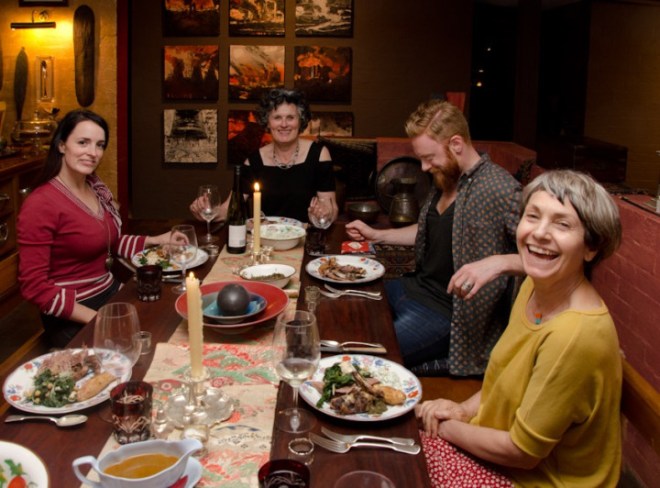
Mandy (head of table) with some of her paintings in the background after preparing another unforgettable country feast. Laura on the left, Alexander and me on the right

A Memorable Finish

As if the meal had not already been generous enough, dessert followed.

Mandy baked a rhubarb cake using rhubarb from her own garden and served it with homemade saffron ice cream made from the eggs laid by her hens.

All of this had been prepared by someone who, just as easily, could have spent the day in her painting studio. In fact, some of Mandy’s paintings can be seen hanging behind the dining table, a reminder that her creativity extended effortlessly from the canvas to the kitchen.

It was another unforgettable meal shared with a Mandy at Pennyroyal—one that celebrated beautiful produce, thoughtful cooking and the pleasure of gathering  with friends around a table.

Thank you Mandy, another memorable meal.

Having a good time on the back of Guy’s truck!

Goat or Kid?

Goat (capra in Italian) refers to the mature animal, while capretto is young goat or kid. As a general rule, Italians have traditionally preferred eating kid because of its delicate flavour and tenderness, although slow-cooked mature goat can be equally rewarding when prepared with patience and care.


If you enjoy cooking goat/kid, you may also like these recipes on my blog:

RICETTE per capretto (e capra) Recipes for slow cooked kid and goat

RAGÙ DI CAPRETTO; Goat/ kid ragout as a dressing for pasta

SPEZZATINO DI CAPRETTO (Italian Goat/ Kid stew)

SICILIAN SEAFOOD COOKING, ITALIANICIOUS and READER’S FEAST Bookstore. Recipe for Slow cooked goat in Nero D’Avola

KID/GOAT WITH ALMONDS (SPRING IN SICILY, CAPRETTO CON LE MANDORLE)

BRAISED KID (capretto) in a simple marinade of red wine, extra virgin olive oil and herbs


MA2SBAE8REVW