CARCIOFI ALLA ROMANA

When cooking Carciofi alla romana , the globe artichokes are cooked upside down. Carciofi are arti

IMG_8510

Whereas globe artichokes, if stuffed, are cooked upright.

STUFFED ARTICHOKES

I enjoy globe artichokes and typically prepare them by stuffing, braising and serving them hot or cold. If peas or broad beans are in season, they are also added to the braise. A mixture of fresh breadcrumbs, parsley, garlic and grated Parmesan or Pecorino cheese is my most frequent stuffing, but I have also used minced meat, black olives and anchovies, or ricotta and almond meal for a delicate variation. Each globe artichoke holds approximately half a cup of stuffing, with larger artichokes containing more.

Once stuffed, the globe artichokes are placed upright and packed tightly into a pan and braised in white wine and/or stock. Extra virgin olive oil is an essential ingredient and it is used liberally.

CARCIOFI ALLA ROMANA

Small artichokes are ideal to cook alla romana – as the Romans do.

IMG_8492

The artichokes (carciofi) currently in season in Melbourne are the small, purple, spiny varieties.

The globe artichokes that were in season previously have nearly finished, but some of the smaller, undeveloped ones remain.

photo 1
These baby artichokes are typically preserved in oil.
RECIPE FOR CARCIOFI ALLA ROMANA

For carciofi alla romana, use the smallest artichokes you can find, but the small, purple, spiny ones would be my preference. In this recipe, the artichokes are also stuffed, but lightly …about a teaspoon of stuffing for each.

Carciofi alla romana are braised, but they are placed upside down and I use greater amounts of oil in the braising liquid – a mixture of water and a little white wine, but  the  aim is to have very little, concentrated and flavourful liquid at the end of cooking, and this will be mostly oil.

IMG_8494

The stuffing:

For the stuffing for the number of artichokes I had (9) I used 1 large clove of garlic, ½ cup fresh parsley finely chopped, ½ cup fresh mint finely chopped, salt and pepper and all mixed with a little extra, virgin olive oil.

Clean and prepare the artichokes as you would globe artichokes. Use acidulated water (1 lemon). Peel off the tough outer leaves until you reach the softer paler leaves. The stems of my artichokes were not worth peeling, but if they are, peel the outer layer of the stem and, as is usual with this recipe, keep the stems attached to the base. Cut approximately one-third of the top of the artichoke to remove the spiny leaves. Using your fingers, gently separate the leaves in the centre of each artichoke to create a space for the stuffing.

Mix the garlic, parsley, seasoning and mint with 1 tablespoon of oil. Stuff the artichokes with this mixture.

IMG_8496
The stuffing of the artichokes process.

Place about 1 cm of olive oil in the bottom of a narrow pot and arrange the artichokes close together and side by side…. but upside down. Add a little white wine and enough water to reach about 1/3 from the top of the height of the artichoke. Add salt and pepper, cover and simmer over low heat until the artichokes are soft and can be easily pierced with a fork.

IMG_8505
The artichokes are cooked upside down.

Check them occasionally and if they are too dry add a little water if necessary in small amounts.

IMG_8507
The cooked Carciofi Alla Romana.

When the artichokes are cooked, remove the lid, turn up the heat and evaporate the liquid until you have mainly oil.  Remove the artichokes from the pot, drizzle the liquid over them and serve them at room temperature.

There are a number of recipes on my blog about artichokes and accompanying  photos. Artichokes are not difficult to prepare and cook, and they are delicious.

SBS Italian Radio; Stuffed artichokes; photos

CARCIOFI FARCITI (Stuffed artichokes: with meat and with olives and anchovies)

STUFFED ARTICHOKES WITH RICOTTA AND ALMOND MEAL

CARCIOFI (Artichokes)

To find other recipes, use the search button on my blog and key in Artichokes.

STUFFED BAKED FENNEL WITH PANGRATTATO – FINOCCHI RIPIENI

This is a recipe for a stuffed baked fennel. Breadcrumbs are called Pangrattato (grated bread) in Italian.

DEFINITION OF PAN GRATTATO and its use.

Mollica is the soft part of the bread with crusts removed but in the culinary world both pangrattato and mollica have acquired new significances and have been enhanced. Both refer to breadcrumbs lightly toasted in in olive oil, herbs and seasonings and variations include anything from garlic, red pepper flakes, pine nuts, anchovies, lemon zest , cinnamon or nutmeg, salt and a little sugar.

IMG_7807

Mollica or pangrattato adds texture, fragrance and complex flavours and is usually used as a stuffing or topping, especially for pasta in Calabria, Puglia and Sicily. For example,  Pasta con le Sarde and Sarde a Beccafico are two Sicilian recipes that use enhanced breadcrumbs:

When I make pangrattato I store left overs in a jar in my fridge and use it to enhance other dishes: this time I used it to stuff fennel.

STUFFED FENNEL RECIPE

I use Pangrattato to stuff fennel.

For moisture and extra flavour I added  a little ricotta and a little grated cheese – pecorino or parmigiano.

IMG_8160

 PROCESS

  1. Cut the stems off the fennel and remove the toughest and usually damaged outer leaves.
  2. Cut the fennel into quarters.
  3. IMG_8247
  4. Cook the fennel in salted water, bay leaves salt and lemon juice for about 10 minutes until it is slightly softened. Remove it from the liquid and cool.
  5. Make the filling: Work the ricotta in a bowl with a fork, mix in the pangrattato and grated cheese.
  6. IMG_8249
  7. Prise open the leaves of the fennel and stuff with the pangrattato stuffing.
  8. IMG_8251
  9. Place the quarters into a baking bowl that allows them to stay compact and upright (like when you are cooking stuffed artichokes).
  10. Drizzle olive oil on top (or a little butter) and bake at 180 – 190°C for about 15 minutes
  11. IMG_8256

SPAGHETTI with PRAWNS and ZUCCHINI

SPAGHETTI with ‘NDUJA, SQUID, VONGOLE AND PAN GRATTATO

PASTA CON LE SARDE – an iconic Sicilian recipe from Palermo. Cooked at Slow Food Festival Melbourne

PASTA CON SARDE – the baked version, Palermo, Sicily

SARDE A BECCAFICO (Sardines stuffed with currants, pine nuts, sugar and nutmeg)

IMG_7805

PEPERONATA – PIPIRONATA (Sicilian) Braised peppers

Peperonata (pipironata in Sicilian) are  braised peppers usually made with the red and yellow peppers, onions and tomatoes. In some parts of Sicily potatoes are added. Mainly for colour,  sometimes 1-2 green peppers are added.

Cooked peperonata

Peperoni (peppers) are vibrantly coloured – green, red and yellow and I have also seen  new varieties of dark green (almost black) and cream ones as well.

Capsicum/ Pepper almost a black colour

Towards the end of summer and to mid-autumn there are greater numbers of yellow and red peppers – these are much sweeter in taste.

Ingredients for Peperonata

The vegetables are braised slowly and the results are fabulous – the onions and tomatoes almost melt and coat the peppers.

Peperonata cooking

As a contorno, it is an excellent accompaniment for simply cooked fish or meat (BBQ or fried). It makes a great filling for panini and transports well for picnics.

Traditionally there are two ways of making peperonata. The first method is to add all the ingredients in a wide pan with some olive oil and to cook it slowly on low heat. Add a little water and stir it periodically so that they do not stick. In Sicily sausages are also commonly cooked in this way – once the water evaporates, the fat/oil is left in the pan to fry and brown the ingredients.

The second method is to soften the onion before adding the peppers (and later the tomatoes). This is my preferred method.

Like Caponata, Peperonata is eaten cold (room temperature). The flavours mature and it keeps well in the fridge for days.

RECIPE: PEPERONATA

Vary amounts accordingly and as you can see in the photos I just wanted it for two people.

INGREDIENTS

red (and yellow) peppers, 1 k
tomatoes, 2 ripe, peeled and diced
onion, 1-2 sliced
extra virgin olive oil, ¼ cup
fresh basil leaves or sprigs,  a few and to taste
salt and freshly ground black pepper
a little sugar and red wine vinegar

METHOD

Clean and cut the peppers into thin strips.
Sauté the onions in the oil.
When the onions are soft, raise the heat and add the peppers. Add seasoning, toss on high heat until they are well coated and beginning to fry.
Add the tomatoes and some basil, cover and cook until the peppers are soft (about 20-30 minutes).
Remove the lid, raise heat and cook until any excess liquid has evaporated.

VARIATIONS

**Like my cousin Lidia from Augusta (south of Catania) I always add a teaspoon of sugar and a dash of vinegar during the final minutes of cooking. This provides that classical Sicilian sweet and sour flavour.

In other parts of Sicily, it is common to add 2-3 potatoes: either part cook chip-size potatoes and add them half way through cooking or fry uncooked potatoes at the same time as the onions.

Add more fresh basil at the time of serving.

PEPERONATA(SICILIAN SWEET AND SOUR PEPPERS)

ROASTED CHARRED PEPPERS

PEPPERS WITH BREADCRUMBS- PIPI CA MUDDICA – PEPERONI CON LA MOLLICA

PUMARORU CA CIPUDDA (Tomatoes with onions). INSALATA DI POMODORO (Tomato salad)

POMURORU is the Sicilian word for tomatoes, POMODORO is the Italian, and simple tomato salads feature very frequently in my kitchen.

This is not surprising as local tomatoes and basil in summer are at their best.

IMG_7587

ABOUT THE INGREDIENTS in Tomato Salad

When I say simple, I mean made with basic ingredients – in season tasty tomatoes, fresh basil, spring onion, the inside part of the celery, salt and extra virgin olive oil. In fact, so simple that I have not written the recipe for a tomato salad in my blog.

Just writing about tomato salad makes me want to have some – I can taste the fresh bread that I particularly like to use to mop up the juices. Good, extra virgin olive oil is as important as the quality of the tomatoes.

IMG_6568
SO many types of tomatoes

A SIMPLE FAMILY AFFAIR

I have inherited my like of tomato salads from my father; it is one of the things my father made well and my parents, especially when they were elderly would eat a tomato salad almost every day for lunch (accompanied with some sort of cheese, smallgoods, frittata, or left over meat or fish from the night before). This sort of tomato salad  was not considered special enough to present to guests – it was family, simple, every-day food and to a certain extent it has remained so in my present home.

IMG_2974.JPG[1]
Beautiful tomato produce
ABOUT SQUEEZED ONION

Apart from the simple tomato salad made with spring onion, my father excelled in the salad his mother used to make (NONNA Rosa lived in Ragusa, Sicily). this salad  was made with squeezed onions or as he used to call  it – cipolla dolce (sweet onion) – the onion is made sweet by having the bitter juices squeezed out of it before it is used.

IMG_2021
Tmatoes in California. I found so many varieties

The squeezed onion makes the taste of the salad unique and my children and nephews still mention this legendary version of a nonno-tomato salad. When they were in season the large, fresh, salad onions were his favourites (sold in bunches with the bulbs and part of the green stalk still attached) but the ordinary white or the red onions sufficed at other times.

IMG_3063
Tomatoes I bought in South of France

HOW TO MAKE squeezed  CIPPUDDA (onion) for salad

Cipudda is the Sicilian word for onion and cipolla the Italian.

Probably because it is used extensively in Calabria, red onion is called cipolla calabrese or cipolla di Tropea in Italian, Tropea is a very picturesque, old fortified town built on a cliff overlooking a spectacular beach in Calabria.

I now have the old colander my father used to use to strain the onion – this was one of the very few, kitchen implements that came with us from Trieste where we lived before coming to Australia.

IMG_7591
In Italian a colander or strainer is called a scolapasta

Amusing: in Italian a colander or strainer is called a scolapasta – scola means strain…and where would Italians be without an implement to drain their pasta!

 RECIPE for PUMARORU CA CIPUDDA (Tomatoes with onions)

To sweeten onion: Expect to shed tears during this process.

Place 2 large, thinly sliced onions in a colander, sprinkle with about 2 heaped tablespoons of salt and leave it for about 30 minutes. Do not be concerned about the quantity of salt, it will draw out the onions’ strong juices. If fresh onions are in season, leave the sliced onions with the salt for about 15 minutes.

Use your fingers and palms to squeeze the onions inside the colander – the juices and the salt will just dribble through the perforations.

My parents have always made tomato salad with firm, slightly golden, unripe tomatoes. Interestingly in Italy, tomatoes (pomodoro) were first called pomo d’oro, apples of gold and these early specimens were not necessarily red in colour.

My father was making salad well before the heirloom varieties of tomatoes were available – he would have enjoyed using these tomatoes that come in a multitude of colours and variety of shapes. Interestingly, not all are coloured red.

In most parts of Sicily, the most common tomato salad is as follows:

6-8 tomatoes
extra virgin olive oil at least ½ cup
fresh basil (or dried oregano)
salt and freshly ground black pepper
1 stalk of celery from the inside part of the celery and include some of the pale green leaves – all sliced thinly
1 spring onion sliced thinly or replace the spring onion with the sweetened onions

Cut the tomatoes into bite size pieces and add everything else and serve.

IMG_2964
My son’s Alex’s tomatoes

REGIONAL VARIATIONS by other Sicilians

From Comiso and Vittoria (towns south of Ragusa) and popular inland (in Enna and Caltanissetta) it is common to cut large tomatoes called (cuore di bue — ox heart), horizontally into halves, remove the seeds and stuff each crevice with chopped garlic, salt and extra virgin olive oil. On visits to the South of France I found that these tomatoes are popular and eaten in the same way. Surprise, surprise!

IMG_3062

In my last post I made reference to Sicilian tomato salad. See post:

RICOTTA, TOMATOES and Basil. A perfect summer dish.

These little beauties below were left by a neighbour at my door.

I feel a tomato salad coming on.

IMG_7605
Yellow Tomatoes
IMG_7598
So many excellent varieties of tomatoes

RICOTTA, TOMATOES and Basil. A perfect summer dish.

GREEN TOMATOES: Pickled under oil

TOMATO SALAD WITH GORGONZOLA (INSALATA DI POMODORI E GORGONZOLA)

RICOTTA, TOMATOES and Basil. A perfect summer dish.

Summer is the season for ricotta, tomatoes and basil. When tomatoes are sweet and fragrant, and basil is growing abundantly, very little else is needed to create a memorable dish.

One of the pleasures of eating out is returning home inspired to cook my own version of something I have enjoyed. Often it is not only the flavours that stay with me, but also the presentation.

That happened after a meal at Gauge in Brisbane. Among the dishes my friends and I shared was Cow’s ricotta, sansho pepper, heirloom tomatoes and olive. It was beautifully balanced, elegant in its simplicity, and it immediately sparked ideas.

In summer, my parents who lived in Adelaide enjoyed a tomato salad almost every day. The salad was accompanied by fresh cheeses purchased from their local cheese factory, including ricotta, Formaggio Fresco, Bocconcini, Mozzarella and Ricotta salata. Occasionally, the ricotta was still warm.

IMG_0134
The tomato salad with Asian herbs in Brisbane – Cow’s ricotta, sansho pepper, heirloom tomatoes and olive.
The Magic of Fresh Herbs

The restaurant used an Asian herb, but what fascinated me most was how easily the character of the dish could be changed simply by choosing a different herb.

Each herb brings its own personality. Thyme adds warmth, oregano and sweet marjoram a Mediterranean fragrance, tarragon a gentle aniseed note, dill freshness, while the many varieties of basil available today each contribute something different. The ingredients remain the same, yet the flavour changes completely.

That flexibility is one of the pleasures of cooking.

IMG_7562
Whipped Ricotta
A Summer Favourite at Home

The evening after I returned from Brisbane I was cooking for friends. I had excellent tomatoes, fresh cow’s ricotta and an abundance of basil growing on my balcony. The inspiration from Brisbane became my own version.

Presentation mattered almost as much as flavour. My photographs do not quite capture how attractive the dish looked, but it was fresh, colourful and full of natural flavours. Served with good bread or crisp crackers, it made a perfect summer starter.

Recreating the Dish

The restaurant’s version was:

Cow’s ricotta, sansho pepper, heirloom tomatoes and olive.

The ricotta and heirloom tomatoes were easy enough to source.

Sansho pepper (also known as Japanese pepper) has a distinctive citrus freshness, reminiscent of lemon myrtle. It is readily available from many Asian grocers, but there are plenty of alternatives. I enjoy experimenting with different peppercorns and with dried Mexican chillies that I grind fresh. Some are smoky, some earthy, some fruity and others wonderfully hot.

On this occasion I chose pink peppercorns. They added gentle spice, subtle sweetness and looked beautiful against the white ricotta.

IMG_7560
The basil oil, pink peppercorns, fresh small leaf basil and tomatoes
Olives — Or Just Their Flavour?

Interestingly, the restaurant did not use whole olives. Instead, the olive flavour came from black olive salt.

More recently I have seen another restaurant use dehydrated olives, which provide an intense burst of flavour and wonderful texture.

For my version, whole olives felt too dominant, so I scattered over a few tiny capers instead. They added the salty contrast I wanted while keeping the presentation delicate. Small leaves of Greek basil completed the dish.

A Sicilian Touch

I also added finely sliced spring onion for freshness.

Next time I may include one of those tender pale-green inner celery stalks, finely sliced. In my family, tomato salads always included onion and celery — the traditional Sicilian way of preparing them. It is a combination I still love.

Bringing Everything Together

I whipped fresh cow’s ricotta with a little salt until smooth and creamy.

The basil oil was simply good-quality extra virgin olive oil blended with basil leaves picked from my balcony and a pinch of salt.

The tomatoes came, as they often do, from one of my trusted fruit and vegetable stallholders at Melbourne’s Queen Victoria Market. Starting with excellent produce is what makes a dish like this shine.

With good bread and a glass of chilled wine, it was everything I want from summer cooking: simple, fresh and full of flavour.

IMG_7581
Basil growing on my balcony- 2 varieties

TOMATO SALAD WITH GORGONZOLA (INSALATA DI POMODORI E GORGONZOLA)

A SAVOURY COEUR À LA CRÈME to accompany a summer fresh tomato salad or summer vegetables

RICOTTA how to make it


.


CAPONATA DI NATALE (Christmas, winter caponata made with celery, almonds and sultanas)

Caponata di Natale is a traditional Sicilian Christmas caponata that surprises many people familiar only with the more common eggplant version.

In Sicily, caponata exists in many forms, and not all caponate contain eggplants.

This festive caponata reflects the season in which it is served. While eggplants and peppers are abundant during the Sicilian summer, they are not winter vegetables. For Christmas, some Sicilians prepare a caponata based on celery hearts, creating a dish that is lighter, fresher and particularly suited to festive meals.

It may be very different from the Christmas fare many Australians expect, but it makes a wonderful antipasto, salad or accompaniment to roasted meats and fish.

A Christmas CAPONATA  – a Dish Rooted in Sicilian Seasons

One of the pleasures of Sicilian cooking is its respect for seasonal produce. Traditional Christmas tables often feature dishes that celebrate winter vegetables rather than relying on ingredients available year-round.

In many parts of Sicily, celery is the principal ingredient in Caponata di Natale. Some regional versions also include leafy winter greens such as chicory, spinach or endive.

Traditionally, the celery is boiled before being sautéed. I prefer a simpler approach: slicing the celery very finely and cooking it gently in olive oil until just softened. This preserves some of its texture and freshness while allowing it to absorb the sweet-and-sour flavours that are characteristic of Sicilian caponata.

IMG_7435
Caponata di Natale served at room temperature—a traditional Sicilian Christmas antipasto made with celery, olives, capers and almonds
The Magic of Agrodolce

Like many Sicilian dishes, this caponata relies on the balance of agrodolce—the combination of sweet and sour flavours.

The sweetness comes from sugar and sultanas, while vinegar provides acidity. Salty capers and olives add depth, and almonds contribute richness and texture.

The result is a dish full of contrasts:

  • Sweet and sour
  • Salty and fruity
  • Soft and crunchy
  • Delicate and robust

It is these contrasts that make Sicilian caponata such a memorable dish.

IMG_7432
Unlike the better-known eggplant caponata, this festive Sicilian version celebrates winter vegetables, especially tender celery hearts.


IMG_7429
The sweet-and-sour agrodolce dressing brings together the distinctive flavours of capers, olives, sultanas and almonds.

Sultanas or currants are both good to use. Muscatels and raisins are OK as well, but their size may not be as visually pleasing.

Sometimes I toast the almonds, sometimes I have used pine nuts.

IMG_7433
Prepared a day ahead, Caponata di Natale develops deeper flavours and is ideal for entertaining.

Serving Caponata di Natale

Although I often serve this caponata alongside meat or fish, I particularly enjoy it on its own at the beginning of a meal with good bread and a glass of wine.

Like most caponate, it improves with time. Preparing it a day ahead allows the flavours to develop and meld together beautifully.

Serve it at room temperature and finish it with toasted almonds or, for an extra layer of texture, a sprinkling of toasted breadcrumbs.

Caponata di Natale (Christmas Caponata)

Serves 6–8

Ingredients
  • 1 cup blanched almonds, toasted and chopped
  • 1 large celery heart, using only the pale inner stalks and tender leaves
  • 1 large onion, finely chopped
  • ¾ cup sultanas or currants
  • ½ cup capers (salted or in brine)
  • ¾ cup green olives, pitted and chopped
  • ½ glass white vinegar
  • 3 tablespoons sugar
  • ½ cup extra virgin olive oil
  • Salt and freshly ground black pepper
Method

Prepare the Vegetables

Finely slice the celery stalks and chop the tender leaves.

Heat the olive oil in a deep frying pan and gently sauté the celery and onion. Season lightly with salt and cook for about 10 minutes, or until softened.

Add the olives, sultanas and capers. Cook for a further 2 minutes.

Transfer the mixture to a bowl.

Make the Agrodolce Sauce

Using the same pan, gently heat the sugar until it begins to melt and lightly caramelise.

Carefully add the vinegar and allow it to bubble and reduce slightly.

Return the vegetable mixture to the pan and stir well to coat everything in the sweet-and-sour sauce.

Add some of the almonds, reserving the remainder for garnish.

Rest and Serve

Transfer the caponata to a serving dish and refrigerate overnight.

Bring to room temperature before serving.

 Top with the rest of the almonds or breadcrumbs when ready to serve.

A Caponata for the Festive Table – SICILIAN SEAFOOD COOKING

This celery-based Christmas caponata is one of the many traditional Sicilian caponate featured in my book Sicilian Seafood Cooking. It demonstrates the remarkable diversity of Sicilian cuisine and the way seasonal ingredients shape festive cooking across the island.

While it may not resemble the caponata most people expect, it remains unmistakably Sicilian—rich in contrasts, deeply rooted in tradition, and always at its best when shared, especially with guests who are only familiar with eggplant caponata.

THE MANY VERSIONS OF CAPONATE and grilled food

ARTICHOKES and how we love them; CAPONATA DI CARCIOFI

CAPONATA Catanese (from Catania) made easy with photos

SICILIAN CAPONATA DI MELANZANE from Palermo (Eggplant caponata with chocolate)

SICILIAN CAPONATA DI MELANZANE from Palermo (Eggplant caponata with chocolate)

Caponata has evolved over the ages to become a true symbol of Sicilian cuisine. It is cherished especially during festive occasions—making it a perfect dish for Christmas celebrations. As you might expect, there are countless regional variations and enhancements to what began as a humble dish.

The influence of Sicilian aristocracy played a significant role, with the chefs known as monzu—a term derived from the French monsieur—adding their unique flair and creativity. This blend of tradition and innovation has made caponata into an iconic, classic and traditional dish, showcasing the diverse flavours and culinary heritage of Sicily.

In this post I have included the version of caponata enriched with chocolate.

In Sicilian cooking, the melanzana (eggplant) is often referred to as the queen of vegetables, right behind the tomato in importance. This high status is well-deserved, as the eggplant is the principal ingredient in caponata, bringing depth and richness to the dish. The versatility and unique flavor of eggplants make it a standout component in many Sicilian recipes.

Below is a photo of two of the most popular types of Sicilian eggplants – the common very dark variety and the violetta – the violet variety. This is referred to as a sweet variety, it is not as seedy or bitter as its counterpart.

IMG_3183 (1)

I like to keep my caponata di melanzane simple, though the possibilities for ingredient variations are endless. Some recipes incorporate garlic, while others might include oregano. You’ll find versions with anchovies, sultanas, or even pine nuts and toasted almonds—each of these variations are both authentic and delicious.

Staying true to the Palermo tradition, just before serving, I like to sprinkle a handful of coarse breadcrumbs (toasted in a bit of hot extra virgin olive oil)  and/or chopped blanched and toasted almonds on top. This finishing touch adds a delightful crunch and enhances the dish’s overall texture, making it even more enjoyable.

!

In my view, Peter Robb perfectly encapsulates the essence of Sicilian caponata in his book Midnight in Sicily. He vividly compares the caponata he enjoyed in Palermo with the version he had experienced in Naples. This comparison highlights the unique flavors and ingredients that define Sicilian cuisine with its  its distinctive flavours within Italian gastronomy.
As Robb discovered: eggplant is the purple heart of Sicilian caponata – and it is the principal ingredient.

I realised caponata in Palermo was something very different. It was the colour that struck me first. The colour of darkness. A heap of cubes of that unmistakably luminescent dark, dark purply-reddish goldy richness, glimmerings from a baroque canvas, that comes from eggplant, black olives, tomato and olive oil densely cooked together, long and gently. The colour of southern Italian cooking. Caponata was one of the world’s great sweet and sour dishes, sweet, sour and savoury.

The eggplant was the heart of caponata. The celery hearts were the most striking component: essential and surprising. Pieces of each were fried separately in olive oil until they were a fine golden colour and then added to a sauce made by cooking tomato, sugar and vinegar with a golden chopped onion in oil and adding Sicilian olives, capers …….

IMG_7425 (1)

CAPONATA DI MELANZANE CON CIOCCOLATA (Caponata with chocolate)

In Sicilian cuisine there are a number of recipes, which include chocolate to enrich the flavour of a dish (see HARE or RABBIT COOKED IN CHOCOLATE and chocolate in eggplant caponata is a common variation in certain parts of Sicily.

In the early 1500s, the Spanish conquistadors discovered a variety of unknown foods in the New World.Among these was xocolatl, (chocolate) obtained from ground cacao seeds. Spanish nobility arrived in Sicily during the 15th and 16th centuries and they brought their exotic ingredients from the New World to the island. This was also an ostentatious period of splendour and opulence for the clergy and the Sicilian aristocracy.

Although many traditional Sicilian dishes are said to be Spanish legacies, it is more accurate to say that some Sicilian cuisine incorporated both Sicilian and Spanish traditions.

Follow the recipe for eggplant caponata below and add good quality cocoa or/and dark chocolate with a high percentage of cocoa .

Cocoa: The majority of the recipes for caponata enriched with chocolate suggest the use of cocoa powder (about 2 tablespoons of cocoa to 2 tablespoons of sugar dissolved in a little water to form a thick paste). Add this mixture to the pan after you have made the agro dolce sauce and before you add the cooked vegetables.

Dark Chocolate: My most favoured alternative is to use 50g of dark, extra fine chocolate (organic, high cocoa content – 70%). Add the chocolate pieces into the agro dolce sauce and stir it gently as it melts, and then I add the cooked vegetables. This results into a much smoother and more luscious caponata.

In a modern Sicilian restaurant with a young chef, I was presented with an eggplant caponata where the chocolate was grated on top, much like grated cheese on pasta. A creative and successful alternative.

IMG_7375

Process for making eggplant caponata

You will need a deep, large fry pan aand sometimes I use my wok. If you use a non-stick frypan you may not need as much oil, but the surface will not be as conducive to allowing the residue juices to form and caramelise as in a regular pan. (After food has been sautéed, the juices caramelise – in culinary terms this is known as fond. Non-stick pans do not produce as much fond).

Although the vegetables are fried separately, they are all incorporated in the same pan at the end. When making large quantities I sometimes use a wok.

extra virgin olive oil, ¾ cup (depending how much the vegetables will absorb)
eggplants, 3-4 large, dark skinned variety
onion 1, large, chopped
red tomatoes, 2 medium size, peeled and chopped or 2 tablespoons of tomato paste and a little water or some canned tomatoes
capers, ½ cup, salted or in brine
green olives, ¾ cup, stoned, chopped
celery, 2-3 tender stalks and the pale green leaves (both from the centre of the celery)
white, wine vinegar, ½ cup
sugar, 2 tablespoons
salt and freshly ground pepper

Cut the eggplant into cubes (approx 30mm) – do not peel. Place the cubes into abundant water with about 1 tablespoon of salt. Leave for about 30 minutes – this will keep the flesh white and remove any bitter juices while you prepare the other ingredients. Although it is not always necessary to do this, the eggplant is said to absorb less oil if soaked previously. You will need to weigh the eggplant down. I use a lid that is smaller than the basin to keep the eggplants submerged.

Prepare the capers – if they are the salted variety, ensure that they have been rinsed thoroughly and then soaked for about 30 minutes before use, and then rinsed again.

Chop the onion.
Slice the celery into very fine slices and chop the green leaves.
Peel, and coarsely chop the tomatoes (or use tomato paste or canned tomatoes).

Drain the eggplants and squeeze them to remove as much water as possible – I use a clean tea towel.
Heat a large frypan over medium heat with ½ cup of the extra virgin olive oil.
Add eggplant cubes and sauté until soft and golden (about 10-12 minutes). Place the drained eggplants into a large bowl and set aside (all of the vegetables will be added to this same bowl).
Drain the oil from the eggplants back into the same frypan and re-use this oil to fry the next ingredients. Sometimes I use a colander to drain the batches of eggplant and this makes it easier to return the drained oil into the frypan.

Add the celery and a little salt gently for 5-7 minutes, so that it retains some of its crispness (in more traditional recipes, the celery is always boiled until soft before being sautéed).
Remove the celery from the pan and add it to the eggplants.

Sauté the onion having added a little more oil to the frypan. Add a little salt and cook until translucent.
Add the tomatoes or the tomato paste (with a little water) to the onions, and allow their juice to evaporate.
Add the capers and olives. Allow these ingredients to cook gently for 1- 2 minutes.
Empty the contents of the frypan into the other cooked vegetables.


For the agro dolce sauce (sweet and sour sauce):

Add the sugar to the frypan (already coated with the caramelised flavours from the vegetables). Heat it very gently until it begins to melt and bubble. Add the vinegar and allow it to evaporate.

IMG_7384
Incorporate the cooked vegetables into the frypan with the agro dolce sauce.
Add ground pepper, check for salt and add more if necessary.
Gently toss in all of the cooked ingredients over low heat for 2-3 minutes to blend the flavours.
Remove the caponata from the pan and cool before placing it into one or more containers. Store in the fridge till ready to use and remove it from the fridge about an hour before eating– it will keep well in the fridge for up to one week.

When ready to eat, sprinkle with either toasted almonds or toasted breadcrumbs. I like to add fresh basil or mint leaves.

In my first book, Sicilian Seafood Cooking there is whole chapter devoted to caponata. I have also written other posts with recipes on the blog :

A MOUNTAIN OF CAPONATA – two days before Christmas 

CAPONATA SICILIANA (CATANESE – Caponata as made in Catania) 

FENNEL CAPONATA (Sicilian sweet and sour method for preparing certain vegetables)

CAPONATA (General information and recipe for Caponata di patate – potatoes)

FRITTEDDA (A sauté of spring vegetables)

Frittedda: A Traditional Sicilian Sauté of Spring Vegetables

Frittedda is one of Sicily’s finest celebrations of spring. This traditional Sicilian dish combines the season’s first artichokes, broad beans and peas, gently sautéed so that each vegetable retains its own distinctive texture and flavour—the sweetness of the peas, the slight bitterness of the artichokes and the delicate, nutty taste of the broad beans. Rather than a heavily cooked vegetable stew, frittedda is closer to a warm salad that showcases the freshness of the ingredients.

The Tradition of Frittedda in Sicily

In Sicily, frittedda is traditionally prepared in early spring (primavera), particularly around the Feast of San Giuseppe (19 March), when peas and broad beans first come into season. Although the dish is most closely associated with the north-west of the island, especially Palermo and Trapani, variations are also found in the farming districts of Caltanissetta, Enna and Agrigento, each reflecting local ingredients and traditions.

My Version of Frittedda

Because frittedda celebrates the arrival of spring, I enjoy adding fresh asparagus, although this is not part of the traditional recipe. I also occasionally add a small amount of good broth to deepen the flavour. Sicilian cooks rarely use stock, preferring to let the quality of their sun-ripened vegetables speak for themselves.

I think frittedda is best served at room temperature, much like caponata, where the flavours have had time to develop. It makes a wonderful antipasto with crusty bread, but it is equally delicious spooned over pasta for a simple spring meal.

IMG_6024
Broad beans and small purple artichokes
Frittedda
Regional Variations

Like many Sicilian dishes, frittedda changes from one province to another.

In Palermo, cooks often finish the dish with a light agrodolce of caramelised sugar and vinegar, like in the flavours of caponata.

In Enna, in the heart of Sicily, wild fennel is commonly added during cooking, giving the dish an aromatic flavour that reflects the island’s rural traditions.

img_3060-1
White asparagus


DSC_0019
Shelled fresh broad beans

FRITTEDDA

Ingredients

artichokes, about 3 young, tender
peas, 750g (250g, shelled weight)
broad beans, young, 1kg (these will result in about shelled 350g) The broad beans should be young and small — if they are not, (remove the outer peel of each bean)
asparagus (250g). Snap the bottoms from the asparagus and cut the spears into 2cm lengths
spring onions, 3-4, sliced thinly (including the green parts)
lemon, 1 for the acidulated water
extra virgin olive oil, about ½ cup
salt and pepper
white wine vinegar, ½ tablespoon or the juice of ½ lemon
sugar, about a teaspoon
fresh mint leaves, to sprinkle on top before serving

PROCESS

  1. Prepare the artichokes by removing the tough outer leaves. Young artichokes can be difficult to find in Australia, so you may need to discard more leaves than you would in Sicily.
  2. As you clean the artichokes, place them in acidulated water (the juice of 1 lemon added to water) to prevent discolouration.
  3. Quarter each artichoke, then slice each quarter thinly. Don’t discard the stems—peel away the tough outer layer and slice the tender centres.
  4. Heat a generous splash of extra virgin olive oil in a wide, heavy-based pan. Add the sliced artichokes and sauté gently for 5–7 minutes, tossing the pan rather than stirring to keep the slices intact.
  5. Taste the artichokes. If they need further cooking, add about ½ cup of water, cover the pan and cook gently for another 10 minutes, or until they are just tender when tested with a fork.
  6. Add a little more olive oil, then the spring onions, peas and broad beans. Season with salt and freshly ground black pepper. Toss the vegetables gently so they cook evenly without breaking up. Cook for 5–7 minutes, adding a splash of water (or a little stock, if using) if the pan becomes too dry.
  7. Add the asparagus and cook for another 2–3 minutes, just until tender but still bright green.
  8. Transfer the frittedda to a serving bowl to prevent the vegetables from continuing to cook in the hot pan.
  9. Season with the white wine vinegar or the juice of ½ lemon. The acidity balances the natural sweetness of the vegetables. If desired, add a small pinch of sugar to enhance the sweet-and-sour balance.
  10. I sometimes grate in a little fresh nutmeg, which complements the sweetness of the peas and broad beans. Scatter fresh mint leaves over the frittedda just before serving, as mint discolours if added too early.

Serving suggestion: Frittedda is best served at room temperature, allowing the flavours to develop fully.

Variations

As with many traditional Sicilian dishes, frittedda varies from one part of the island to another.

In Palermo, cooks often finish the dish with a light agrodolce (sweet-and-sour) dressing made from caramelised sugar and vinegar, much like the seasoning used for caponata.

In Enna, in the heart of Sicily, wild fennel is added during cooking, giving the dish a distinctive aromatic flavour that reflects the island’s inland traditions.

wild fennel_0011
Wild Fennel in Sicilian market

Similar spring recipes:

PASTA e FAVE (Pasta with broad beans; a wet or dry pasta dish)

FAVE (Broad beans)

PASTA ALLA FAVORITA (Pasta with artichokes, broad beans, peas alla favorita)

WILD MUSHROOMS, I have been foraging again

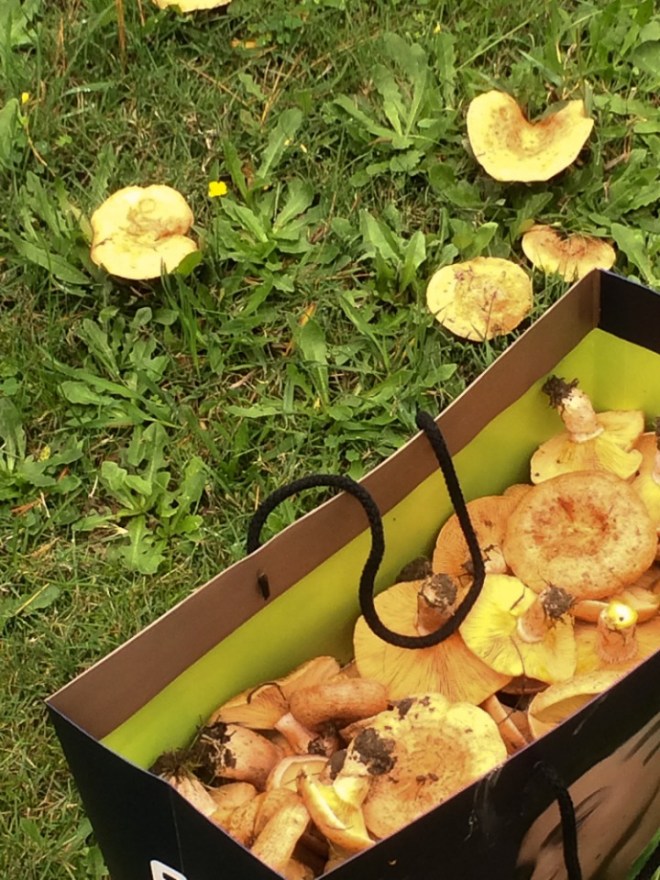
It is wild mushroom season again, and I have been out foraging.

Every year, around ANZAC Day in Victoria, I begin scanning the pine forests for one of my favourite edible mushrooms: the saffron-coloured pine mushroom (Lactarius deliciosus), also known as the saffron milk cap or red pine mushroom. The anticipation is always part of the pleasure. Some seasons are generous, others less so, but the search is always rewarding.

This latest harvest weighed just over 3 kilograms—a very satisfying morning’s work.

Wild mushrooms are one of autumn’s great seasonal pleasures. Every basketful carries memories of quiet walks through pine forests, careful searching beneath fallen needles and the satisfaction of bringing home something gathered by hand. For me, cooking them is simply the final—and perhaps the most enjoyable—part of the adventure.

Saffron mushrooms with Italian pork and fennel sausages

The saffron milk cap is one of the easiest wild mushrooms to recognise. Its rich orange cap and carrot-coloured milk, released when cut or bruised, make it distinctive. As the mushroom ages or is handled, the gills often develop green-grey patches. Although these may look unappealing, they are a perfectly natural characteristic of the mushroom and do not affect its flavour.

One of my favourite ways to enjoy these mushrooms is tossed through fresh tagliatelle, where their earthy flavour needs little more than olive oil, garlic and parsley. They are equally delicious served alongside Italian pork and fennel sausages, a combination that celebrates the robust flavours of autumn.

Cooked mushrooms in my freezer

I cook the mushrooms as soon as possible after I have collected them.

Mushrooms cooking

Cleaning Wild Mushrooms

Freshly picked mushrooms should be prepared as soon as possible.

Unlike cultivated mushrooms, pine mushrooms are often covered with sand, soil, grass and pine needles. While some can be cleaned with a damp cloth, many need to be rinsed briefly under gently running water. The important thing is to clean them quickly rather than soaking them.

I always remove the woody, hollow stems completely. Over the years I have discovered that they often provide a convenient hiding place for insects. Any bruised or damaged sections are trimmed away, although I don’t worry about the characteristic green staining that appears on the gills.

After describing all this preparation, they may sound like hard work—but they are absolutely worth the effort.

Preserving the Harvest

When I collect a large quantity, I cook the mushrooms on the day I bring them home. They reduce considerably in volume as they cook, concentrating their flavour.

Once cooled, I portion them into containers and freeze them. Having cooked wild mushrooms ready to use means I can enjoy the flavours of autumn throughout winter. They can be added to risotto, folded through pasta, served on bruschetta, or paired with grilled meats and sausages whenever the mood strikes.

Keeping the Cooking Simple

Wild mushrooms rarely need elaborate treatment. Their flavour is best appreciated with restrained seasoning and good olive oil.

If you are fortunate enough to collect pine mushrooms—or if you find them at a local market—try them simply sautéed with garlic, olive oil and parsley, stirred through pasta, or served alongside roasted or grilled meats.

More Mushroom Recipes

WILD MUSHROOMS ; Saffron Coloured, Pine Mushrooms and Slippery Jacks
PASTA WITH MUSHROOMS Pasta ai funghi

Simple recipes for cooking any mushrooms:

FUNGHI AL FUNGHETTO (Braised mushrooms)
FRICASSE DE SETAS CON ANCHOAS (Spanish, Wild Mushroom and Anchovy Fricassee)

Sicilian Pumpkin with vinegar, mint, sugar and cinnamon

Fegato di sette cannoli

It is autumn  in Australia and  there are plenty of pumpkins around. I like cooking pumpkin this way because it has unusual flavours and it can be made well in advance. I have presented it both as an antipasto and as an accompaniment to main dishes.

I cook this dish quite often and I am surprised that I have not written about it on my blog.

The following text is a condensed version from my first book  Sicilian Seafood Cooking. The photograph is also from the book. This all took place in my kitchen – I cooked it , Fiona Riggs styled it and Graeme Gillies photographed it.

This  Sicilian specialty  is sometimes called zucca in agro dolce (pumpkin in sweet and sour sauce) but I prefer the more colloquial Sicilian name, ficato ri setti canola – literally, ‘liver of the seven spouts (or reeds)’.

It is a colourful and aromatic dish. There is the strong colour of the pumpkin, tinged brown at the edges, and contrasted with bright green mint. The sweetness   of the pumpkin is enhanced by the flavours and fragrance of garlic, cinnamon and vinegar. It is better cooked ahead of time – the flavours intensify when left at least overnight, but it can be stored in the fridge for several days.

The dish is said to have originated among the poor, in what is known as one of the quartieri svantaggiati (‘disadvantaged suburbs’) of Palermo.

Sicilians are colourful characters and like stories. It is said that the pumpkin dish was first cooked and named by the herb vendors of the Piazza Garraffello a small square in Palermo. These were the days before refrigeration and balconies and windowsills were often used to cool and store food, especially overnight. As the story goes, the herb sellers could often  smell the aroma of veal liver coming from the balconies of the rich. At home, they cooked pumpkin the same way as the well-to-do cooked liver (fegato) and, wanting to create a bella figura, they hoped the fragrance of their cooking would mislead the neighbours into thinking that they too were well-to-do and could afford to eat liver.

The typical way of cooking liver is to slice it thinly, pan-fry it and then caramelise the juices in the pan with sugar and vinegar to make agro dolce (sweet and sour sauce).

As for the seven spouts (sette cannoli), they are the short cane-shapedspouts of an elegant 16th-century fountain in the piazza. Below – cathedral in Palermo.

In Australia I generally use the butternut or Jap pumpkin,The pumpkin is sliced 1cm (.in) thick and traditionally fried in very hot oil (if thicker, they take too long to cook).

Although baking the pumpkin slices is not traditional, I prefer this method .It certainly saves time in the preparation (see variation below). Serve it at room temperature as an antipasto or as a contorno (vegetable side dish).

1kg (2lb 4oz) pumpkin
10 cloves garlic
extra virgin olive oil (1. cup
if frying 1/3 cup if baking)
3 teaspoons sugar
1 cup white wine vinegar
1 teaspoon ground cinnamon
small mint leaves
salt and freshly ground pepper

Fried Method

Peel and remove the seeds of the pumpkin and cut into 1cm (in) slices.
Peel and slice 4 cloves of garlic.
Heat the olive oil in a large heavy-based frying pan. Add the garlic cloves.
Remove when it has coloured and fry the pumpkin slices, turning them only once in case they break, until they become soft and begin to colour around the edges. Add salt to taste. Remove the pumpkin and discard some of the oil,
but keep any juices.
Use the same frying pan for the agro dolce sauce: add the sugar, stir it around the pan to caramelise it, and then add the vinegar and cinnamon.
Stirring constantly, allow the sauce to thicken slightly as the vinegar evaporates.
Add the remaining garlic cloves and few sprigs of mint to the warm sauce.

Add the pumpkin to the sauce, and sprinkle with pepper. Allow the sauce to penetrate the pumpkin on very low heat for a few minutes. Alternatively, pour the sauce over the pumpkin and turn the slices a couple of times. Cool
and store in the fridge once cool. Eat at room temperature.

When ready to serve, arrange the slices in a serving dish, remove the old mint (it would have discoloured). Scatter slices of fresh garlic and fresh mint leaves on top and in between the slices.

Baked version

Cut the pumpkin into thicker slices, about 2–3cm (1in).
Sprinkle with salt and place on an oiled baking tray.
Bake the pumpkin and garlic in a 200C (400F) oven (discard the garlic when the pumpkin has cooked).
Make the agro dolce sauce (see the above) in the baking tray instead of a frying pan.

I also add fresh bay leaves – like the look and the taste of it.

The mint must be fresh mint.

Proceed as the recipe above.