

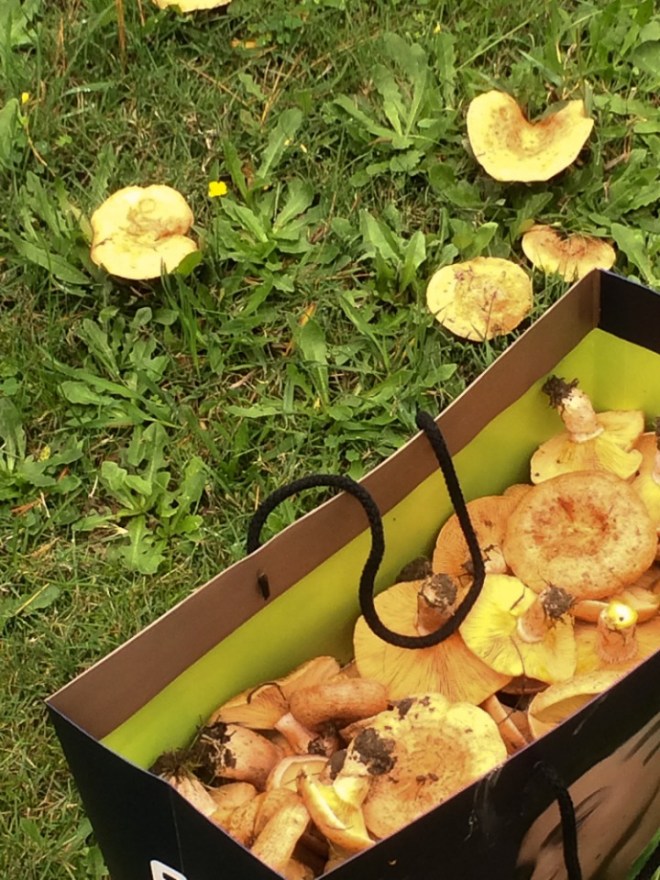
It is wild mushroom season again, and I have been out foraging.
Every year, around ANZAC Day in Victoria, I begin scanning the pine forests for one of my favourite edible mushrooms: the saffron-coloured pine mushroom (Lactarius deliciosus), also known as the saffron milk cap or red pine mushroom. The anticipation is always part of the pleasure. Some seasons are generous, others less so, but the search is always rewarding.
This latest harvest weighed just over 3 kilograms—a very satisfying morning’s work.
Wild mushrooms are one of autumn’s great seasonal pleasures. Every basketful carries memories of quiet walks through pine forests, careful searching beneath fallen needles and the satisfaction of bringing home something gathered by hand. For me, cooking them is simply the final—and perhaps the most enjoyable—part of the adventure.

The saffron milk cap is one of the easiest wild mushrooms to recognise. Its rich orange cap and carrot-coloured milk, released when cut or bruised, make it distinctive. As the mushroom ages or is handled, the gills often develop green-grey patches. Although these may look unappealing, they are a perfectly natural characteristic of the mushroom and do not affect its flavour.
One of my favourite ways to enjoy these mushrooms is tossed through fresh tagliatelle, where their earthy flavour needs little more than olive oil, garlic and parsley. They are equally delicious served alongside Italian pork and fennel sausages, a combination that celebrates the robust flavours of autumn.

I cook the mushrooms as soon as possible after I have collected them.

Cleaning Wild Mushrooms
Freshly picked mushrooms should be prepared as soon as possible.
Unlike cultivated mushrooms, pine mushrooms are often covered with sand, soil, grass and pine needles. While some can be cleaned with a damp cloth, many need to be rinsed briefly under gently running water. The important thing is to clean them quickly rather than soaking them.
I always remove the woody, hollow stems completely. Over the years I have discovered that they often provide a convenient hiding place for insects. Any bruised or damaged sections are trimmed away, although I don’t worry about the characteristic green staining that appears on the gills.
After describing all this preparation, they may sound like hard work—but they are absolutely worth the effort.
Preserving the Harvest
When I collect a large quantity, I cook the mushrooms on the day I bring them home. They reduce considerably in volume as they cook, concentrating their flavour.
Once cooled, I portion them into containers and freeze them. Having cooked wild mushrooms ready to use means I can enjoy the flavours of autumn throughout winter. They can be added to risotto, folded through pasta, served on bruschetta, or paired with grilled meats and sausages whenever the mood strikes.
Keeping the Cooking Simple
Wild mushrooms rarely need elaborate treatment. Their flavour is best appreciated with restrained seasoning and good olive oil.
If you are fortunate enough to collect pine mushrooms—or if you find them at a local market—try them simply sautéed with garlic, olive oil and parsley, stirred through pasta, or served alongside roasted or grilled meats.

More Mushroom Recipes
WILD MUSHROOMS ; Saffron Coloured, Pine Mushrooms and Slippery Jacks
PASTA WITH MUSHROOMS Pasta ai funghi
Simple recipes for cooking any mushrooms:
FUNGHI AL FUNGHETTO (Braised mushrooms)
FRICASSE DE SETAS CON ANCHOAS (Spanish, Wild Mushroom and Anchovy Fricassee)

May I ask you where are likely to find pine mushrooms in the wild in Australia? I enjoy your site very much :)
It all depends where you live. In Victoria I find many in the Mornington Peninsula.
I find using a large cardboard box and not stacking them more than 2 rows high keeps them from bruising. They are so good fried with butter, garlic, pepper & sea salt! I’m in the NW if Vic and you can find them over this way in the pine plantations of Daylesford, Macedon, Spargo etc:-)
Thanks Lee. I know plenty of places where to collect the slippery jacks and the saffron pine mushrooms. I hav never peeled the slippery, what a lot of work!
My favourite way of processing slippery jacks has been to wipe them clean. When i lived in Adelaide I had a powerful fan heater and i used to wipe the mushrooms clean, slice them and dry them..
These baby slippery jacks I wrote about were particularly grubby because they were very small and very close, if not buried, in the cut grass and pine needles that they were growing in.