I was in Russia recently and I came back to Australia with a yearning to make Italian Russian Salad. I ordered it in a restaurant in Saint Petersburg and in one in Moscow and in both cities it contained beetroot.
Italian Russian Salad has no beetroot.
Italian Russian salad.
My mother’s Russian salad was simple and contains potatoes, carrots, french beans, peas, giardiniera or citriolini (pickled vegetables and cornichons), hard boiled eggs and egg mayonnaise.
Vegetables for Russian salad
When my mother was still alive and still capable of cooking Russian Salad , it was something that she made often as an antipasto.
Russian Salad and Zuppa Inglese (dessert) were two dishes that were particularly popular in restaurants when we left Trieste before we came to Australia. Both continued to be presented frequently in Adelaide where we lived on special occasions or for birthdays and when we invited guests for Sunday lunch – the preferred time to have a long lunch followed by a game of cards while the house trembled to the sound of opera.
ingredients for Russian salad.
Interestingly, not all my recipe sources include beetroot as an ingredient for Russian salad as made in many parts of the world including Russia.
The majority of the Russian recipes prefer French dressing rather than mayonnaise and some recipes contain turnip; this makes sense as root vegetables are common in Russia.
Egg mayonnaise to dress and coat the top of Russian salad.
Variations of one particular recipe as served by the Russian nobility (probably those who spent time in France) contains a melange of flavours, either or a combination of ox tongue, lobster, ham. Truffles or cooked mushrooms also feature. Some of the French like chicken meat. Capers and anchovies in some.
Egg Mayonnaise is the wow factor!
The Belle Époque is over: I think that keep it simple is my motto, and egg mayonnaise is the wow factor.
For recipes and more information of INSALATA RUSSA, MAIONAISE (mayonnaise in Italian) and other recipes with egg mayonnaise:
Travelling recently through Tyrol, Vienna and Russia, I was struck by how often Goulash appeared on menus. Whether called Gulyás in Hungary or Gulasch in Austria and Trieste, this deeply comforting dish clearly travelled widely through the former Austro-Hungarian Empire, adapting to local tastes and traditions along the way.
Curious once again about its origins, I returned to one of my favourite cookbooks on Hungarian cuisine — Cuisine of Hungary by George Lang — still one of the most detailed and informative books I own on the subject.
Gulasch in Trieste
— for many years. As a child living in Trieste, I grew up with the strong culinary influences of Central Europe. Trieste was part of the Austro-Hungarian Empire until the end of the First World War, and many dishes from that period remain firmly embedded in the city’s cuisine.
Triestian Gulasch is usually made simply with beef, onions and paprika. The onions and meat are slowly browned in lard and olive oil, but bacon is generally not used. Unlike many northern European versions, Triestian recipes rarely include potatoes, peppers or additional vegetables, and they are never thickened with flour.
Some cooks add caraway seeds or a little tomato paste, but red wine is not traditional.
My Version of Gulasch
Like many home cooks, I have gradually adapted the dish over time.
I almost always cook with wine and have always added red wine to my Gulasch. Perhaps this came from my mother’s cooking; it is something I have never questioned. I also rely heavily on herbs in my kitchen, so bay leaves naturally find their way into the pot. And because I enjoy a little complexity in flavour, I use both sweet and hot paprika.
I do not add potatoes directly to the stew. Instead, I prefer to serve them separately — perhaps as patate in teccia or creamy mashed potatoes enriched with milk and butter.
More often though, I serve Gulasch with polenta, one of the great accompaniments of Triestian cooking.
In Tyrol I was also served Goulash with braised red cabbage, which worked beautifully.
I do not add potatoes to the braise and prefer to present then separately, either Patate in teccia or creamy mashed potatoes with lashings of milk and butter. However, I am more likely to present it with Polenta, a favourite accompaniment in the cooking of Trieste.
Goulash as presented in a restaurant in Tyrol. It was accompanied with braised red cabbage.
What Makes a “True” Hungarian Gulyás?
According to George Lang, a true Hungarian gulyás should contain no spice other than paprika and caraway seeds.
He insists that lard, bacon and onions are essential and famously warns:
“Never use flour. Never Frenchify it with wine. Never Germanize it with brown sauce.”
Traditionally, the only additions should be potatoes or galuska (small dumplings).
But, as with all traditional dishes, variations exist from household to household and region to region. Some cooks add tomatoes or tomato paste, garlic, green peppers or hot cherry peppers for extra heat.
That flexibility is part of the reason why this dish survived across borders and cultures.
George Lang’s Kettle Gulyás Recipe
This recipe Kettle Gulyás comes from “The Cuisine of Hungary” by George Lang (Penguin Books, 1971)
Ingredients
2 tablespoons lard (or vegetable oil)
2 medium onions, coarsely chopped
1.1 kg beef chuck or round, cut into cubes
225 g beef heart (optional), cubed
1 garlic clove
Pinch of caraway seeds
Salt
2 tablespoons paprika
1 ripe tomato
2 green frying peppers or Italian peppers
450 g potatoes
Method
Peel and roughly chop the onions.
Heat the lard in a large heavy pot or Dutch oven. Brown the beef cubes in batches, taking care not to overcrowd the pan. Remove the meat as it browns.
Add the onions and cook gently over low heat until glossy rather than browned.
Return the beef to the pot.
Crush the garlic, caraway seeds and a little salt together using the flat side of a knife.
Remove the pot briefly from the heat. Stir in the paprika and garlic mixture quickly with a wooden spoon, then immediately add warm water. George Lang warns against adding cold water at this stage because it can toughen the meat.
Cover and simmer slowly for about one hour.
Meanwhile, peel and chop the tomato, slice the peppers into rings and dice the potatoes.
After the meat has braised for an hour, add the tomato, peppers and enough water to create a soup-like consistency. Season lightly with salt and continue simmering for another 30 minutes.
Add the potatoes and cook until tender. Adjust seasoning and add hot cherry peppers if you prefer a spicier version.
Food, Memory and Empire
What fascinates me most about Goulash and Gulasch is not simply the recipe itself, but the way food travels across borders and becomes absorbed into local identity.
A Hungarian shepherd’s dish became part of the everyday cooking of Trieste, Vienna and much of Central Europe. Each place adapted it slightly, yet the essential character remained — slow-cooked meat, onions, paprika and warmth.
These are the dishes that tell stories of migration, empire, trade and memory.
And perhaps that is why I continue to cook Gulasch after all these years.
Trieste, Ponte Rosso
For my recipe of Gulasch, as cooked in Trieste see:
Recipes for rabbit and chicken consistently generate reader interest especially around Easter. This Ragusa, Sicily-style rabbit recipe coincides with the Easter season in Australia and is always popular.
For those who do not camp, rabbit is a suitable Easter recipe. Alternatively, home cooks are increasingly appreciating these traditional recipes for rustic meats.
But here’s the question I often get: Is rabbit considered a suitable Easter dish in Australia?
The answer is yes, but rabbit is not as common or inexpensive as it once was. If you find rabbit hard to source or expensive, you can easily substitute chicken in any of the rabbit recipes below, and vice versa. The flavours and techniques are quite adaptable.
The photos of some of my Sicilian dishes show how popular rabbit and chicken are in Sicilian cuisine.
This post has links for many of my favourite Italian rabbit, hare and chicken recipes that are already on my blog, as well as a few recipes for an Italian Easter that include kid, lamb and pies that are very common in Ragusa, Sicily.
Cooking with the Seasons
One thing that always fascinates me is how the seasons influence our cooking -especially when comparing Italy and Australia. While Italians are celebrating Easter in spring with tender lamb or kid, fresh artichokes, spring greens, and creamy ricotta that is at its best in spring, we in Australia are in autumn.
Natale con i tuoi, Pasqua con chi voi.
This is a common Italian saying that seems appropriate for Australia as well. Whether that’s friends, neighbours, or family, Easter is a time to gather around good food, and that’s what these recipes are all about.
Easter in Ragusa, Sicily
If you happen to be in Ragusa with some of my relatives in Sicily, you might celebrate Easter casually with family and friends, sharing scacce or impanate -delicious pastries filled with vegetables or vegetables and meat wrapped in a golden, olive-oil pastry. (You’ll find links to my recipes for those below!)
If you decide to substitute rabbit for chicken in a recipe, just remember:
Rabbit is leaner and may need a little extra moisture while cooking.
Cook it longer and more gently — slow braises bring out its unique flavour.
Sometimes, some recipes are just so simple that I do not bother writing about them, but then I buy a new cookbook and notice that simple recipes are what we like and want…and besides, not everybody grew up in an Italian household and they may not be familiar with this style of cooking.
One simple way of cooking some vegetables, for example eggplants, zucchini or mushrooms is afunghettoinbianco ortrifolate.
A funghetto, translates asmushroom, i.e.in the style or method of how you would cook mushrooms – simply sautéed in extra virgin olive oil with garlic and parsley.
Inbianco translates as inwhite, i.e. without tomatoes. Photo above is of king mushrooms cooked afunghetto.
This style of cooking is a common way to cook either of these three vegetables throughout Italy, but it is typical of the Veneto. I grew up in Trieste, so I identify with this style of cooking very much.
Once again,I will write this recipe as an Italian – no measurements. The recipe is so simple, and the photos tell the story so who needs measurements!
eggplants/aubergines, cut into cubes
extra virgin olive oil,
cloves of garlic, chopped (to taste)
chopped parsley
pepper and salt
extra virgin olive oil
Use gentle to medium heat throughout the cooking – the ingredients are not fried, they are sautéed till softened.
Heat a splash of oil in a frypan (I like to use a frypan with a heavy base).Add the garlic and stir it around for a very short time so that it begins to soften.
Add the eggplants and stir often until they have softened and have coloured. Add pepper and salt.
Add the chopped parsley and keep on stirring through for about 30 seconds…and I hate to say it…until it has softened.
Eat hot or cold – fabulous as a starter, side dish….as a dressing for pasta?
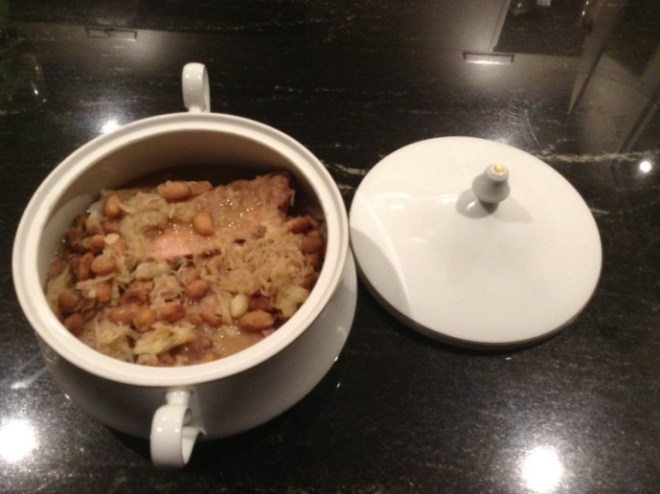
Iota is made with Pork Hock, Polish Wedding Sausage, Borlotti and Sauerkraut = IOTA (a lean version) sounds very complicated, but it is not.
Iota (also known as Jota) is one of those dishes that always brings a smile to the table—not just because it’s delicious, but because it sparks great conversation. Many of my friends are genuinely surprised to learn that this hearty, rustic soup is actually an Italian traditional dish from Trieste, in the region of Friuli Venezia Giulia, just north of Venice.
Classic Iota can be quite rich, especially when made with fatty cuts of pork. But it doesn’t have to be a heavy dish at all. With just a few tweaks—mostly in the choice of meat and how you handle the broth—you can make a beautifully fragrant, deeply satisfying lean version without losing any of its soul.
Beans to start: Borlotti
Begin with borlotti beans—those gorgeous pink-flecked beans that turn creamy and chestnut-like once cooked. Soak them overnight so they soften up, and then simmer them until tender. Their earthy sweetness is one of the foundations of a good Iota.
Borlotti beans soaked and ready—creamy, earthy, and essential for a good Iota.
The pork element: Hock for flavour, not fat
Instead of adding fatty cuts, use a pork hock. It still gives you that deep, savoury flavour but with much less richness. Place the hock in a pot of cold water and let it come to a gentle simmer. Slow cooking is key here—let it bubble away until the meat is soft and ready to fall off the bone.
About half an hour before the hock is done, drop in some peeled potatoes. They’ll cook in the porky broth and help thicken the soup later. Once everything is tender, lift out the hock, pick off the lean meat, and set it aside. The broth will have a layer of fat on top—skim this off to keep the dish light.
Lean pork hock simmering slowly to create a rich, flavourful broth without the heaviness.
Sauerkraut in IOTA
Sauerkraut is what gives Iota its distinctive zing. Cook it gently in the skimmed pork broth—it softens, mellows, and absorbs a lovely depth of flavour. When the sauerkraut is tender, stir in roughly half the cooked borlotti beans and some of the potatoes. Use a potato masher to lightly mash this mixture. You’re not aiming for a purée—just enough to create body and texture.
Assembling your Iota
Now for the satisfying part: bringing everything together.
Add the remaining whole borlotti beans, the rest of the cubed potatoes, the chunks of lean pork hock meat, and slices of Polish Wedding Sausage. I love using this particular sausage because it’s traditionally made from lean cuts, lightly smoked, and subtly seasoned. It adds protein and flavour without making the dish greasy or heavy.
Stir it all together, let it warm through, and enjoy how the flavours mingle—tangy, smoky, earthy, comforting.
Wedding sausage.
And there you have it: a lighter, leaner version of traditional Iota that still feels like it has been simmering on a Triestine family stove for generations.
Sauerkraut cooking gently in the skimmed pork broth, adding tang and depth to the IOTA.
There are other posts for making Iota and these include quantities of ingredients:
Luganighe con Capuzi is a Triestine dish and the name of the dish is written in the Triestine language. In Italian it would be called Salsicce e Crauti – sausages and sauerkraut.
As a child, I lived in Trieste with my parents, while my Sicilian relatives resided in Ragusa, Catania and Augusta. Both Trieste (located at the head of the Gulf of Trieste in the Friuli-Venezia Giulia region) and Sicily are at the extreme ends of Italy, and as one would expect, their cuisines are very different.
I grew up with both cuisines and appreciate them both for very different reasons.
Capuzi garbi (or crauti/krauti) is sauerkraut in Triestino (the Triestine dialect) and it is a very popular ingredient in Triestine cuisine especially when mixed in Gulash (made with pork or beef), or with a lump of smoked pork, or luganighe (Triestine) – salsicce di maiale in Italian, and pork sausages for us mere mortals in the English speaking world.
When you look at a map of Italy, it is easy to see why this part of Italy has common roots with the cooking of Austria, Hungary, Slovenia, Croatia and Istria.
I have German and Polish friends who also enjoy sauerkraut, and like my relatives and friends from Trieste, they tend to overcook it. My mother also did this when preparing capuzi garbi.
However, as we know, cuisine evolves and some of us have adopted new methods of cooking traditional foods.
In my kitchen, I cook sauerkraut for approximately a quarter of the time compared to the traditional method. I occasionally add a small amount of fresh cabbage to lighten the flavour and provide a different texture. Caraway seeds are also added as do many Triestini.
A small amount of browned flour in oil is added to the sauerkraut towards the end of cooking. Unlike my Triestine contemporaries, I also add bay leaves and a dash of white wine.
INGREDIENTS
The ingredients are: pork sausages, sauerkraut, bay leaves and caraway seeds. Onion, extra virgin olive oil and pepper (the sauerkraut could be sufficiently salty). Fresh cabbage and a dash of white wine are optional.
PROCESS
Drain the sauerkraut and squeeze out the moisture. Soften some onion in a little oil (in Trieste lard is also common and added to the oil).
Adding a little white or savoy cabbage is optional.
And with the cabbage, add the sauerkraut and the remaining ingredients. A dash of white wine (or water) will keep it moist during cooking.
Cover and cook for about 15- 20 minutes on low heat until the sausages are nearly cooked and the flavours have had a chance to meld.
Remove the sauerkraut and slightly brown the sausages – only for appearance.
This dish is excellent with Patate in Teccia…. another Triestine culinary delight. A techie is a pan in Triestine . The potatoes are squashed in the pan. See:
Pesce in Saor is one of the iconic dishes of Venetian cuisine, and it is marinated fish. It is also popular throughout the coastal areas of the Veneto region.
Pesce in Saor—describe a traditional method of preserving fish by frying it and marinating it in vinegar, onions and other flavourings, creating the distinctive Italian balance of agrodolce (sweet and sour).
Long before refrigeration, marinating or ‘sousing’ fish extended its shelf life and is still a popular method. Vinegar inhibits microbial growth in a manner like salt while sugar acts as a preservative and softens the vinegar’s sharpness. This practical necessity has evolved into one of Italy’s most memorable regional dishes.
Pesce in Saor – Sweet-and-sour marinated fish, one of Venice’s and Trieste’s most celebrated traditional dishes.
Pesce in Saor and My Family Traditions
The Italian word for fish is pesce, but in the Triestine dialect it becomes pesse. I lived in Trieste as a child, where pesse in saor was commonly prepared with sardines and served with soft white polenta.
My Sicilian grandmother also made marinated fish, known in Sicilian as pisci ammarinatu, but her flavourings reflected the cuisine of Catania in Sicily. She preferred mint, bay leaves and garlic in the vinegar marinade, whereas the Venetian and Triestine versions include raisins and pine nuts.
These regional variations demonstrate how a simple preservation technique became adapted to local tastes and ingredients.
Marinated Fish Throughout Italy
Venice is not alone in its love of soused fish. Similar preparations appear throughout Italy:
Pesce alla scapece from central and southern Italy, with regional versions flavoured with saffron, garlic or sage.
Pesce in carpione from Lombardy, scented with celery and carrot.
Scabeccio from Liguria, featuring garlic, rosemary and peppercorns.
Sardinian versions that may include chilli, garlic and tomato.
The idea extends well beyond Italy. Escabeche is found throughout Spain and Portugal and travelled to North Africa and Latin America. Nordic countries also have long traditions of preserving fish in acidic marinades. Even a German friend of mine prepares soused fish, adding coriander seeds to his recipe.
Part of the bay of TriesteTrieste, Ponte Rosso
Childhood Memories of Trieste
My maternal grandmother always had pottery terrines of marinated fish in her Sicilian kitchen, covered simply with plates used as lids. When she visited us in Trieste, she continued the same practice, and our kitchen would soon fill with the unmistakable aroma of fish and vinegar.
She especially loved eel. We would walk together to the Pescheria on the waterfront in Trieste, where she would select a live eel from a large tank and the fishmonger would prepare it for her. I never enjoyed watching that part, but I loved visiting the fish market overlooking the bay.
The Old Pescheria of Trieste – now EATALY
Today, the fish market building has been fully renovated and found a new life as Eataly, but my memories remain tied to the sounds, smells and traditions of the old Pescheria.
The Old Pescheria of Trieste as I remembered it
Using Coorong Mullet Instead of Sardines
Traditionally, pesce in saor is prepared with sardines that are lightly dusted with flour and fried until crisp. However, many small firm fish are suitable.mullet, sand whiting, garfish, flathead or leatherjackets, cleaned and filleted
On some regular trips from Melbourne to Adelaide, I drove through Meningie at the northern end of the Coorong and bought freshly caught Coorong mullet. Their firm flesh made them an excellent substitute, and I used them to prepare this version.
Traditionally, the fish is lightly dusted with flour and salt before it is fried in very hot, extra virgin, olive oil. Although the flour helps to hold the fish together, the oil used to fry the fish will need to be discarded (the sediment will taint the taste of the oil) and the flour coating will often come away from the fish in the marinade.
Coorong mullet and how it is sold and wrapped in newspaper
Recipe: Pesce in Saor
Serving suggestion: White polenta is traditionally used as an accompaniment for fish and yellow polenta is usually an accompaniment to meat.
Good bread is also good.
Ingredients
Serves 4–6
12–16 fresh sardines or other small fish such as mullet, sand whiting, garfish, flathead or leatherjackets, cleaned and filleted
Plain flour
Salt
Olive oil for frying
2–3 large white onions, finely sliced
1 cup raisins
1 cup pine nuts, lightly toasted
White wine (enough to soak the raisins)
250 ml white wine vinegar
Freshly ground black pepper
Method
Soak the raisins in the white wine for about 30 minutes.
Lightly dust the fish with flour and a little salt, shaking off any excess.Fry the fish in plenty of hot olive oil until golden and crisp. Drain on kitchen paper.
Gently sauté the onions in a little olive oil until soft but not browned.
Add the vinegar and freshly ground black pepper and simmer for a few minutes.
In a deep terrine or ceramic dish, place a layer of fish followed by onions, drained raisins and pine nuts.
Continue layering until all the ingredients are used, finishing with onions, raisins and pine nuts.
Pour the vinegar mixture over the fish, ensuring everything is well coated.
Cover and refrigerate for at least 24 hours before serving. Like many marinated dishes, the flavours improve with time.
Serve at room temperature, traditionally with soft white polenta.
Coorong Mullet fillets, a very suitable fish to make in Saor
This is baccalà that has been soaking for two days. I kept it in the fridge in a sealed container and changed the water four times per day.
This is baccalà that I am poaching in some water (to cover) and some bay leaves. I usually poach it in milk but the friend I was preparing this for is allergic to dairy.
I let it cool and removed the bones, skin and cartilage.
I then drained the solids because I wanted to use some of the liquid in the mixture that I blended in my food processor – the baccalà, with oil and garlic until it looked like mayonnaise.
So what is this?
BaccalàMantecato and I present it spread on crostini.
I have the recipe in my second cookbook Small Fishy Bites and is popular in Trieste and Venice and neighbouring localities .
For background and full recipe see early post: Baccalà Mantecato
This time, I am writing about Presniz, a rolled pastry sweet that is eaten at Christmas and Easter. Presniz comes from Trieste where I spent my childhood. My parents were Sicilian but lived in Trieste and this is where I lived before I came to Australia.
Trieste is in the north-eastern region of Italy called Friuli-Venezia Giulia: you may recognize some of the cities and towns in this region – Udine, Pordenone, Cividale, Gorizia, Trieste.
Trieste was once the main port of the Austro-Hungarian Empire and the region of Friuli-Venezia Giulia has Germanic, Slavic and Latin cultures so it is no surprise to find that the food from this region can be very different to other Italian regions.
Presnitz-triestino
At Easter, when we lived in Trieste, we bought Presniz from a Pasticceria (pastry shop) and it was only when we came to Australia and where the traditional food we were used to was not available, that my mother began to make Presniz with my aunt (from Trieste) at Easter. More common in my household and made all year round was another favourite – a Stucolo de Pomi, (an apple strudel). Also common in Friuli-Venezia Giulia is Gubana (often called Putiza in Trieste. Gubana and Putiza may have started off as being different but over time have melded to become the same thing).
All three popular dolci (pastry/sweets/ desserts) from Friuli-Venezia Giulia are made with pastry and rolled around a filling – the strudel has mainly apples, the Preznis and the Gubana/Putiza have a predominant filling of nuts.
Pinza is also a very common Easter treat in Trieste – this is a sweet brioche like bread made with many eggs and butter and similar to the consistency and colour of a panettone, but devoid of any dry fruit or nuts. Pinza is usually eaten with ham especially on Easter morning – strange but true.
There are many variations in the fillings of both the Presniz and the Gubana but basically in Trieste, the Presniz is more likely to have short pastry and mixed nuts in the filling (variations of walnuts, hazelnuts, pine nuts and almonds), whereas the pastry of the Gubana has yeast and the filling was once predominately made of of walnuts. Over time even flaky pastry is used for Presniz by some pasticceri (pastry chefs) in Trieste. Recipes evolve and the filling for the two have become similar; chocolate and candied citrus are also often added.
The Gubana originated and is popular in the Natisone valley in Friuli, on the border with Slovenia and in the towns of Gorizia, Cividale and Udine. The origins of Gubana has attracted many researches, both in terms of its origin as the name in Austro-German literature or literature of the Czech Republic. As you can guess, there are still no conclusions.
I have looked at many sources for information and recipes for Presniz and they differ significantly, especially for making the pastry. I have two bibles of Triestine cooking – La Cucina Tipica Triestina by Accademia Italiana della Cucina delegazione di Trieste (1983) and La Cucina Triestina Maria Slelvo (1987) and the recipes could not be less alike.
I have provided two recipes for making pastry – these are by far the simplest.
PASTRY FOR PRESNIZ
From Culinaria Italy: Pasta, Pesto, Passion, the ingredients.
Ingredients are: 250 flour, 250 butter, 5-6 tbs milk, juice of one lemon, 1 egg and salt.
The instructions are: Rub the butter into half of the flour and leave the mix to stand overnight. Mix the remaining flour with the rest of the ingredients. Leave to stand for1 hour and then mix the two together. Roll out thinly on a cloth.
From: La Cucina Tipica Triestinaby Accademia Italiana della Cucina delegazione di Trieste
Ingredients are: 250 flour, 250 butter, 4 tbs milk, juice of one lemon, 2 eggs and salt.
The instructions are as above.
If anything I think that my mother and aunt always added a bit of grappa to the pastry. As for the filling: Many of the recipes do not provide amounts for the nuts, but this combination should be sufficient for the amount of pastry. It is interesting to see that in La Cucina Triestina, Maria Slelvo (1987) does not suggest hazelnuts – one of her recipes suggests using either walnuts or almonds, another has walnuts and pine nuts and a third recipe just walnuts.
Most of the recipes suggest blanching all of the nuts – blanching almonds is fine, but I am unsure that I want to spend time blanching walnuts of hazelnuts.
This combination below is to my taste, but with all Italian recipes, vary it to suit your tastes.
Nuts: mixed 300g = use a greater amount of walnuts than hazelnuts or almonds, i.e. ½ walnuts, ¼ hazelnuts, ¼ almonds.
60g pine nuts
100g raisins and/or sultanas
grated peel from lemon and orange
100g of fresh breadcrumbs lightly toasted (in a fry pan) in about 60g butter
60g dark chocolate, broken into little pieces
50g sugar
3 tablespoons rum or grappa
To brush on the pastry:
1-2 eggs to paint on top of the pastry
2 tbs jam
2 tbs butter
Soak the raisins/ sultanas in the rum or grappa and leave them to plump for about an hour or more.
Grind the nuts (not to a powder). In L’Artusi, La scienza di Cucina e L’Arte di Mangiare Bene, Pellegrino Artusi suggests cutting each nut into three and crushing the pine nuts into pieces as large as a rice grain (Go for it!). He also suggests adding cinnamon and some powdered cloves to the mix.
Roll out the pastry into a long strip (about 15 cm wide) and 0.5 cm thick. I use baking paper to roll the pastry on. Leave the pastry to rest while you mix the filling.
Mix all of the ingredients together (not the ingredients to brush on the pastry). The filling will be moist. Taste the mixture and see if you would like it sweeter – add more sugar.
To Assemble:
Brush the pastry with beaten egg (not all of it, leave some for the top once it is rolled, this will add gloss) and then with a little warmed jam. Add bits of solid butter on top.
Spread the filling over this, but leave an edge of pastry all round- about 2 cm. Roll it on to itself and make a long shape – about 10 cm in circumference. Seal the ends. Coil it into a loose snail shape/ spiral and place it on some baking paper. Arrange it on buttered and floured baking tray. See pictures – a Gubana is snail shape, coiled closer together and usually baked in a tin, a Presniz is not quite joined together.
Brush the rest of the egg over the pastry, sprinkle it with a little sugar.
Bake in 180°C for about 60 minutes.
Let cool before serving. It stores well (wrapped in metal foil) for about a week.
or Radicchio Triestino, a small-soft-leaf radicchio.
My father grew Radicchio Triestino in his Adelaide garden but I have never seen it for sale in Australia.
These are some of the salad vegetables I am able to purchase at the Queen Victoria Market. Notice the pale coloured beetroot (I also cook the leaves like spinach). The beetroot I ate in Trieste was always pale in colour.
Next to the red radicchio is the head of speckled, pale radicchio (radicchio biondo= blonde/blond).
Fennel and the baby cabbage are also suitable salad vegetables, as is rocket – rucola in Triestine.


 Ponte Rosso, Trieste




 :