CHICKEN GOULASH (Gulasch di pollo from Trieste)

Free-range birds are supposed to have room to roam and space to grow and therefore I may be incorrectly assuming that because they move they should not be accumulating as much fat as conventional chickens. Nevertheless, I seem to be spending more and more time removing large amounts of fat from the free-range organic chickens before I cook them.

IMG_1222

In this recipe I used a whole chicken divided into sections – perfect for stews and braises with the bones providing great depth of flavour.

I spent my childhood in Trieste and grew up with both Sicilian and Triestan food.

I wrote a recipe for Goulash as made in Trieste in 2012. Goulash is usually made with beef or a mixture of meats but this goulash recipe is made with chicken.

Goulash is spelled gulasch in Trieste; this city in the north-eastern side of Italy was once part of the Austrian – Hungarian and had very strong links with Austria at one time.

The strong red colour is achieved by paprika; no tomatoes or other vegetables are used apart from onions. This reflects the way goulash is made in Austria whereas in other countries where goulash is popular including Hungary, goulash is augmented with other vegetables – green and red bell peppers, tomatoes and carrots are the most commonly used.

I usually make make goulash with beef and because it is lean, I sauté the meat in the oil or fat after I have softened the onions. But because this chicken had sufficient fat in the skin I sautéed it before the onions and skimmed off any unwanted fat that had been released during the sautéing.

IMG_1217-800x800

INGREDIENTS
1chicken cut into sections

2-3 onions, sliced finely
extra virgin olive oil and if you have it, about 2 tbsp. lard

2-4 bay leaves and a sprig of sage
2 tbsp. sweet paprika and 1/2-1 tbs of hot paprika
¾ cup of red or white wine and 1 tbs caraway seeds (optional, but I like to do this)
water or stock to cover the meat
salt to taste

PROCESSES
Sauté the chicken pieces in a minuscule amount of olive oil and if you wish pour off excess fat as the chicken browns.

Remove the chicken from the pan, add more oil/lard to the pan if you wish and sauté the onions until it is golden.
Add paprika, herbs and caraway seeds and return the chicken to the pan.
Add wine and some stock (or water) and salt; cover and simmer on low heat until the meat is tender.  Stir occasionally and make sure that the level of liquid is maintained.

In Trieste it is usual to accompany goulash with spatzle (spaezle in German) or polenta or knodel (dumplings made with bread, but some also make them with potatoes) .

I presented the goulash with speatzle, but I did not make it.

SPAEZLE

To make spaezle  mix 2 eggs and as much flour and water it needs to make into a soft dough, leave it for about one hour wrapped in plastic wrap and then press the mixture through the holes of a colander  into boiling salted water or into the boiling juice of the gulasch. (Use a colander with largish holes).

I purchased Riesa Spaetzle made in Riesa Germany. It claims to be made with fresh eggs and the best durum wheat; Riesa is a town in the district approx. 40 kilometres (25 miles) northwest of Dresden. Usually the spaezle is tossed in a little butter after it is drained.

I presented it with braised Kale. It was all very enjoyable.

RECIPE FOR GOULASH MADE WITH BEEF.  Gulasch (goulash As Made in Trieste)

twr-ps_th_spaetzle_int-191x300


INSALATA RUSSA (Party time – Russian salad)

Helping my mother to make Insalata Russa was my job throughout my childhood and teenage years. It was a legacy from Trieste and a reliable antipasto served on special occasions. She kept making it well into the 80s and then it would re-appear intermittently throughout the years. She would present it before we would sit at a table for a meal, as a nibble…  she would pass around a spoonful of Insalata Russa on a slice of bread from a French stick.

Those of you who are of a certain age may remember Rosso Antico (a red aperitif) or a Cinzano (vermouth) or a martini. Sometimes it would be a straight gin with a twist of lemon.  Today you may prefer a different aperitif like Aperol or a glass of Prosecco or a Campari  – you get the idea!

It keeps well in the fridge and is an easy accompaniment for drinks – I am thinking of those unexpected guests who may pop in …. a drink, a small plate of Insalata Russa and some good bread. If my mother was still alive she would probably be making it on Christmas eve or Christmas day.

Insalata Russa is made with cooked vegetables: peas, green beans, carrots and potatoes cut into small cubes and smothered with homemade egg mayonnaise. She always decorated the top with slices of hard-boiled eggs and  slices of stuffed green olives. Sometimes she also placed on top small cooked prawns or canned tuna.

***** Modern Times…..Try it sprinkled with Yarra Valley caviar (fish roe) instead.

yarra-valley-banner2-compressor

Ensaladilla rusa is the Spanish version of this salad and it is a very common tapas dish; It was certainly still popular as a Tapas in Madrid and Barcelona when I was there last year.

The Spaniards make it the same way, but the canned tuna is often mixed in the salad rather than being placed on top. Some versions have olives, roasted red peppers or asparagus spears arranged on top in an attractive design or just plain with boiled eggs around the edge of the bowl.

Making it with my mother, we never weighed our ingredients, but the following combination and ratios should please anyone’s palate.

IMG_0457

This recipe (and the photos of the pages in the book) are from my second book – Small Fishy Bites.

2-3 medium sized potatoes, waxy are best
1 cup of shelled peas
3 carrots
3 hard-boiled eggs
3/4 -1 cup of green beans cut into 1cm pieces
1/2 cup of Italian giardinieria (mixed garden pickles in vinegar) or cetriolini (small pickled gherkins)
1 and 1/2 cups of homemade egg mayonnaise

Cook potatoes and carrots in their skins in separate pans; cool, peel and cut them into small cubes.
Cook the peas and beans separately; drain and cool. 
Hard boil the eggs; peel them and cube 2 of them.
Cut the giardiniera into small pieces (carrots, turnips, cauliflower, gherkins).
Mix all of these ingredients together with a cup of home made egg mayonnaise.
Level out the Russian salad either on a flat plate or in a bowl and leave in the fridge for at least an hour before decorating it by covering it with the remaining mayonnaise.
Have a good old time placing on the top slices of hard-boiled eggs, drained tuna or small cooked prawns and caviar. Bits of giardiniera will also add colour.

Maionese (Mayonnaise)

My mum made maionese with a wooden spoon. I use a food processor or an electric wand to make mayonnaise:

Mix 1 egg with a little salt in the blender food processor, or in a clean jar (if using the wand).
Slowly add 1–1 ½ cups of extra virgin olive oil in a thin, steady stream through the feed tube while the blender or processor is running, Before adding additional oil, ensure that the oil, which has previously been added has been incorporated completely.
Add a tablespoon of fresh lemon juice when the mayonnaise is creamy. If you are not making the traditional Italian version, it is common to add vinegar instead of lemon juice and a teaspoon of Dijon mustard.
As an alternative, the Spaniards like to add a little saffron (pre-softened in a little warm water). Add this once the mayonnaise is made.
 IMG_0832


RADICCHIO, TUNA AND BORLOTTI SALAD and BRAISED FENNEL WITH TAPENADE


photo

INSALATA DI TONNO, FAGIOLI E RADICCHIO (Tuna salad with borlotti beans and radicchio)

This very simple salad was popular as an antipasto or a light meal when I was growing up as child in Trieste. In the Triestian dialect this salad is called Insalata di tonno, fazoi, zivola e radiccio.

Trieste, located in northeastern Italy near Venice, is a city where this salad is commonly served in trattorias, particularly those offering a buffet.

photo

No quantities are required for the recipe; the proportions are flexible. I prefer a higher ratio of beans to tuna and cook my own (covered with water, soaked overnight, changed and cooked slowly without salt).When cooking the beans,  I also add bay leaves or a stick of celery, a whole carrot or onion for additional flavour.

If you are using canned beans, a tin is 400g. A tin of tuna 425g.
If the tuna is not packed in oil, drain it before using.

INGREDIENTS 

tinned tuna (packed in oil, the tuna is not drained and is broken up with a fork)
borlotti beans (drained if canned)
red radicchio
red onion, finely cut rings
For the dressing combine extra virgin olive oil, red wine vinegar, a little French mustard and some salt and pepper.
PROCESS
You can combine all of the ingredients together or layer it.
Layer it:
Place red radicchio leaves at the bottom of a bowl as a bed for the salad. Next, put on the beans, then the tuna and onion as the top layer.
Pour over the dressing and toss.


BRAISED FENNEL

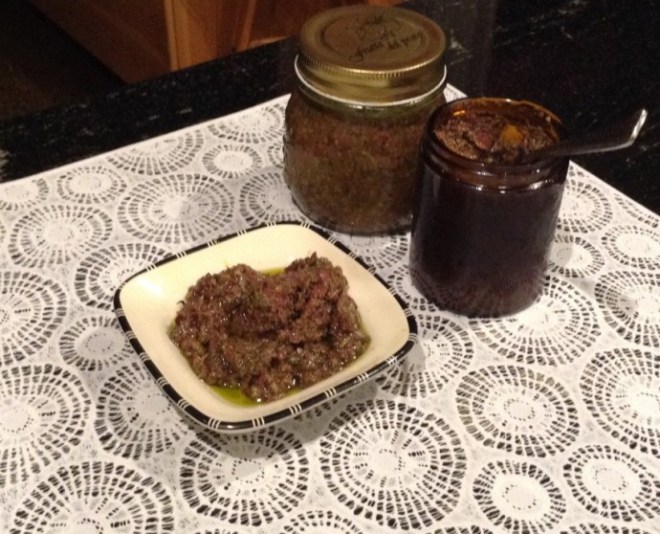
Sometimes a little bit of imagination makes an old favourite look special. This is just baked fennel with black olives but the special touch is that I used tapenade (which I make regularly and usually have some on standby in the fridge – see photo above).

I have written about making tapenade. See: TAPENADE

photo
INGREDIENTS
1-2 fennel bulbs
2 garlic cloves, finely chopped
½ cup tapenade
¾ cup white wine, stock or water or pernod, a mixture any
2 tbs extra virgin olive oil
2 tbs butter
1 tsp sugar
salt and pepper 
PROCESS
Prepare the fennel:
Remove the fennel stalks that are not worth saving from the bulbs and discard – keep some of the fresher ones (this is mainly done for appearance but may be  also be suitable for eating). Trim away any bruised or discoloured portion of the bulbs. Cut the bulbs length-wise (vertically) into eights (or more or less) depending on the size of the fennel. Save the fronds.
Add the sliced fennel to a pan with hot olive oil and butter and sauté for 5-10 minutes, turning occasionally.
Add seasoning and about 1 cup of liquid (see above). Add garlic and fronds.
Cook uncovered on gentle- moderate heat for about 10 minutes, the liquid will reduce but add more if necessary
Add a teaspoon of sugar to help caramelize the juices. Increase the heat to evaporate any liquid left in the pan – this will result with the fennel cooking in the left over oil and butter and turning a deep gold colour. .
Place the fennel on a dish and pour over it any juices. Add a couple of spoonfuls of tapenade to the pan and heat it – only just to take off the chill.  Spoon the tapenade onto the fennel and serve. I guess the chives add to the composition, but these are not necessary.

APPLE STRUDEL (TRIESTE: Strucolo de pomi)

This is a recipe for an apple strudel as made in Trieste. Unlike the very thin pastry common in the Austrian strudel and other European countries that once belonged to the Austrian- Hungarian empire, the pastry in a Triestine strudel is not as thin and therefore easier to roll.

Cooked strudel cut 2

Autumn is a good time for apple desserts and I was asked recently about suitable food to take on a picnic. This apple strudel is nice to eat hot or cold and the pastry does not go soggy.

With Easter coming up and apples been so abundant, a Strucolo de pomi could be the go.

FullSizeRender

I have written about Strucolo before and as a child it was my job to prepare the apples. Here is the link to the recipe:

STRUCOLO DE POMI (Apple strudel as made in Trieste).


VANILLE KIPFERL or CHIFELETTI as called in Trieste

My friend called them Vanille Kipferl, I recognised them instantly as Chifeletti (‘ch’ sound is pronounced as k in Italian and ‘letti’ at the end of words in Italian means small.). Same recipe, different name. But it is not surprising that we share the same recipe – my friend is from Vienna and I came from Trieste and both cities were part of the Austo- Hungarian empire.

DSC_0158

The Vanille Kipferl (or Chifeletti) are frail, crescent-shaped, little biscuits dusted with icing sugar. They are popular at Christmas time in Austria and together with her much-loved cherry cake they were my friend’s contribution to our shared Christmas eve dinner. I ate the last of the kipferl recently; they last well and the flavour is said to improve when stored well.

I have found slight variations in the different Triestine and Austrian recipes sighted, (for example some add egg yolks to the mixture), but the ratio of ingredients seems to be the same. In Trieste, rather than adding vanilla to the dough they use icing sugar that has been flavoured with vanilla beans.

DSC_0021

Chifeletti in Trieste are also called Lunette (small moons) or Curabiè, perhaps from Kourabiès, which are the Greek version of these biscuits. Interestingly enough there is an eastern Greek Community in Trieste and when visiting this very pleasant Italian city, it is worth seeing the Greek Orthodox church – Church of Saint Nicolò. There is also a Serbian – Orthodox church called San Spiridione, but this is another story and very telling of the historical culture and racial mix in Trieste’s population.

DSC_6162-640x4231

In my mother’s pantry, the jar used to store her icing sugar always had vanilla beans buried in it. Vanilla infused icing sugar for dusting is optional but if you want the real deal: Place vanilla beans in a jar of icing sugar, seal it and leave it for at least a week.

300g plain flour
250g butter
80g sugar
100g finely ground almonds
vanilla (a little paste or essence)
1 pinch salt
icing sugar for dusting

Rub the butter into the flour, sugar, ground almonds and salt and form it into dough.  Shape the dough into a ball, cover it with plastic film and leave it in the fridge for a couple of hours.

Divide and shape the dough into finger thick long rolls and cut each roll into 2 cm pieces. Curve each small piece of dough into small moon shapes.

Place the biscuits on a baking tray lined with baking paper and bake in a pre-heated oven at 150°C for 10-15 minutes (They should be pale golden in colour and must not brown).

Remove them carefully from the oven and from the baking tray and when they are still warm dust them with plenty of icing sugar (vanilla flavoured).

When they are cold store them carefully in layers, in a tin with plenty of icing sugar.

The photo of my friend’s Cherry cake is below. As you can see, the batter is like pastry and there are many cherries in the centre.

DSC_6174

P.S.

Other pastries also called  Chifeletti  popular in Trieste are made with potato dough. These are fried and then rolled in sugar; my mother and Triestine aunts used to make these with the same dough as gnocchi…..gnocchi for lunch, followed by Chifeletti made with some left over dough.


GULASCH (Goulash as made in Trieste)

I bet that you have never seen gulasch spelt like this…unless you are from Trieste. Trieste was part of the Austro- Hungarian empire and much of its cooking reflects this.

Gulasch in Trieste is made with meat, onions and paprika. It does not contain tomato or potatoes or peppers or other spices. I have seen recipes that include a few winter herbs – rosemary or marjoram, but this is not common.  My touch is to also add some red wine and caraway seeds; some cooks do this, some do not.

In Trieste gulasch can be made with beef or pork and may have a mixture of meats: beef shin, pork and maybe horse meat. I do not wish to put you off; I make mine just with beef, either shin, bolar or oyster blade, and it tastes wonderful.
Like all meat stews or braises it is best made the day before to allow the flavours to develop even further.
It needs to cook slowly – I cooked mine for about three hours and the slow cooking is essential.

INGREDIENTS
2 k beef (shin, bolar, oyster blade) cut into large squares
2-3 onions, sliced finely
extra virgin olive oil and if you have it, about 2 tbsp. lard (no mucking around with this recipe)
2-4 bay leaves
2 tbsp. sweet paprika and 1/2-1 tbs of hot paprika
¾ cup of red wine and 1 tbs caraway seeds (optional, but I like to do this)
water or stock to cover the meat
salt to taste

PROCESSES
Sauté the onions in hot oil till golden.
Add beef and paprika and sauté the beef.
Add  wine and some stock (or water), caraway seeds and salt; cover and simmer on low heat until the meat is tender.  Stir occasionally and make sure that the level of liquid  is maintained.

In Trieste, i triestini (the people from Trieste) may accompany their gulasch with spatzle (egg, flour, water made into a soft dough and the mixture is pushed through the holes of a colander into boiling salted water or into the boiling juice of the gulasch). Some like to have it with knodel (dumplings made with bread but some also make them with potatoes) others with polenta.

I like to have it with polenta – plain, ordinary (not Instant) polenta cooked in salted water and stirred until it begins to detach itself from the sides of the pot, then baked in an oiled tin till it forms a nice crust. Love it, and I doubt very much if my Sicilian relatives would enjoy it.

For other recipes from Trieste, see:

IOTA (Recipe, a very thick soup from Trieste) Post 1

IOTA FROM TRIESTE, Italy, made with smoked pork, sauerkraut, borlotti beans – Post 2

Strucolo de pomi (apple strudel)
Gnocheti de gris (semolina gnocchi in broth)
Patate in teccia (potatoes braised with onions)
Dolomiti – baccala mantecato (creamed baccala)
Risi e bisi (rice and peas- risotto)

MA2SBAE8REVW

GNOCHETI DE GRIES (as called in Trieste), GNOCCHETTI DI SEMOLINO (Italian), SEMOLINA Small GNOCCHI

GNOCHETI DE GRIES (as called in Trieste), GNOCCHETTI DI SEMOLINO (Italian), SEMOLINA Small GNOCCHI are popular additions to Brodo (broth). They are popular in Trieste.

BRODO (Broth)

In my parent’s house we ate brodo (broth) once per week. Sometimes it was made with chicken, sometimes with yearling beef and at other times it was a mixture of the two meats; a few bones were always included.

We always had brodo as the first course and the boiled meat as the second course, and this was always accompanied with Salsa verde.

Brodo is popular all over Italy and is considered essential especially when a member of the household is feeling unwell. It is seen as a restorative food in many other cultures.

What to have in Brodo

Often we would have tortellini in brodo, but at other times, my mother added pastina (small pasta); these were either capelli d’angelo (angel’s hair) or thin egg noodles or stelline (small stars) or quadretti (small squares).

Most of the time we had or favourite: gnocchetti di semolino floating in our brodo – these are small gnocchi, a specialty from Trieste.

Because I spent my childhood there I became an expert gnocchetti maker from an early age.

Gnocchetti in brodo.

Recently, I have been making brodo with semolina gnocchetti. I used a tea spoon to shape them.

IMG_0194

RECIPE GNOCCHETTI  made with Semolina
To make brodo, see:  BRODO DI GALLINA
INGREDIENTS
50 g of butter,
1 egg,
100g of semolina,
pinch of salt,
grated Parmesan cheese (1 tbs in the mixture and some to present at the table)
PROCESSES
Make the brodo:
Beat softened butter and egg with a small wooden spoon until soft and well mixed. Use a small jug, milk saucepan or a bowl with steep sides.
Add the semolina and grated cheese slowly and continue to mix vigorously until perfectly smooth.
Bring the broth to the boil.
Use a wet teaspoon to shape the gnocchetti. Take small quantities of the mixture and slip small oval shapes off the spoon into the boiling broth. Keep the broth on a gentle boil.

Continue shaping the gnocchetti and poaching them until the mixture is finished. The gnocchietti rise to the surface when cooked (about 5 minutes). If cooking large quantities of gnocchetti, to prevent over cooking, take the cooked ones out with a slotted spoon before slipping in the new ones, but with the above amounts this will not be necessary.

Ladle broth and a few gnocchetti into each bowl and present with grated cheese.

IMG_3404
Pastina, cut into little squares (quadrettini) by hand

The pasta I use  in brodo is commercially made, but when I eat brodo in Sicily at my zia Niluzza’s (my father’s sister) makes fresh quadrettini (very little squares) – she cuts the fresh pasta amazingly quickly.

MUSSELS IN TRIESTE and Mussel recipes

IOTA FROM TRIESTE, Italy, made with smoked pork, sauerkraut, borlotti beans ; Post 2


BACCALÀ MANTECATO (Creamed salt cod, popular in the Veneto region and Trieste)

dsc_0054
 Ortigia, Syracuse

According to my Sicilian relatives, only Sicilians know how to cook baccalà. Having lived in Trieste (north Italy), I was very familiar with this fish that is cooked in a variety of ways in this region. I particularly like baccalà mantecato, (boiled cod fish and then whipped or beaten with oil and garlic – one of the most representative recipes in Venetian cuisine). I tried to introduce my Sicilian relatives to this once, but they were not interested. Sicilians are particularly conservative about food that isn’t theirs.

IMG_7493

Baccalà mantecato is not easily found in restaurants (most restaurants in Australia cook Southern Italian food) but I have eaten it at Guy Grossi’s, The Merchant –an osteria in Melbourne with typical food from the north-east of Italy.  Most of the food is presented as cichetti— bite-sized morsels.

The food at The Merchant brings back many childhood memories, including the Veneto dialect used for the names of the offerings on the menu (very similar to the Triestino dialect spoken in Trieste) .

Baccalà mantecato, has the thickness of a creamy, mashed potato. The fish spread is served cold and in my youth i ate it spread on crostini – thin slices of white bread, lightly fried till crisp in extra virgin olive oil. We passed the crostini around to guests while they drank an aperitivo. – usually a vermouth. Needless to say, a glass of prosecco or soave is also a good accompaniment. In Venice, baccalà mantecato is more likely to be spread on crostini made with cooked polenta that has been lightly toasted ( lightly fried or grilled) .

DSC_0772(1)

There are various recipes for how to make this and not all add milk. I was taught that the milk sweetened the taste and helped to preserve the white colour.

Thick pieces of salt cod (cut from the centre) are the thickest and the best. Leave the skin, but cut away fins and obvious bones. Cut into serving size pieces (7- 10cm). Rinse well in running water before soaking for 36-48 hours (over soaking will not spoil the fish, especially if the pieces of baccalà are thick). Keep it covered in a bowl in the fridge. Change the water at least 4-5 times.

INGREDIENTS
baccalà, 800g, pre soaked
garlic, 1-2 cloves chopped very finely (I use a garlic press)
extra virgin olive oil, at least 1 cup
pepper
bay leaf, 1-3
parsley,  finely chopped 1-2 tablespoons
milk, 2 litres
water, 1 litre
PROCESSES
Cover the pre soaked baccalà with cold water and milk, and bring it slowly to the boil. Add a bay leaf.
Simmer gently for 30- 40 mins. Allow it to rest and cool in the liquid.
Remove the fish from the poaching liquid, pick out all the bones and remove the skin. Use a fork to break the flesh into small pieces.
Place fish in a bowl and add the garlic and about ½ cup of extra virgin olive oil. Begin to beat the fish with a wooden spoon and keep on adding oil as you would if you were making mayonnaise by hand. The mixture will look like a thick, white, fluffy cream. Keep on adding oil until the mixture will not absorb any more – it may absorb 1-1½ cups of oil.
The above process can also be done in a food processor.

The photograph of baccalà montecato was one of the entrées presented a couple of years ago as part of The Melbourne Food and Wine Festival; the event was called Around Italy in 7 Days – Travel north to south with a different gastronomic journey each night.

Massimiliano Ferraiuolo was the chef (originally from Naples) who was visiting from Italy for a week’s residence at Society Restaurant and cooking each evening. (This was the evening to celebrate food from the north of Italy). the baccalà montecato was presented on a bed of mashed fresh peas with black toasted bread (black squid ink was used in the bread mixture), sprinkled with paprika, toasted almonds and a fresh, red autumn leaf . Pumpernickel bread is also suitable.

MA2SBAE8REVW

PATATE as a contorno (Two recipes for ‘squashed’ potatoes, Patate in tecia).

Last week’s post mentioned patate in teccia (potatoes in a pan), a perfect accompaniment for vitello arrosto (veal roast). In fact in Trieste where this recipe is common, it can be the perfect contorno to accompany many other hot main courses which have a little gravy or juice.

In teccia is triestino (dialect used in Trieste) for cooked in a pan.

Patate schiacciate,  means ‘squashed potatoes’. I was away with friends over the weekend and one of my friends cooked these potatoes (see photo). He was surprised that I too knew them as ‘squashed’ and that they are cooked in various parts of Italy.

Here are two recipes for ‘squashed’ potatoes.

PATATE IN TECCIA (Trieste)

INGREDIENTS

potatoes 600g
onion, 1 large
extra virgin olive oil, 6 tablespoon
salt and pepper to taste

PROCESSES

Place whole, un-peeled potatoes in cold water and boil until cooked. Drain them.
In Trieste the potatoes are peeled and squashed into smaller, uneven sections. I sauté the potatoes un-peeled (and not forgiven for doing this by Italians).
Sauté and soften the onion till they are a light golden colour. Use extra virgin oil.
Add the potatoes and cook on medium heat until they begin to colour (form a crust) on the bottom. Stir them continually so that they can continue to colour (this process will take about 10 minutes).
*Sometimes I have used duck fat, the render of having cooked duck – the taste is superb, but it is not traditional.
PATATE SCHIACCIATE

INGREDIENTS

potatoes 600g
extra virgin olive oil, 6 tablespoon
salt and pepper to taste
Heat the oven to 200 C
Place whole, un-peeled potatoes in cold water and boil until cooked. Drain them.
Position potatoes in a well-oiled baking pan (not-overlapping) and squash them with the palm of the hand (or a cup).
Dribble with the remaining oil and sprinkle with salt and pepper.
Bake the potatoes for about 20 minutes till golden (have formed a crust) and serve.
*I often use duck fat instead of oilve oil, but this is not traditional.
See  recipe for Vitello Arrosto
Roast veal but cooked wet on the stove top rather than the oven.

VITELLO ARROSTO (Roast Veal)

When we first arrived in Australia, we lived in Adelaide and one of the favourite things that my mother cooked when we had guests, was vitello arrosto (roast veal).

It was not vitello as we had been used to in Trieste (veal which was very pale in colour and young), however, we were very fortunate to have a good Hungarian butcher who did his best to supply us with cuts of meat that we were better acquainted with.

When I was a teenager I often had friends who came to stay and I used to tell them that what we were eating was roast veal, they were confused. Firstly because it was not roast lamb (my mother thought that what Australians called lamb was really pecorona – ultra big sheep), but secondly because what we called roast was not a roast cooked in the oven, so why did we call it roast?

Ovens were not commonly used, baking was not common, but wet roasting was, and if you look at recipes for vitello arrosto you will find that the most common way of cooking it is in a pan with a close fitting lid on top of the stove. The juices do not dry out and the roast will be tender and very flavourful.

This is not a recipe my Sicilian relatives cooked – their arrosto was always cooked slowly in the oven, with onions, a little tomato, bay leaves and usually with potatoes. This was also moist and cooked for some of the time partly covered. The photo above of the meat was taken in a meat market in Sicily; the cut of meat that my relatives often use for a boneless roast is called a reale.

Ask your butcher for a piece of veal that you can roast.  A leg of veal is suitable, but it will be gelatinous and not every one likes this.

it is also called Vitello in Pentola ( saucepan/pan),  in Australia it is often called a Dutch oven; is a good shape to use for vitello arrosto.

INGREDIENTS
roasting veal in one piece of 1.5 – 2 kg
extra virgin olive oil, ½ – ¾ cup
white wine,  up to 2 cups or 1 cup wine, 1 cup stock
onion, 1 cut into quarters
carrots, 3, leave whole
fresh rosemary, sage and whole garlic cloves to stud the meat
salt and pepper to taste
PROCESSES
Make holes in the meat (use a sharp, thin knife) and stud the meat with the flavourings – use separate flavours for each hole.
Heat the oil, brown the meat well on all sides.
Pour in 1 cup of the wine and evaporate.
Add the onion and carrots, a few more sprigs of rosemary and sage, salt and pepper.
Cover and cook over low heat for about 1½ hours, but keep on adding a little more wine (or stock) so that the meat is kept moist and does not stick to the bottom of the pan (add extra water or stock if necessary).

When the meat is cooked, cut the roast into thin slices and serve it with the sauce (I always include the bits of onion and carrots, some cooks use a mouli to passare (grind/ mash) the vegetables into the sauce.

My mother always presented the veal with spinach sauteed in butter and nutmeg and patate in teccia…but these are part of another story.

PATATE as a contorno (Two recipes for ‘squashed’ potatoes, Patate in tecia).