Sicilian Wine and Food Experience and The Wine Depository

My next Sicilian cooking class will be:

Sicilian Wine and Food Experience, Thursday 1st October 7pm
An intimate event that will see you not only eat and drink in a Sicilian manner but learn as you go.

The event will be conducted by Phil Smith, owner and creator of The Wine Depository.

Sicilian+3+wheeler_0105

The Wine Depository is a Melbourne-based bespoke wine retailer and consultancy here to challenge how and when we drink wine. We offer a hand picked (and rigorously tested) range of wines to either enjoy now or tuck in the cellar. We’re known for rare and hard to find wines, lesser known varietals and smaller producers.

The Wine Depository and Phil provide:
Wine Cellar Advice
Wine Sales
Private Tastings
Corporate Wine Services
**Wine Events and Education
Sicilian Wine and Food Experience is one of these events.

From The Wine Depository’s website:
Phil knows that every time you taste a wine it is an event and it can be educational. He effortlessly brings these elements together in his wine tasting events, whether a casual tasting or a Masterclass over dinner. The emphasis is on good wines that will broaden your wine drinking knowledge or at the very least be extremely yummy. The Wine Depository often brings a knowledgeable and engaging speaker to take you through the wine selection.

Information on the Wine Depository’s website about Sicilian Wines

Website:
The Wine Depository

Sicilian Wine and Food Experience Event


San Francisco, Marin County – a large selection of organic produce

I loved all of the bits of San Francisco and Marin County I saw; Marin County is located in the North San Francisco Bay Area of the State of California.

IMG_2096

I loved the buses in San Francisco – very stylish.

IMG_2102

I loved the houses in San Francisco.

IMG_2116

And once again as in NYC and Michigan, I was very impressed by the large range of fresh, seasonal and local produce in food shops, supermarkets, Farmers’ Markets, eateries and in restaurants.

IMG_2020

This demonstrates that many of the residents are highly conscious and supportive of quality, fresh organic produce and health.  But I  am also aware that although I travelled to many different neighbourhoods in San Francisco that appeared to be representative across a variety of cultures and economic demographics, I may not have seen the total picture.

IMG_2052

It was such a pleasure to see artisan goods in Downtown SF and the neighbourhoods beyond. The packets of beans in the photo above are heirloom varieties and many of them are very ancient types.

IMG_2018

There were large barn-like  supermarkets that concentrated solely on organic food and some of the little shops, (equivalent to some of the Health shops found in Australia) were very well stocked with organic produce.

In Marin County and not just in specialist food stores there are large sections of organic produce in supermarkets; in the very large Whole Food supermarkets there were also displays of brought home ready-to-eat foods.

IMG_2025

And  salads.

IMG_2024

The cheeses looked freshly cut, packaged and clearly labelled; it came from all over the world.

IMG_2028

Fresh and dried fungi and mushrooms of all sorts were in The Ferry Building .

IMG_2023

And there were some exotic varieties.

IMG_1986

In restaurant menus, I particularly enjoyed seeing combinations of cuisines (fusion food) and dishes with  unexpected ingredients (for example there was a a salad of kale, strawberries, croutons and goat gouda  and the oysters were combined with finger limes, pickled mustard seeds and Madras curry).

IMG_2167

I valued observing that in some restaurant menus the producers were also mentioned (for example California Olive Ranch olive oil or Mariquita Farms heirloom tomatoes etc.)

Below, some Vietnamese Fusion Food.

IMG_2011

Japanese fusion food.

IMG_2089

This bean curd dish (Asian) was accompanied with broccoli rabe (an Italian vegetable) sautéed with caramelized shallots and lemon grass.

IMG_2091

Braised green leafy vegetables with red peppers and black garlic.

IMG_2083

Ready to eat or take home oysters with prepared sauces.

IMG_1985

Or to eat there.

IMG_1976

And even at the San Francisco airport the range of organic and fresh and local food was impressive. I could have bought good quality bread and a lump of local cheese and I would be given a plate, cutlery, order a glass of Californian wine and sat down to enjoy it. On this occasion, I selected one of several types of coconut waters.


IMG_2177

What do I think about the range of food available in Australian airports? Not much, and we could do so much better.

IMG_2178

And one last thing. I enjoyed seeing deer roaming freely in home gardens in Novato in Marin County where my friends live.

Deer in Buckeye Court


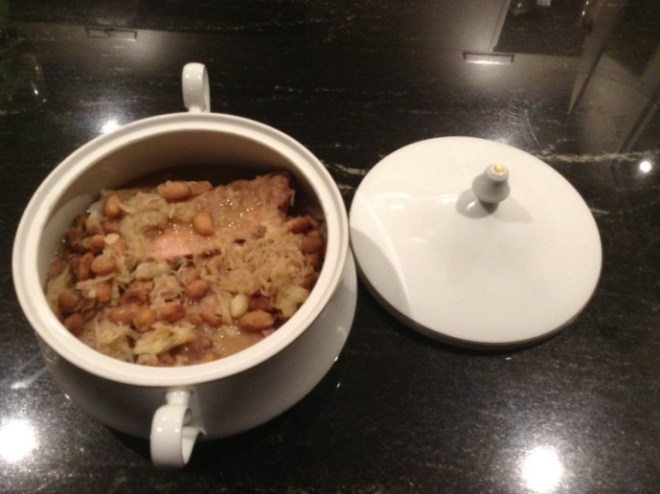
IOTA FROM TRIESTE, Italy, made with smoked pork, sauerkraut, borlotti beans – Post 2

It is winter in Melbourne and time to cook Iota again.

Smoked pork, sauerkraut, borlotti beans? Italian you say?

IMG_1573

Yes, and it demonstrates just how regional Italian cuisine can be.

Iota is an extremely hearty soup from Trieste, the city where I grew up as a child until I came to Australia.

Details and recipe for Iota (A Very Thick Soup From Trieste)

See also Gulasch (Goulash As Made in Trieste)

For a complete meal, end the one course Iota dish with a salad or two.

Popular in Trieste:

Matovilc, see: Salad Green: Matovilc, Also Called Lamb’s Lettuce and Mâche

or Radicchio Triestino,  a small-soft-leaf radicchio.


My father grew Radicchio Triestino in his Adelaide garden but I have never seen it for sale in Australia.

These are some of the salad vegetables I am able to purchase at the Queen Victoria Market. Notice the pale coloured beetroot (I also cook the leaves like spinach). The beetroot I ate in Trieste was always pale in colour.

Next to the red radicchio is the head of speckled, pale radicchio (radicchio biondo= blonde/blond).

Fennel and the baby cabbage are also suitable salad vegetables, as is rocket – rucola in Triestine.

IMG_1585:


EATING WELL, Camping in Tasmania, BBQ chicken-Pollo alla Diavola

I always mange to eat well, even when camping.

IMG_1439

I have just spent 12 day a camper van visiting remote places mainly on the West, North and North-east coast of Tasmania.


I have been to Tasmania on a number of occasions but was not very familiar with the number of lakes in the centre of the island, the west coast – Queenstown, Cape Sorell, Macquarie Harbour and Strahan, The Tarkine forests, Corinna, Arthur River and West Point, then along the north coast to the east…Lake William National Park, Binalong Bay, Bay of Fires (just to name some places).

IMG_1358

My partner and I (and sometimes with a couple of friends) ate oysters, fish and excellent beef and chicken, fabulous potatoes, excellent cheeses, eggs, wine, apples and all sorts of vegetables.

IMG_1404

The photo below shows red lentils and carrots (cooked with a curry the previous night) and braised red cabbage with apples and caraway seeds from two nights before.

IMG_1467

I  cannot resist foraging and managed to find pine mushrooms, blackberries and wild fennel – not difficult.

IMG_1436

I did not take photos of all the food, but here are a couple.

I always cook pulses, even when I am away. These are mashed white beans with rosemary and olive oil drizzled on top.

IMG_2705

And there was fish, but often hard to buy…plenty of fishermen but no shops to sell it.

IMG_1144

Tasmania….

IMG_1459

How beautiful….

IMG_0354

…and varied.

IMG_0366-800x600

The chicken cooked on the BBQ is a version of pollo alla diavola. Most of the time this chicken is cooked with a weight on top and usually called pollo al mattone (chicken cooked under a brick). . They were small chickens so this may have made them more pliable. I have written a post about Pollo alla Diavola in an earlier post. I did not use a brick on this occasion but we made sure that the chickens were quite flat

Use a small chicken (younger and small in size – approx 1 k).
Once butterflied, marinade it for at least an hour in oregano, black pepper, salt, extra virgin olive oil and grated lemon peel.
Alla diavola means ‘as the devil cooks it’, therefore add plenty of pepper and use a moderately hot flame.
Press the chicken quite flat.
Turn once after about 20 minutes. Cook for about 40-50 minutes, remove chicken from the fire, cover with foil and a tea towel on top and allow it to rest  for about 10 minutes to finish cooking.
it will be quite coloured on the outside but it will taste great.
 IMG_1440
 

EARTH HOUR, Planet to Plate: The Earth Hour Cookbook 2015

EARTH HOUR

● Earth Hour will take place at 8:30pm local time, Saturday, March 28, 2015.
● In 2014 one in three Australians took part in Earth Hour, turning off their lights to show their support
for cutting carbon pollution and tackling global warming.
● Earth Hour began in Sydney in 2007, initiated by WWFAustralia
to raise awareness of the effects of climate change. 2,200 businesses and over 2 million people took part.
● Earth Hour has now spread to 162 countries and over 7,000 cities, making it the world’s largest
environmental movement.
● Anna Rose is National Manager of Earth Hour Australia and was recently named the Australian
Geographic Conservationist of the Year.

2 amazing recipes.

This is a collection of 52 recipes by Australia’s top celeb

EARTH_HOUR_LOGO

PLANET TO PLATE: The Earth Hour Cookbook
In the lead up to Earth Hour on Saturday, March 28 2015 at 8:30pm, Earth Hour Australia will release Planet
to Plate: The Earth Hour Cookbook a collection of 52 celebrity chefs including Margaret Fulton, Matt
Preston, Neil Perry, Luke Mangan, Kylie Kwong, Jill Dupleix and Matt Stone. The recipes are
combined with firsthand stories from Australian farmers highlighting the impact global
warming is having on their farms and the availability of our favourite foods grown here in
Australia.


IMG_1292

I am proud to say that I also have a recipe in the Planet to Plate: an Earth Hour Cookbook (even if on this list my name has been misspelled).

IMG_1297 - Version 2

This book spotlights global warming impacts on Aussie food and farmers.

In an Australian publishing first, Planet to Plate will uniquely and beautifully incorporate firsthand
stories from Australian farmers highlighting the impact global warming is having on their farms and the nation’s availability of fresh, homegrown food. Burning fossil fuels such as coal and gas makes global warming worse, contributing to more extreme weather and droughts that threaten farming communities and Australia’s supply of fresh food.
Anna Rose, National Manager of Earth Hour Australia and Australian Geographic Society Conservationist of
the Year, says that the launch of Planet to Plate is an innovative way to remind Australians of one of the
strongest reasons to take action to tackle global warming: our food.
“Besides being a collection of the very best recipes from the country’s top chefs, Planet to Plate will highlight
the fact that global warming is already affecting produce we enjoy in our everyday lives including fresh
vegetables, cereals, bread and fruit.
“Our much loved farmers are the custodians of the nation’s food bowl and need our support to minimise the
harm carbon pollution is having on the supply of fresh food that we are so lucky to enjoy in Australia.”

The Food Stylist for the cookbook is Fiona Rigg – she was the food stylist for my first book, Sicilian Seafood Cooking.

IMG_1302
_______________________________________________________________________________________________

Proceeds from the cookbook will go to supporting Earth Hour’s work with schools, small business and
community groups.
Families, friends, schools and communities across Australia are encouraged to purchase a copy of the
cookbook for some inspiration on Earth Hour night. Millions are expected to host or attend an Earth Hour
gathering, dinner or BBQ in their community to help spread the word about the need for action on global
warming and what individuals can do to help.


IMG_1294
Photos above are from pages of Planet to Plate: The Earth Hour Cookbook.

The information about Earth Hour and Planet to Plate: The Earth Hour Cookbook is taken from Earth Hour Australia: the MEDIA RELEASE and DIARY ALERT.

CHICKEN GOULASH (Gulasch di pollo from Trieste)

Free-range birds are supposed to have room to roam and space to grow and therefore I may be incorrectly assuming that because they move they should not be accumulating as much fat as conventional chickens. Nevertheless, I seem to be spending more and more time removing large amounts of fat from the free-range organic chickens before I cook them.

IMG_1222

In this recipe I used a whole chicken divided into sections – perfect for stews and braises with the bones providing great depth of flavour.

I spent my childhood in Trieste and grew up with both Sicilian and Triestan food.

I wrote a recipe for Goulash as made in Trieste in 2012. Goulash is usually made with beef or a mixture of meats but this goulash recipe is made with chicken.

Goulash is spelled gulasch in Trieste; this city in the north-eastern side of Italy was once part of the Austrian – Hungarian and had very strong links with Austria at one time.

The strong red colour is achieved by paprika; no tomatoes or other vegetables are used apart from onions. This reflects the way goulash is made in Austria whereas in other countries where goulash is popular including Hungary, goulash is augmented with other vegetables – green and red bell peppers, tomatoes and carrots are the most commonly used.

I usually make make goulash with beef and because it is lean, I sauté the meat in the oil or fat after I have softened the onions. But because this chicken had sufficient fat in the skin I sautéed it before the onions and skimmed off any unwanted fat that had been released during the sautéing.

IMG_1217-800x800

INGREDIENTS
1chicken cut into sections

2-3 onions, sliced finely
extra virgin olive oil and if you have it, about 2 tbsp. lard

2-4 bay leaves and a sprig of sage
2 tbsp. sweet paprika and 1/2-1 tbs of hot paprika
¾ cup of red or white wine and 1 tbs caraway seeds (optional, but I like to do this)
water or stock to cover the meat
salt to taste

PROCESSES
Sauté the chicken pieces in a minuscule amount of olive oil and if you wish pour off excess fat as the chicken browns.

Remove the chicken from the pan, add more oil/lard to the pan if you wish and sauté the onions until it is golden.
Add paprika, herbs and caraway seeds and return the chicken to the pan.
Add wine and some stock (or water) and salt; cover and simmer on low heat until the meat is tender.  Stir occasionally and make sure that the level of liquid is maintained.

In Trieste it is usual to accompany goulash with spatzle (spaezle in German) or polenta or knodel (dumplings made with bread, but some also make them with potatoes) .

I presented the goulash with speatzle, but I did not make it.

SPAEZLE

To make spaezle  mix 2 eggs and as much flour and water it needs to make into a soft dough, leave it for about one hour wrapped in plastic wrap and then press the mixture through the holes of a colander  into boiling salted water or into the boiling juice of the gulasch. (Use a colander with largish holes).

I purchased Riesa Spaetzle made in Riesa Germany. It claims to be made with fresh eggs and the best durum wheat; Riesa is a town in the district approx. 40 kilometres (25 miles) northwest of Dresden. Usually the spaezle is tossed in a little butter after it is drained.

I presented it with braised Kale. It was all very enjoyable.

RECIPE FOR GOULASH MADE WITH BEEF.  Gulasch (goulash As Made in Trieste)

twr-ps_th_spaetzle_int-191x300


PANETTONE AND PANFORTE for an ITALIAN CHRISTMAS

DOLCETTI+ONE255B1255D
Photo by Patrick Varney, Raglan Images for  Italianicious ( magazine) Nov- Dec 2010

Marisa Raniolo Wilkins, Marianna Di Bartolo and Mary Taylor Simeti

I first posted the content of this post on Dec 20th, 2010. I called it: PER NATALE, COSA SI MANGIA? At Christmas, what do you eat?

I am able to view the stats for each of my posts and all of the posts about Christmas have been viewed many times, but this one has not been popular. Is it the title?

It contains some general information about the food that is common in Sicily around Christmas time but it also contains information about Panettone and Panforte – both popular at Christmas. There is also a recipe for Panforte.

Now, on Dec 15, 2014, it is time to post it again and give it another title:

PANETTONE AND PANFORTE for an ITALIAN CHRISTMAS


CHRISTMAS IN SICILY

You are probably wondering what Sicilians eat for Christmas in Sicily.

When the respected writer Mary Taylor Simeti (an expatriate American, married to a Sicilian organic wine maker and farmer and most importantly, one of the greatest authorities and writer about Sicilian food) visited Melbourne recently, she and I and pastry cook Marianna De Bartoli, who owns Dolcetti, a pasticceria in North Melbourne, were all asked this same question during an interview for Italianicious Magazine (Nov-Dec issue 2010).

We all gave the same answer, which is that there is no one answer since the cuisine and traditional food of Sicily is very regional. Sicily may be a small island, but the food is very localised and very different from region to region.

The three of us also agreed that Christmas Eve was more important than Christmas day – it is a meatless occasion and fish is the first choice. In some places Sicilians eat stoccofisso (stockfish) or baccala, where in others they eat eel. Usually families wait up and go to midnight Mass. And for those that do, Christmas lunch will often begin with a light first course. For example, chicken broth with maybe some pastina (small pasta suitable for broth) or polpettine (small meatballs) made with shredded cooked chicken meat, egg, a little fresh bread and grated cheese.

In Ragusa, where my father’s family comes they tend to eat the same foods as they do at Easter: scacce and large ravioli stuffed with ricotta dressed with a strong ragu (meat sauce) made with tomato conserva (tomato paste) and pork meat.

These are followed by some small sweets like cotognata (quince paste), nucatuli and giuggiulena (sesame seed torrone).

In other parts of the island gallina ripiena (stuffed chicken cooked in broth) is popular, while others may eat a baked pasta dish, for example: anelletti al forno. timballo di maccheroni or lasagne made with a very rich, strong meat ragu. This may be followed by capretto (kid) either roasted or braised.

There may be cassata or cannoli for dessert or the wreath shaped buccellato made with dried figs, almonds, walnuts, sultanas and spices (from Latin buccellatum meaning ring or wreath).

There are links to recipes for all the words in blue above.

PANFORTE or PANETTONE FOR CHRISTMAS

Both panettone and panforte are popular Christmas sweets in Italy.

In recent years panforte has become popular in Australia, but you are probably more familiar with panettone. This may be because there are so many different brands of panettone available and they are exported to many parts of the world, especially in countries where Italians have migrated.

Italians are very happy to buy both of these Christmas sweets and the big brands are of excellent quality. Generally Italians where ever they live would rather buy these than make them at home. I have never tried to make panettone but I have made panforte several times very successfully.

PANETTONE

This Christmas sweet bread is now popular not just in northern Italy where it originated.

It is said that the early version of panettone ( means bread big) was not the light textured, yeast perfumed, fruit bread we are familiar with, before it was made common by industrial production. It was a type of heavy, enriched, Milanese fruit bread baked at home and not just eaten at Christmas time. Panettone was made famous and affordable when it was commercially produced (from the 1920’s) and railed all over Italy. As a child growing up in Trieste the most famous panettone was the Motta brand (and still a well known brand in Italy) and part of the charm was opening the box and releasing the fragrance.

Popular brand of Panforte

PANFORTE

Panforte is from Siena (within Tuscany) and contains exotic spices of ancient times. It is made with dry fruit and nuts – candied orange peel, citron, chopped almonds, spices, honey, butter and sugar and very little flour to bind the ingredients; it has no yeast, has a very solid texture and is shaped like a disc. Panforte (from pane forte) means strong bread and in earlier times it may have been derived from the Tuscan pane pepato (peppered bread), meaning strongly peppered with spices.

Just like panettone there are some excellent varieties of imported panforte. I like Panforte Margherita (the light coloured version developed in honour Queen Margaret of Savoy’s visit to Siena). Panforte Nero is the dark variety made with dark chocolate.

Being a purist (or as my daughter used to refer to me as a food fascist) I cringe when I see ”gourmet” versions of panforte for sale, some of these contain glace cherries, or glace ginger; I even hesitate at the inclusion of pistachio or macadamia, not the norm, but could be more acceptable.

My favourite recipe is from The Italian Baker by Carol Field (recipe below).

In spite of writing recipes, I am not one for following recipes closely. I always improvise and adapt amounts of ingredients to suit my taste. For example I double the amount of pepper, nutmeg and coriander.  On occasions I have also included walnuts and pine nuts which were included in panpepato, a predecessor.

If I make Panforte Nero I add unsweetened cocoa (Dutch cocoa powder about 2-3 tablespoons) and some bittersweet chocolate.

 Ingredients:
1 cup whole hazelnuts,
1 cup blanched almonds
1 cup candied orange peel and citron, coarsely chopped
1 teaspoon lemon zest
½ cup unbleached all purpose flour
1 teaspoon cinnamon, ground
¼ teaspoon coriander
¼ teaspoon cloves, ground
¼ teaspoon fresh nutmeg, ground
½ teaspoon black pepper, ground
¾ cup sugar
¾ cup honey
2 tablespoon unsalted butter
Method:
Heat the oven to 180c.
Toast the hazelnuts on a baking sheet until the skins pop and blister, 10 to 15 minutes.  Rub the skins from the hazelnuts in a kitchen towel. Toast the almonds on a baking sheet until very pale golden, about 10 to 15 minutes.  Chop the almonds and hazelnuts very coarsely. Mix the nuts, orange peel, citron, lemon zest, flour, cinnamon, coriander, cloves, nutmeg and pepper together thoroughly in a large mixing bowl.
Use a 9 inch springform pan; line the bottom and sides with baking paper Heat the sugar, honey, and butter in a large heavy saucepan over low heat, stirring constantly, until the syrup registers 242 to 248 on a candy thermometer (a little of the mixture will form a ball when dropped into cold water). Immediately pour the syrup into the nut mixture and stir quickly until thoroughly blended.  Pour immediately into the prepared pan and smooth the top with a spatula.  The batter will become stiff and sticky very quickly so you must work fast.
Bake about 30 to 40 minutes.  The panforte won’t colour or seem very firm even when ready, but it will harden as it cools. Cool on a rack until the cake is firm to the touch. Remove the side of the pan and invert the cake onto a sheet of paper. Peel off the baking paper. Dust heavily with confectioners’ sugar.
Love this stuff!!


A SEAFOOD CHRISTMAS Feast with Fran Kelly – RADIO NATIONAL BREAKFAST PROGRAMME

INTERVIEW ON ABC RADIO NATIONAL BREAKFAST WITH FRAN KELLY discussing a Sicilian seafood feast for an Australian Christmas

I  first published this post on 7/12/2011

This morning I had the privilege of joining Fran Kelly on ABC Radio National’s Breakfast program to talk about my book, Sicilian Seafood Cooking, and the rich traditions of Sicilian Christmas feasts.

We discussed how Sicilians celebrate with seafood but mainly this is on Christmas Eve – elegant, vibrant dishes that capture the essence of the Mediterranean and how Australians might embrace these flavours as a delicious, sustainable alternative to the traditional turkey, chicken, or ham.

When I plan a Christmas menu, I think beyond habit. I consider who I’m feeding, the weather, how much I want to cook, and what looks fresh at the market. I ask myself: what will be the showpiece of this meal? Will it be an antipasto that sets the tone, a luscious pasta, or a stunning main course — or perhaps a series of small, memorable plates that celebrate the diversity of the sea?


ISciacca+fish+B

In Sicilian Seafood Cooking, many traditional recipes call for swordfish and tuna – prized in Sicily but now often overfished. I’ve honoured these dishes by keeping their names and heritage, but I also offer sustainable alternatives, showing that flavour and responsibility can, and should, coexist beautifully on our plates.

Sustainability in seafood isn’t just a trend — it’s an urgent responsibility. The seas that have nourished generations are under increasing pressure, and every choice we make as cooks and consumers matters. In Sicily, the sea is part of daily life; fishermen have long understood the rhythms of the tides and the importance of taking only what the ocean can give. I wanted that same respect to guide my book — to celebrate Sicilian culinary traditions while adapting them for a modern world that demands awareness and care.

By choosing locally sourced, seasonal seafood, we not only protect marine ecosystems but also discover an extraordinary range of flavours and textures. Mackerel, sardines, squid, and mussels can all take centre stage, offering richness and depth equal to that of larger, threatened species. Cooking sustainably is not about compromise — it’s about creativity, connection, and honouring the true spirit of Mediterranean food culture.

spada DSC_0063

Sicilians begin their festive meals simply — perhaps with a plate of glossy olives, a handful of roasted nuts, or a few slivers of marinated seafood. These modest starters are intentional; they tease the palate without spoiling the appetite for what’s to come. Inspired by this tradition, I’ve chosen a light fish entrée to open the meal.

Pasta, of course, is indispensable on a Sicilian table. It’s a celebration in itself, and so I’ve offered several alternatives for the first course — each one reflecting the flavours of the sea and the season. For those who prefer something different, I’ve also included a rice dish. In Sicily, rice was once cooked quite plainly, never stirred continually like a northern risotto, yet always full of character and soul.

By the time you reach the second course, a pause may be welcome — but for those ready to continue, I’ve included two main dishes that bring the feast to a satisfying close. Each one carries the essence of Sicilian cooking: generosity, simplicity, and respect for the ingredients.

Fish restaurant_0118

Vegetables are not part of this particular menu, but they are absolutely central to Sicilian cuisine. In Sicilian Seafood Cooking, I’ve included many vibrant vegetable recipes — dishes that showcase the island’s love of fresh, seasonal produce. And, of course, the book is filled with beautiful photography — not only of the food but also of Sicily itself. As Fran mentioned during our interview, the images capture the soul of the island: its light, its colours, and its deep connection to the sea.

The landscape photographs were taken by my partner during our journeys around Sicily — from bustling fish markets to quiet coastal villages. The food photography was by Graeme Gillies, with styling by Fiona Rigg, whose eye for texture and authenticity brought each dish to life. Every recipe in the book was cooked by me, in just five days, in my small kitchen at home. Meanwhile, the photographer and stylist transformed my dining room into a studio. It was intense, creative, and deeply satisfying .

Starter / Antipasto

TONNO CUNZATO

Raw Marinaded Tuna

The fish needs to be fresh and of excellent quality and sliced thinly. Keep it in the fridge while it is in the marinade. The recipes for marinating tuna suggest using a mixture of 7 parts vinegar to 3 parts lemon juice. I prefer to use just lemon juice or 9 parts lemon juice to 1 part vinegar. You may wish to experiment.

This dish is usually served as an antipasto.

Suitable fish:

The recipe is intended for bluefin tuna which is not sustainable unless it is line caught. Any skinless fillet cut thinly can be marinated the same way.

Ingredients:
500g tuna or other thinly cut, skinless fish
Juice of 4 lemons
¼ – ½ cup white wine vinegar
Dried oregano to taste
2 spring onions (scallions) finely chopped
2-3 stalks celery (pale green stalks and leaves from heart) finely chopped
½ cup capers
¼ cup finely cut parsley
¾ cup extra virgin olive oil
Salt & freshly ground pepper
Method:
Marinate the fish in the lemon juice and vinegar, making sure that the fish is covered with the marinade. Add oregano and place in the fridge for 30 minutes.
For the dressing, mix together the spring onions, celery, capers, parsley, olive oil and seasoning. When ready to serve, remove the fish from the marinade and pour the dressing on top.
 

First Course

RAVIOLI DI RICOTTA CU NIURU DI SICCI

Ricotta Ravioli With Black Ink Sauce

Ingredients
2 ½ cups of ricotta
Salt to taste
Extras: sugar, citrus peel or finely cut marjoram
1 quantity pasta (recipe p45)
 pasta with black inkJPG
Black ink sauce:
600g squid or cuttlefish plus 2-3 ink sacs
1 medium onion &/or 2 cloves garlic
½ cup olive oil
100g ripe tomatoes, peeled and chopped
1 large tblsp tomato paste
1 cup finely cut parsley
1 cup white wine
Salt
Chilli flakes or freshly ground pepper
Clean the squid or cuttlefish carefully and extract the ink sac. Cut into 1cm rings and set aside. The tentacles can also be used.
For the sauce, sauté the onion and garlic in the oil, add the tomatoes and tomato paste, parsley, white wine and sale. Bring to the boil and reduce until the salsa is thick.
Cook the pasta.
Add the ink and chilli flakes to the sauce and mix well. Add the squid rings and cook over a medium-high heat until the squid is cooked to your liking.
Method:
Drain the ricotta
Place it in the colander lined with cheesecloth and refrigerate for at least 2 hours or overnight.
Mix the ricotta with a little salt and any of the extra flavourings.
Make the ravioli
The most authentic and quickest way to cut the ravioli is by hand. There is no prescribed size- can be round or square or half-moon shaped.
To make individual ravioli, cut pasta into circles or squares. Place heaped teaspoons of stuffing in the centre of each, continuing until all the stuffing is used. For half-moon shapes fold the pasta over the filling. For others lay another circle or square over the top then moisten edges with a little water and press together carefully to seal properly.
Set the finished ravioli on a lightly floured cloth. They can rest in a cool place for up to two hours.
Cooking
Cook the ravioli as you would any pasta. Lower them into water a few at a time and scoop each out when it floats to the surface.
Dress them carefully with the black ink sauce so as not to break them. Serve as is or with a scoop of ricotta or some grate pecorino.

First course

RISO CON GLI ANGELI

Rice with Angels

Ingredients
400g cockles
400g mussels
3 cups arborio, carnaroli or vialone rice
3 cloves garlic, chopped
½ cup finely cut parsley
¾–1 cup extra virgin olive oil
200g (7oz) prawns, shelled
and de-veined, cut into pieces; some left whole
200g (7oz) squid (small with tentacles), cut into slices
100g (3½oz) of one or a
mixture of: crabs, lobster, Moreton bay bugs, scallops (optional)
grated pecorino
salt and red chilli flakes to taste
vogolefresh2a
Method
Clean the cockles and mussels (see pages 84 and 87). Steam in a covered frying pan coated with a little oil. Once opened, shell them, but reserve some mussels in their shells. Cut up the flesh and save the juice.
While you are preparing the seafood, cook the rice (add the rice to plenty of rapidly boiling, salted water). Drain and place in serving bowl.
In a wide pan, sauté the garlic and parsley in extra virgin olive oil. Add prawns, squid (and any other seafood) and season. Stir for a few minutes, then add the clam juice. Toss for a few minutes without reducing the liquid.
Add mussels and cockles (shelled and unshelled) and heat through.
Mix the seafood with the rice. Arrange some mussels in their shells on top to look like angels with open wings. Serve with grated cheese.

First course

SPAGHETTI CON L ’ARAGOSTA

Spaghetti with crayfish

pasta e granchi (crabs)_0090


The terms lobster and crayfish are often used interchangeably, but the marine species are lobsters and the freshwater species are crayfish. There are many types of lobsters known by a variety of local names.

Lobsters (aragoste) are popular around Trapani, although they are expensive. When making pasta with aragosta, I often buy spiders (the legs) – they can be quite meaty and very suitable for a pasta dish that requires cooked lobster. When buying lobster, select a heavy specimen with a good strong shell. They molt several times in their life cycle and, if they are pale with a thin shell, they are not likely to have much flesh. As for size, anything less than 1.5 kg (3lb 5oz) is not worth buying – a lobster under that size doesn’t have enough meat, especially from the spiders.

There is no comparison between the taste of a freshly cooked lobster and one purchased already cooked.Although this recipe is especially suited for lobsters, other crustaceans can be used.
This dish requires cooked lobster and it is added last. The other ingredient sare raw and pounded in a mortar and pestle (or pulsed in a food processor). The raw ingredients can also be finely chopped and mixed together. Use fresh ripe tomatoes.

This pasta dish is fantastic for the hot weather and it could be part of a celebratory lunch (such as Christmas in the Southern Hemisphere).

Ingredients
Lobster, no less than 50g (1¾oz) of meat per person
Juice of 3 lemons, plus grated zest of 1 lemon
about ½ cup extra virgin olive oil
2 cloves garlic
600g (1lb 5oz) ripe tomatoes, peeled, seeded and drained, chopped
1 small bunch of basil
½ cup finely cut parsley
½ cup capers; if salted soaked and thoroughly rinsed
500g (17½oz) spaghetti or spaghettini
salt and freshly ground pepper to taste
Method
Remove the flesh from the lobster, tear or cut into small portions and place it in a bowl with the juice of 1 lemon and some of the oil.
Use a mortar and pestle to combine the rest of the ingredients. Begin with
the garlic, then add the tomatoes, seasoning, and some more oil. Then stir in
the basil, parsley capers and, lastly, the zest of 1 lemon – stir these into the
pesto. Add some of the lemon juice, taste the pesto and add more if necessary
(you may not need all of the lemon juice).
Cook and drain the spaghetti. Arrange in a serving bowl, add the pesto
and lobster and mix it gently. I like to add more grated lemon zest on top.
 

Second Course

CALAMARETTI RIPIENI CON MARSALA E MANDORLE

Stuffed calamari with fresh cheese, almonds and nutmeg braised in marsala

Ingredients
6 medium squid (or 12 small squid)
1 cup breadcrumbs, made from good-quality day-old bread, toasted in a little oil
2 tablespoons flat-leaf parsley, finely cut
¼–½ teaspoon nutmeg
150g (5oz) fresh cheese (tuma, pecorino fresco, mozzarella, fior di latte or bocconcini), cut into small cubes
1 cup dry marsala
½ cup almonds, blanched and chopped
3 tablespoons extra virgin olive oil
salt and freshly ground pepper to taste
Squid@market_0022 copy
Method
Clean the squid: pull off the head and the inside of the squid and discard. Cut
off tentacles and save them for another time.
Mix the remaining ingredients except the oil together; check the seasoning.
Stuff the squid and secure each end with a toothpick.
Sauté each squid in olive oil – when the juice escapes it caramelises – turning once only during cooking. Alternatively, cover with foil and bake in a 200°C (400°F) oven for about 10 minutes. The squid will produce its own juice. To caramelise, remove foil and bake the squid for an extra 10 minutes.
Variation
Add chopped pistachio rather than almonds.


Second course

PESCE INFORNATO CON PATATE ACETO E ACCIUGHE 

Baked fish with potatoes, vinegar and anchovies


Ingredients
1–1.5kg (2lb 4oz–3lb 5oz) whole fish, or large pieces
½ cup extra virgin olive oil
3 tablespoons red wine vinegar
2 onions, finely chopped a small bunch parsley, finely chopped
250g (9oz) potatoes, thinly sliced
3–6 anchovies, finely chopped (see above)
juice of 2 lemons, plus grated zest of 1 lemon
salt and freshly ground pepper to taste
snapper
Suitable fish
Any whole fish or large fillets of medium to firm fish, preferably with the skin
on. The fish is cooked whole and carved like meat at the table.
Method
If using whole fish or fillets with skin, make a series of slashes in the skin. Mix
the oil with the vinegar, onions and parsley. Add seasoning and marinate the
fish for about an hour, turning frequently.
Place the fish in an ovenproof dish, spoon half of the marinade over it and bake for 10 minutes in a 200°C (400°F) oven. Arrange the sliced potatoes around the fish. Sprinkle the potatoes and the fish with more marinade, the anchovies, lemon juice and grated zest. Bake for another 20–35 minutes, depending on the type of fish. Serve hot.
Variation
 Place rosemary and bay leaves underneath the fish in the baking pan.

SICILIAN SEAFOOD CHRISTMAS: My interview with Fran Kelly was mainly about my book, SICILIAN SEAFOOD COOKING. She asked me submit some recipes that would be suitable for an Australian Christmas

https://www.abc.net.au/listen/programs/radionational-breakfast/3719180
 
BAKED FISH WITH POTATOES and ANCHOVIES
CALAMARI RIPIENI CON FORMAGGIO FRESCO E MARSALA (Stuffed calamari with fresh cheese and braised in marsala)


PASTA CON BOTTARGA ( Pasta with Grated Bottarga)

Just recently I was speaking to a group of lovers of Sicily (TSAA-The Sicilian Association Of Australia) about recipes from my book Sicilian Seafood Cooking (Reprint edition, Released date 1 Dec 2014) that are easy to cook and very suitable for festive occasions. One of these recipes was Pasta con bottarga – it is special.

Si vo viviri gustusu, ova di tunnu e cacocciulu spinusu (Sicilian proverb).
Se volete vivere di gusto, uova di tonno e cardi spinosi (Italian translation).
If you wish to live like a gastronome, eat tuna eggs and prickly cardoons.

I first wrote this post in March 2009. I cooked Pasta con bottarga on Good Friday (day of abstinence). My mother, brother and sister in law visited us in Melbourne. I had bought the bottarga from Enoteca Sileno.

Bottarga (from the Arab word botarikh – salted fish eggs) features strongly in Sicilian food. It is called buttarga or buttarica in Sicilian and it is the name for the cured roe sacs harvested from the females of the grey mullet (bottarga di muggine) and tuna (bottarga di tonno.) The tuna roe is the most common in Sicily and pasta with bottarga is a Sicilian specialty well worth eating on special occasions.

bottarga DSC_0057

In Sicily almost every part of the tuna is eaten, either fresh or processed – canned, salted, air dried and smoked. These days, the skills and traditions of locally processing and preserving some parts of the tuna are at risk of disappearing. Some of these processes tuna products are listed as endangered tastes in the Slow Food compendium of The Ark of Taste.

Making bottarga is labour intensive. It was once made by dipping the sac in beeswax and leaving it to dry in the sun. In more recent times the roe sac is treated with sea salt, dried for up to two months and hand pressed into a solid mass.

Bottarga is relatively expensive in Australia (and not cheap in Sicily) and is available in specialty food stores that specialize in Italian products. It has a distinctive flavour and is rather salty, so it is used sparingly to flavour dishes. Anchovies are used much the same way, but substituting anchovies for bottarga, would be like replacing truffles with mushrooms.

Before it is grated over the pasta, the outer membrane of the roe sacs needs to be removed and then it is either grated (using the courser part of a cheese grater) or shaved very finely and soaked in extra virgin olive oil to soften before use. Bottarga is also a popular product of Sardinia where it is presented with fresh pasta made in the shape of malloreddus – gnocchetti or small gnocchi. Long pasta such as spaghetti or spaghettini or bucatini are traditionally used in Sicily.

long pasta, 400g (spaghetti, bucatini),
bottarga, 100g
garlic, 5 cloves finely chopped,
parsley, 1 cup, cut finely cut,
basil, 10-12 leaves,
extra virgin olive oil, 1 cup,
red chilli, (to taste).

Heat the olive oil, add garlic parsley and chilli. Over high heat cook it until the garlic is lightly golden and the parsley has wilted.
Mix the cooked pasta with the sauce.
Add grated bottarga and the basil leaves, stir and serve.

.

MA2SBAE8REVW

SICILIAN CASSATA and some Background (perfect for an Australian Christmas)

The background for many of Sicily’s most celebrated sweets, including cassata and marzipan, were refined in convent kitchens. From Palermo’s Martorana to monasteries in Catania and Agrigento, nuns developed elaborate almond and ricotta desserts for religious feasts and aristocratic patrons, leaving a lasting legacy in Sicilian pastry traditions.

In this post I wish to provide more information about the important role of nuns in Sicilian Convents.

18th-19th century basilica in Noto – Benedictine nuns lived in a cloistered convent next to the basilica.
Ricotta, as is still sold in some parts of Sicily.

Convent Traditions: Nuns and the Art of Sicilian Sweets

The refinement of many Sicilian desserts owes much to the nuns of the island’s convents, particularly from the late Middle Ages through the 18th and 19th centuries. Within the cloistered life of these religious communities, convent kitchens became places of remarkable culinary creativity. Nuns prepared elaborate sweets for major religious celebrations — especially Easter, Christmas and the feasts of patron saints — and over time developed a reputation for producing some of the most refined pastries in Sicily.

Many convents supported themselves financially through the sale of sweets made within their walls. These desserts were often sold through small windows or ruote (turning wooden wheels) that allowed goods to be passed outside without the nuns breaking their enclosure. The sweets soon became sought after by local aristocratic families and wealthy households, who ordered them for weddings, baptisms and feast days.

The ingredients used reflected Sicily’s agricultural wealth and its Arab culinary legacy: almonds, sugar, citrus peel, candied fruits and ricotta. Almond paste, known as pasta reale or marzipan, was especially important.

One of the most famous examples comes from Palermo, where the Benedictine nuns of the Convent of Santa Maria dell’Ammiraglio, commonly known as La Martorana, became renowned for shaping coloured marzipan into extraordinarily realistic fruits and vegetables. These sweets, called frutta martorana, were originally prepared for the Feast of All Saints but later became one of Sicily’s most recognisable confectionery traditions.

In Catania, convent pastry traditions also flourished. The Benedictine nuns of the Monastero dei Benedettini di San Nicolò l’Arena, one of the largest Benedictine monasteries in Europe, were known for preparing elaborate sweets for religious festivals and aristocratic patrons. Catania’s rich convent pastry tradition later contributed to famous desserts such as minne di Sant’Agata, small ricotta-filled cakes created in honour of the city’s patron saint.

Further south, in Agrigento, the nuns of convents such as the Monastero di Santo Spirito became celebrated for their almond-based sweets. Their pastries, including delicate almond biscuits and marzipan confections, were closely linked to local almond cultivation and to the Arab-influenced techniques that had shaped Sicilian confectionery for centuries.

Convent kitchens also played an important role in refining the appearance of cassata Siciliana. Through careful layering of sponge cake, sweetened ricotta and candied fruits, and by covering the cake with marzipan and icing, the nuns helped transform what may once have been a simpler ricotta dessert into the richly decorated cassata associated with Sicilian celebrations today.

Although many convents have since closed, their influence remains deeply embedded in Sicily’s pastry traditions. Numerous classic sweets — including cassata, marzipan fruits and other almond-based confections — still carry the unmistakable legacy of convent pastry making, where devotion, patience and artistry were expressed through sugar and almonds.

 The contribution of the monsù

The pastry traditions of Sicilian convents later intersected with the work of the monsù, the French-trained chefs employed in aristocratic households from the eighteenth century onwards. While the nuns preserved and developed many almond- and ricotta-based sweets within convent kitchens, the monsù refined and elaborated these traditions, introducing greater technical sophistication and decorative flourish that helped shape the elaborate cassata and marzipan desserts recognised today.

SICILIAN CASSATA and MARZIPAN AT EASTER (Food and Culture in Sicily, La Trobe University)

CASSATA (It is perfect for an Australian Christmas)

MARZAPANE also called Pasta Reale (Marzipan)

CASSATA ( Post no. 2) Calls for a celebration!!!

Below are some photos of Cassata – from ornate versions to my home made versions:
OLYMPUS DIGITAL CAMERA
Cassata, simple fondant decoration.
cassata P1020058
Cassata made at home.
Cassata 2
Cassata made at home decorated with Marzipan fruit.
Cassata slice
Cassata slice.
Homemade cassata,
Homemade Cassata,