FISH IN MINI CASSEROLES WITH SICILIAN FLAVOURS

Two of my friends live on Waiheke Island in the Hauraki Gulf of New Zealand, located about 17.7 km from Auckland. They both have kayaks and when time and weather permits one or two of them go fishing and it seems that every time they do, they catch fish.

They catch mainly snapper off Oretangi Beach where they live, but if they go to some of the other bays they catch John Dory, Kingfish and Hapuka. The fish in the three photos were caught on two separate occasions and when I stayed with them we enjoyed eating fresh fish very much .

My friend boned one of the fish, a Kawhai, a New Zealand fish which needs to be bled. He smoked it using a simple smoker and manuka wood smoking chips.

We cooked some of the snapper in colourful, enamelled, cast-iron mini “casseroles” or “dutch ovens” using simple Sicilian flavours: tomatoes, capers, garlic, olives and some Sicilian common herbs.. They are brought to the table straight from the oven so do tell your guests to be ultra careful when they eat from them. Also protect your table with mats.

Of course the ingredients can go into one large casserole, covered and baked for 25-30 minutes.

For 4 people

INGREDIENTS
4 pieces of fish (1 serve per person)
4 peeled red tomatoes (or tinned)
1 tbs capers
2 cloves garlic, chopped finely
½ cup of fresh herbs, use 1 or more: parsley, basil, oregano, chopped
2 tablespoons extra virgin olive oil
8 green olives or black olives, stoned

PROCESSES
Preheat the oven to 220°C.
Heat the extra virgin olive oil in a frying pan and pan-fry the fish lightly.
Add a little salt. Remove the fish and set aside.
Add the other ingredients and sauté, until the juice of the tomatoes is
reduced.
Spoon some of the tomato mixture into each mini-casserole. Place 1 piece of
fish in each and top with more tomato.
Either cover with a lid or if using a different type of ovenproof small baking dishes cover with metal foil and bake for 7-10 minutes, depending on how cooked you like your fish.

MA2SBAE8REVW

FILETTI DI SARDINE CON VINO E LIMONE (Sardines with wine)

These two recipes for Filetti Di Sardine Con Vino E Limone  –  Sardines With Wine And Lemon  – use the same ingredients but differ in preparation. One recipe involves sautéing the sardines while the other bakes them. I prefer to use cleaned whole sardines when baking.

A close-up of a fish AI-generated content may be incorrect.
I love sardines. Being a small fish they cook quickly and are still considered by some as being exotic.

In both recipes whole fish or fillets can be used. The sardines as fillets (no bones) can be eaten on fresh or toasted bread and makes a good starter. I like to top them with a little harissa when I do this (mixing of cultures here). However, the first time I tried Harissa was in Augusta, Sicily.

IMG_0088

INGREDIENTS
500 g of fresh sardines (whole or fillets), ½ cup extra virgin olive oil, 1 teaspoon of fresh parsley and ½ tsp of dry oregano, 1-2 cloves of garlic chopped finely, salt and pepper to taste, juice of ½ lemon, ¼ cup white wine.
Instead of using white wine try cooking them with red wine and use red wine vinegar. It alters the taste and colour.

PROCESSES
Sauté sardines in hot extra virgin olive oil, add a sprinkle of salt and pepper to taste, garlic and the herbs. Turn once only. Remove from pan and set aside.
Add lemon and wine and de-glaze the pan. Evaporate a little to form a sauce. Return the sardines to the pan to coat them in the sauce and to reheat.

INGREDIENTS (as above)
I prefer to use whole sardines for the baked version of this recipe. Fillets can also be cooked the same way but will cook more quickly.

PROCESSES
Bake whole sardines 200°C for 25-30.  Bake fillets for 20mins.
Arrange the sardines in a round baking tin that you have coated with the oil. These look very attractive if arranged in a pattern with their heads in the centre and tails radiating out to the edges (like spokes).
Add a sprinkle of salt and pepper to taste, wine and lemon juice,  garlic and the herbs.
Bake and eat when ready.

These too can be accompanied with bread and harissa.

Harissa made with fresh Chillies

HARISSA (A hot chilli condiment)

COZZE (Mussels) GREEN LIPPED MUSSELS WITH TOMATO AND CANNELLINI BEANS

Mussells

Adding tomato and cannellini beans to mussels is a simple yet rewarding culinary experience — full of colour, flavour, and texture.

And when in New Zealand, eating green-lipped mussels is an absolute must. These mussels are impressively large and meaty, quite different from the smaller black varieties common in Australia and Europe.

when I was in New Zealand, I first cooked mussels while staying with friends on Waiheke Island, a beautiful spot in the Hauraki Gulf, about 17 kilometres from Auckland in New Zealand’s North Island.

WAIHEKE KITCHEN

I picked up a fresh batch from the local fish shop and made a classic Cozze in Brodetto — mussels cooked with extra virgin olive oil, white wine, parsley, and plenty of garlic.

GREEN LIPPED MUSSELS, TOMATOES AND CANNELLINI

A few days later, visiting friends in Queenstown in the South Island, I found another great fish shop in Dunedin and couldn’t resist buying more green lipped mussels. This time, I decided to cook the mussels with tomatoes and cannellini beans — and that’s the recipe I’m sharing here. On this occasion, I used tinned beans, which worked perfectly.If you can’t get green-lipped mussels, black mussels will work beautifully.

There were four of us around the table — the kind of night that called for something simple yet special. I love dishes that bring everyone together, and this one did just that: fresh mussels, creamy cannellini beans, and a rich tomato salsa that ties it all together beautifully.I

INGREDIENTS, SERVES 4

Mussels: 2.5 kg, cleaned and de-bearded

Dry white wine: ½ cup

Parsley: ½ cup, finely chopped

Cannellini beans: 2 × 400g tins, cooked and drained

Tomato salsa: 800g tinned red tomatoes, 4 garlic cloves, finely chopped, ¼ cup extra virgin olive oil,  fresh basil leaves or 1 tsp dried oregano, salt, to taste

Make the Tomato Salsa

In a saucepan, combine the tomatoes, olive oil, garlic, and your choice of herbs. Add a pinch of salt and cook uncovered over medium heat for 10–15 minutes, until the sauce thickens and reduces to about 2 cups.

Cook the Mussels

In a large, wide saucepan, add the mussels, white wine, and parsley.Cover and steam over high heat, removing the mussels as they open. Cook the ones that remain closed and they will open.

Once all are cooked, reduce the remaining cooking liquid to about 1 cup. This concentrated broth is briny and full of flavor — no extra salt needed!

Bring It All Together:

Stir the reduced mussel liquid into the tomato salsa.

Add the cannellini beans and simmer gently until heated through.

Finally, add the mussels and toss everything together to coat them in the sauce.

Serve immediately, ideally with some crusty bread to soak up every drop of that incredible broth.

otes from the TableThe sweetness of the mussels and the creamy beans make a lovely contrast, while the tomato salsa adds freshness and depth. It’s a dish that feels both rustic and elegant — and one that tastes even better shared.

QUEENSTOWN KITCHEN:

You can see that I like mussels quite a bit. For other mussel recipes see:COZZE IN BRODETTO (mussels in a little broth)

SAFFRON RISOTTO WITH MUSSELS (Risu cu Zaffaranu e Cozzuli is the Sicilian, Riso con Zafferano e Cozze is the Italian)

COZZE CON SAMBUCA (Mussels with Sambuca- anice flavoured liqueur)

ZUPPA DI COZZE SGUSCIATE (A thick soup made with mussel meat)


PESCE ALLA GHIOTTA (Sicilian Fish, a recipe to satisfy the gluttons)

Wendy is a friend who lives in Ardrossan, a small town on the east coast of the Yorke Peninsula (about 150 km from Adelaide). She and her husband have a boat and they often go fishing. I too have gone fishing on their boat and watched them catch fish, mainly King George Whiting, Squid and Garfish.

To make me jealous and as a subtle way to suggest I should go to visit them, she sent me a photograph of a large Australian Salmon she caught recently; she then sent me more photos of how she cooked it.

Australian Salmon belongs to the perch family (surprisingly it is not a salmon). As you can see from the photo Wendy has filleted the fish. Some people find this fish very fishy, but it lends itself to recipes with strong accompanying flavours.

Wendy chose a recipe from my book, Sicilian Seafood Cooking. The recipe is Fish alla ghiotta from Messina and is cooked with tomatoes, green olives, capers, pine nuts and currants (AGGHIOTTA DI PISCI A MISSINISA – PESCE ALLA GHIOTTA ALLA MESSINESE).


There are many variations of this dish and this one contains Sicilian flavours in excess –  it is sure to satisfy the gluttons.

Sicilians use piscispata (Sicilian for swordfish; pescespada is the Italian), but any cutlets of firm, large fish cut into thick slices or thick fillets are suitable. I like to buy sustainable seafood and  have used: Flathead, Trevally, Kingfish, Snapper, Mackerel and Barramundi. Obviously Australian Salmon can now be added to this list but in Victoria I have not seen much of this fish.

INGREDIENTS
1 cup extra virgin olive oil
6 x 200g (7oz.) fish steaks or
cutlets
1 celery stalk, finely chopped
1 onion, finely sliced
¾ cup salted capers, soaked and washed
1 cup green olives, pitted and chopped
2 cloves garlic, chopped
½ cup currants, soaked in a little warm water for about 15 minutes
½ cup pine nuts
2 – 3 bay leaves
500g (17oz.) tomatoes, peeled, seeded, and chopped (tinned are OK)
salt and freshly ground black pepper

PROCESSES
Heat the extra virgin olive oil in a wide pan, large enough to accommodate the fish in one layer. Shallow-fry the fish for a couple of minutes on both sides over medium-high heat to seal. Remove from the pan and set aside.

For la ghiotta, add the celery and onion to the same oil, and cook until softened, about five minutes. Stir frequently. Reduce heat to medium, then add the capers, olives, garlic, currants, pine nuts and bay leaves and stir well. Add tomatoes, season, stir, and cook for about ten minutes until some of the juice from the tomatoes has reduced.
Arrange the fish in the sauce in one layer and spoon some of the sauce over it. Cover, and cook on moderate heat until the fish is done.

Thank you Wendy for all of these wonderful photos and I am so glad that you enjoyed it.

MA2SBAE8REVW

PASTA CON SPADA E MENTA (Pasta with swordfish and mint)

Coinciding with the Long Weekend in October on Saturday Beachport had one of their regular Market Days, which are held at various times through the year.

dsc_2122

Beachport is a small seaside town in the South East of South Australia close to Robe and Millicent. Anyone familiar with South Australian wine would know about the Limestone Coast and the Coonawarra wine regions. Both are close by. Neighbouring wine regions include Wrattonbully and Mount Benson.

On the foreshore at Beachport there is a large, impressive landmark. It is an historic property called Bompas, formerly Beachport’s original hotel. Bompas has been through many changes, but since April 2012 Sarah and Jeremy are bringing life back into this independent, boutique hotel that serves as a cafe, restaurant and bar with unique accommodation and function facilities.

The reason I am writing about Bompas is that on the October Long Weekend the menu at Bompas featured Pasta with swordfish and mint, one of the recipes in Sicilian Seafood Cooking.The weekend was also the launch of their Asian menu which proved to be very popular.

Sarah and Jeremy now have Trish, an enthusiastic, local and young chef who is very happy to be there and they are equally pleased with her.

In the traditional Sicilian recipe swordfish is the preferred fish, a dense textured fish. I prefer to use sustainable fish and use, mackerel, burramundi, flathead, rockling, yellowtail kingfish or Mahi Mahi. Shell fish also enhances the sweetness of the dish and Sarah, Jeremy and Trish used scallops. They are also looking forward to using local fish on their menu (the fishing season has just started).

Trish did an excellent job of preparing the dish, but what it taught me as the writer is that it may have been useful to include extra hints in the recipe to clarify the process of cooking. Chefs may know how to do it, but what about the person who is not familiar with Italian cooking?

There is so much more advice that the writer of recipes may need to give. For example:

The recipe contains zucchini. What I wish to say is that Italians do overcook vegetables by our standards and in this case it is fairly important that the zucchini are sliced thinly and sautéed till soft – the recipe does not say this. The cooking releases the sweet juices of the zucchini and these are also added to the pasta and contribute to the flavour the dish.

There is also a fair amount of mint, this is added in the cooking process and at the end.

An other thing is that the wine needs to be evaporated so as to caramelize the juices released by the fish when this is sautéed.

And finally, all of the ingredients need to be hot when they are mixed together; this enables the fresh cheese to soften.

For 4-6 people

INGREDIENTS
pasta, 500g, ribbed, tubular like rigatoni or similar
fish, 400g, cut into pieces (4cm)
extra virgin
olive oil, ¾ cup
white wine, ½ cup
garlic, 3 cloves, chopped
mint, fresh, 15-20 leaves
salt and pepper to taste
formaggio fresco or fresh mozzarella or bocconcini, 300g,
salt and freshly ground pepper to taste

PROCESSES
Cut the cheese into small cubes and set aside.
Heat the extra virgin olive oil; add the fish or shellfish and sauté it till it      is lightly coloured.
Add the garlic, wine, about a third of the mint and seasoning to the fish. Cover and cook gently till the fish is ready.
Combine fish, cheese and extra mint leaves (large leaves can be cut into smaller pieces).
Add the sauce to cooked and drained pasta, mix and and serve.

VARIATION
Add slices of 2-3 lightly fried zucchini (cooked separately in some extra virgin olive oil and added at the end). Add any juices left over from the zucchini.
To complement the green colour of the dish I sometimes sprinkle pistachio nuts on top.

I contribute a recipe for Seafoodnews a monthly publication.This is the same recipe and photo of the dish I submitted for the October issue.

MA2SBAE8REVW

SHARKS IN PERIL. Recipe: Pesce in Pastella – fish in batter

Shark+on+blue+2
In the weeks before Christmas, I received an email headed Sharks in Peril. It was sent by Tooni Mahto, Marine Campaigner from The Marine Conservation Society and was a call to action to reduce shark fishing. The gruesome practice of catching sharks purely for their fins was a special focus of Tooni Mahto’s message.  Having watched documentary footage of sharks being hauled on deck and having their fins hacked off, before pitched back into the sea to writhe and drown, I can’t imagine how anyone could sit down to relish shark fin soup.
Many shark species are listed as endangered by all of the conservation associations. And shark is caught and sold under a variety names, the most common being “flake”, which disguise what is really on sale. Many seafood customers are not aware that Fish and Chips shops, especially, use shark, sold as flake for their battered fish. King George whiting and flathead tails are a sustainable and better tasting alternative to ‘flake’. Even before I knew “flake” was actually shark, I never liked the taste.
In Italy, shark is called pescecane (fish/ dog) but it is also called squalo, however it also has other names (palombo, verdesca, smeriglio, vitella di mare) and Italians like the rest of the world may not know that they are eating shark or an endangered species.
From Slow Fish, Italy:
I pescecani non sono una minaccia per gli uomini, sono gli uomini che minacciano (e pesantemente) i pescecani!
Sharks are not a threat to men, it is men who threaten (and heavily) sharks.
 
The Sharks in Peril email came with an invitation to cut out the shape of a globally endangered hammerhead shark, and within the shape to write a message, which could be sent to the Australian Government. The photo above is my best effort to get the message across.
The following quotes have come from the Sharks in Peril Appeal and I hope that it will motivate you to look at their website.
Walking into a supermarket or fish and chip shop the last thing you would expect to see is an endangered species for sale. There would be outrage if tiger, whale or panda were being sold. But you will find globally endangered hammerheads available, right here in Australia. 
Every year a staggering 100 million sharks are caught and killed across the globe. 
Huge consumer demand for shark fins and other shark products has made sharks among the most valuable fish in the sea.
As silently as sharks slip on to the menu, their numbers slip towards extinction.
While more and more nations are giving their sharks sanctuary, here in Australia we’re finning,, filleting and battering them into oblivion. 
But this isn’t a distant problem in a distant ocean. Australian fisheries catch hundreds of thousands of sharks each year, sending shark meat to our supermarkets and fish shops and contributing hundreds of tonnes of fins to the shameful international trade in shark fin. Inconceivably this includes tens of thousands of sharks caught from within the World Heritage listed Great Barrier Reef including endangered species like the scalloped hammerhead.
 
N.B. If you have a copy of the first AMCS guide there are some changes to the classification of particular species of fish.

PASTELLA
Batter is called pastella in Italian and this particular one is mainly used to coat vegetables and fruit before frying, Using a heavy type batter is common for fish in Australia, however Italians generally use a much lighter batter to coat fish before frying ( light coating of flour or dipped in beaten egg first, then fine breadcrumbs).

IMG_0992

Recipe  from L’Artusi, La scienza in cucina e l’arte di mangiare bene (Pellegrino Artusi).

INGREDIENTS
100g plain flour,1 tablespoon of  extra virgin olive oil, 1 egg- separated, salt to taste, and  a little water.

PROCESSES
Combine egg yolk with other ingredients (add as much water as necessary) and make a thick batter.
Rest for 2 hours.
When ready to use add beaten egg white (stiff).

Dip fish in batter and fry.


MA2SBAE8REVW

FISH BALLS IN SALSA – POLPETTE DI PESCE (PURPETTI in Sicilian)

Polpette di pesce are fish balls.
Purpetti (Sicilian) – polpette in Italian– are usually associated with meat, but these purpetti are made with pesce – fish. 
Polpette di sarde are made with sardines and are very popular in Sicily, however other types of fish can be used. Keep in mind that not everyone likes oily fish and sardines are not popular with everyone.
On this occasion and in this version of fish balls I used a combination of snapper and flathead (sustainable in Victoria), but any firm skinless fish is OK and in Sicily high grade fish is less likely to be used.  You will need a meat grinder or a food processor to mince the fish.
DSC_0035
Polpette made with fish can be made with as many combinations of flavours;  I particularly like the combination that is common around Catania – a combination of grated Pecorino, garlic and parsley – the same as for making meat balls. I like to add grated lemon zest and cinnamon as well. If using sardines, I like to use mint rather than parsley.
The polpette can be fried and served plain with a squeeze of lemon or poached in a tomato salsa as I have done on this occasion.

I presented these fish balls to friends simply served with bread to saok up the salsa and accompanied them with some roast peppers and a green leaf mixed salad with radishes – perfect for a light lunch.

This recipe is in my second book, Small Fishy Bites.

INGREDIENTS

fish, 500g, see above
grated pecorino cheese, ½ cup
currants, ½ cup
pine nuts, ½ cup
parsley or fresh mint, ½ cup cut finely
garlic, 2 cloves, chopped finely
salt and pepper to taste
cinnamon powder and lemon zest, ½ teaspoon of each
egg, 1 
breadcrumbs, 1 cup, made from fresh bread

PROCESSES

Cut the fish into chunks and mince using a meat grinder or food processor – I do not like the fish to be miced too finely.
Combine all of the ingredients – the mixture should be quite firm and hold their shape. Shape into small balls.
For the tomato sauce:
In a saucepan large enough to hold the polpette, heat ½ cup of extra virgin olive oil, add a clove of garlic, a little salt and 500g of chopped and peeled red tomatoes (canned or passata).
Heat the salsa to boiling then lower the heat and reduce to thicken slightly for about 5 minutes. Bring to boiling again.
Add the polpette to the tomato sauce, cover and braise for 8–12 minutes. Leave to rest in the sauce for at least 5 minutes – this will help them to set.
Serve hot.


SICILIAN COOKBOOK: Sicilian Seafood Cooking, photography and food styling

Fish+couscous

The book will feature recipes for fish (primi and secondi) and vegetables and will be called Sicilian Seafood Cookbook.  The photography is by Graeme Gillies and food styling by Fiona Rigg, but the book will also have photos that were shot in Sicily over my many travels.

There were approximately 70 dishes, cooked and photographed in 4.5 days. We were busy and the photographer and food stylist did an amazing job, as did the team of volunteer friends who were kitchen hands.

 Fiona dresses cauliflower dish for Graeme to shoot

The kitchen and dining room of my apartment was completely taken over by ingredients, implements, cutlery, crockery and decorative props for the week. Most of the furniture was shipped out and stored with friends and neighbours – so many people pitched in to help.

I source most of my ingredients from my favourite and ever-reliable suppliers in the Queen Victoria Market. But I also travelled to the Preston and Kingston Markets for some of the more exotic things such as sea urchins (ricci) – these unfortunately were suitable for the props only and were not very edible.

DSC_0149

I found Coorong mullets, urchin roe, wild/line caught species of fish (sustainable) from a couple of specialist, restaurant fish suppliers.  I ended up buying about ten cuttlefish to extract the ink and ended up finally finding a live eel in an Asian food market in Adelaide.

 Room set for pix

Fishing the eel out of the tank was extremely dramatic. Several eels made a bid of freedom, slithering along the market floor, as the person serving me, tried his best to get to grips with one of these slippery creatures.  Finally, after much wriggling and squirming, he succeeded. The vendor was ready to give me a live eel in a plastic bag until I told him that I had to fly back to Melbourne with it. I left the shop with a very fresh eel, which I only had to skin. But that is another story.

Eel- top two pieces are the skin

And in those four days that the photo shoot took place, we all worked extremely hard.

Thanks Graeme , Fiona and the friends who come to help.

SAFFRON RISOTTO WITH MUSSELS (Risu cu Zaffaranu e Cozzuli is the Sicilian, Riso con Zafferano e Cozze is the Italian)

A saffron and mussel risotto is one of the dishes I cooked when I stayed with friends in New Zealand.

I have just returned from a two week stay in the North Island and the South Island of New Zealand where there seemed to be a public awareness about sustainable fish and sustainable fishing and farming practices. Seafood seemed plentiful and well priced and I found fish sellers that clearly state their support for sustainable fish species and how they only procure stocks from sustainable resources. There was even information on restaurant menus such as line caught snapper, or this fish was farmed in a sustainable way.

During my stay I ate many varieties of fish that I had not eaten before – I loved it all.

GREEN LIPPED MUSSELS and sustainability

Green lipped mussels (such as the ones in the photo from The Fish Market in Auckland) were around $3.50 per kilo; I did not spot any on restaurant menus, but maybe this is because they mussels are so common. While I was in New Zealand I stayed in serviced apartments (not that I did much cooking), and on one occasion I bought some and steamed them lightly (just enough to open them) and enjoyed them with some lemon juice.

Green lipped mussel farming in New Zealand is sustainable; the government conducts research and careful monitoring into selective breeding, farming and harvesting methods.

A good way to eat mussels (any type) is with rice.

Saffron is used in Sicilian cooking and in this recipe, the rice is simmered in fish stock – the more traditional and older way to cook risotto in Sicily.

INGREDIENTS 
rice, 2 cups of aborio or vialone
fish stock, 6-7 cups
saffron threads, ½-1 small teaspoon
extra virgin olive oil, ½ cup
garlic cloves, 2 chopped finely
mussels, 2 k,
wine, ½ cup, dry white
parsley, ½ cup chopped finely
PROCESSES
Clean the mussels by rubbing them against each other in cold water(or use a plastic scourer). Pull the beards sharply towards the pointy end of the shell.
Heat the oil in a large pan (which can be used to cook both the mussels and the rice), add the garlic and soften.
Add the mussels and the parsley, toss them around in the hot pan, add a splash of wine, cover and cook until they open (about 4-6 minutes). Do not discard any mussels that don’t open – they just need more cooking.
Remove the mussels from the saucepan. Take out half of the mussels from their shells – the mussels with their shells will be used for decoration on top of the rice.
Add about 5 cups of the fish stock and saffron to the same pan and when it reaches boiling point add the rice.
Bring to the boil, cover and simmer over moderate heat, stirring now and again to ensure that the rice does not stick and the stock has been absorbed.
Taste the rice and season with salt if necessary. Add more stock or wine if needed – the rice is done when it’s al dente – just tender, but resistance can still be felt when you bite into it. (The rice will continue to soften).
Stir into the rice the shelled mussels. Place the mussels with the shells on top of the hot rice or gently fold them through the top layer of the hot rice (Italians are never fussy about eating food which is not piping hot).
Leave to rest for a few minutes for the flavours to meld before serving (the rice will also continue to cook and soften slightly).
Green lipped mussels kept fresh and alive under jets of sea water below.
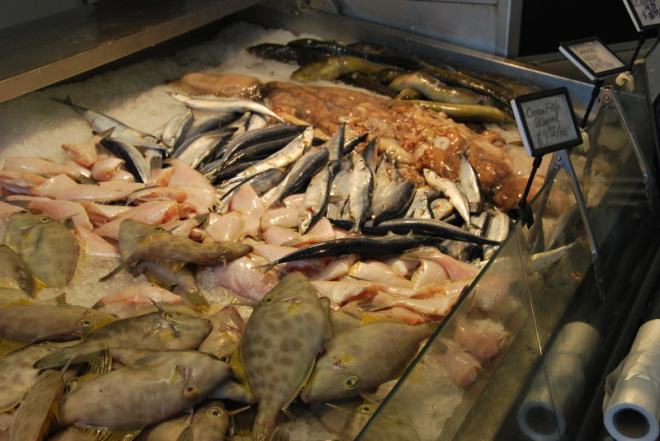
Sustainable fish display in Auckland Fish Market


SARSA DI CHIAPPAREDDI (King George Whiting presented with a sauce made with capers and anchovies)

I like to buy local, sustainable fish and my fish vendor tells me that these King George Whiting are from the coastal Gippsland village of Port Welshpool.

The delicate texture of King George Whiting requires careful handling. These fish only need a little cooking, either on a grill or lightly pan-fried over medium to high heat, as I have done in this recipe.

capersP1010137

Usually, I am happy to present the fish just with lemon. However, there may be times when an accompanying sauce for steamed, baked, grilled or fried fish will bring you greater compliments. I particularly like this Sicilian sauce with delicate tasting fish.

The sauce is called sarsa di chiappareddi in Sicilian and it is made with capers and anchovies. The sauce can be made well in advance and therefore can be particularly useful when having guests.

For me it is most essential to use quality, extra virgin, olive oil. This is especially important for cold sauces, – when the cold sauce hits the hot food, the fragrance of the oil will be strongly evident.

I like to use capers that are packed in salt rather than brine. These need to be well rinsed and then soaked for 30-40 minutes to remove the salt. If you are using capers in brine, drain carefully and only use ¼ teaspoon of vinegar.

Use a tall glass or narrow jug or jar.

INGREDIENTS
parsley, ½ cup, cut finely,
wine vinegar, 1 tablespoonful
anchovies, 3-4 cut finely
capers, 1 cup, if using  the salted variety, rinse well and soak to remove salt, as necessary
pepper or chilli flakes, to taste and salt if necessary
extra virgin olive oil, 1 cup
garlic, 1-2 cloves, finely chopped
PROCESSES
Place the oil and the vinegar together and whip with a fork.
Add all of the other ingredients together and using the fork, mix them together.
Rest the sauce for at least one hour to develop the flavours.

Seafood News

The above recipe and photo were published in the November issue of Seafood News, a small, independent monthly publication dedicated to serving the commercial seafood industry. This Melbourne publication is distributed throughout Australia and reaches all sectors of the industry: markets, fishmongers and some restaurants. The publication will have one of my Sicilian fish recipes per issue. So far I have recipes in Aug-Nov issues.