MERCATO
Some photographs of cooking demonstrations held at Mercato on Saturday 10th November 2012:


More photos on Mercato’s facebook page.
MA2SBAE8REVW

Special emphasis on Sicilian recipes within Italian regional cuisine in an Australian context
Some photographs of cooking demonstrations held at Mercato on Saturday 10th November 2012:
More photos on Mercato’s facebook page.
MA2SBAE8REVW
Friday 9th.


More photos on Mercato’s Facebook page.
MA2SBAE8REVW
Coinciding with the Long Weekend in October on Saturday Beachport had one of their regular Market Days, which are held at various times through the year.
Beachport is a small seaside town in the South East of South Australia close to Robe and Millicent. Anyone familiar with South Australian wine would know about the Limestone Coast and the Coonawarra wine regions. Both are close by. Neighbouring wine regions include Wrattonbully and Mount Benson.

On the foreshore at Beachport there is a large, impressive landmark. It is an historic property called Bompas, formerly Beachport’s original hotel. Bompas has been through many changes, but since April 2012 Sarah and Jeremy are bringing life back into this independent, boutique hotel that serves as a cafe, restaurant and bar with unique accommodation and function facilities.
The reason I am writing about Bompas is that on the October Long Weekend the menu at Bompas featured Pasta with swordfish and mint, one of the recipes in Sicilian Seafood Cooking.The weekend was also the launch of their Asian menu which proved to be very popular.
Sarah and Jeremy now have Trish, an enthusiastic, local and young chef who is very happy to be there and they are equally pleased with her.

In the traditional Sicilian recipe swordfish is the preferred fish, a dense textured fish. I prefer to use sustainable fish and use, mackerel, burramundi, flathead, rockling, yellowtail kingfish or Mahi Mahi. Shell fish also enhances the sweetness of the dish and Sarah, Jeremy and Trish used scallops. They are also looking forward to using local fish on their menu (the fishing season has just started).
Trish did an excellent job of preparing the dish, but what it taught me as the writer is that it may have been useful to include extra hints in the recipe to clarify the process of cooking. Chefs may know how to do it, but what about the person who is not familiar with Italian cooking?
There is so much more advice that the writer of recipes may need to give. For example:
The recipe contains zucchini. What I wish to say is that Italians do overcook vegetables by our standards and in this case it is fairly important that the zucchini are sliced thinly and sautéed till soft – the recipe does not say this. The cooking releases the sweet juices of the zucchini and these are also added to the pasta and contribute to the flavour the dish.
There is also a fair amount of mint, this is added in the cooking process and at the end.
An other thing is that the wine needs to be evaporated so as to caramelize the juices released by the fish when this is sautéed.
And finally, all of the ingredients need to be hot when they are mixed together; this enables the fresh cheese to soften.
For 4-6 people
INGREDIENTS
pasta, 500g, ribbed, tubular like rigatoni or similar
fish, 400g, cut into pieces (4cm)
extra virgin
olive oil, ¾ cup
white wine, ½ cup
garlic, 3 cloves, chopped
mint, fresh, 15-20 leaves
salt and pepper to taste
formaggio fresco or fresh mozzarella or bocconcini, 300g,
salt and freshly ground pepper to taste
PROCESSES
Cut the cheese into small cubes and set aside.
Heat the extra virgin olive oil; add the fish or shellfish and sauté it till it is lightly coloured.
Add the garlic, wine, about a third of the mint and seasoning to the fish. Cover and cook gently till the fish is ready.
Combine fish, cheese and extra mint leaves (large leaves can be cut into smaller pieces).
Add the sauce to cooked and drained pasta, mix and and serve.
VARIATION
Add slices of 2-3 lightly fried zucchini (cooked separately in some extra virgin olive oil and added at the end). Add any juices left over from the zucchini.
To complement the green colour of the dish I sometimes sprinkle pistachio nuts on top.
I contribute a recipe for Seafoodnews a monthly publication.This is the same recipe and photo of the dish I submitted for the October issue.
MA2SBAE8REVW
Mercato is market in Italian.
If you are in Adelaide, you must visit this store. It provides all lovers of things Italian with a wide selection of small goods and cheeses, grocery items and produce, packaged sweets and biscuits, wine, cooking implements, crockery, cookery books and cookery classes and more. It is the perfect store for cooks and lovers of food and wine .
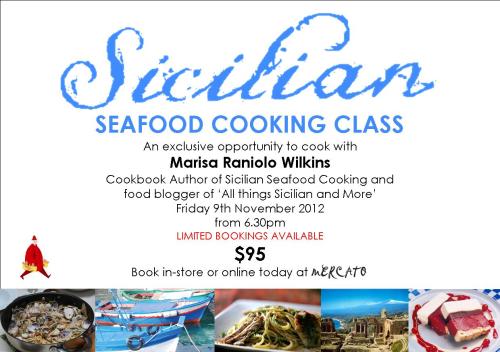
I will be conducting a cookery class at Mercato in November.
|
MA2SBAE8REVW

A Sicilian-born Australian cook creates a deliciously hearty winter soup, writes Christine Salins…
I’ve only just discovered Marisa Raniolo Wilkins’ blog, All Things Sicilian and More, but I’ve had great fun reading about her passion for food, especially the cuisine of Sicily, the island of her birth.
Marisa spent her early childhood in Trieste before moving to Australia with her Sicilian parents, but clearly the childhood memories have never left her.
She is, by all accounts, a generous home cook who is passionate not only about using fresh produce but also about sharing her knowledge of food and its traditions.
 |
| Food photography Graeme Gillies, stylist Fiona Rigg |
Sicilian Seafood Cooking by Marisa Raniolo Wilkins.
Her mother’s surname was Leone, or lion, and there’s a Sicilian proverb that, loosely translated, says “every dog feels like a lion in his own house”.
Marisa describes herself as a lion in control of her own kitchen and she is certainly a fierce advocate of Sicilian cuisine and culture.
So much so that she has now produced a beautiful book, Sicilian Seafood Cooking (New Holland, $45) celebrating the great diversity of Sicilian food and the role that seafood plays in both Sicilian cooking and its economy.
Not only does she draw on her own personal recollections and family traditions, she also takes readers on an historical journey, showing how the cuisine has been shaped by Greek, French, Arab and Spanish influences.
She canvases some of the issues around the sustainability of seafood, and there are some wonderfully evocative illustrations of dishes and Sicilian scenes.
But it’s the recipes, along with the huge number of immensely knowledgeable tips and suggestions, that are the real star, and if you love seafood, you’ll be delighted as I am to join in her culinary journey.
The following recipe reproduced from her book is a deliciously hearty soup for winter. Zuppa di pesce from Syracuse is reputed to be the best in Sicily. Here it is
baked, leaving the fish undisturbed so it does not break up.
You need large chunks of boneless fish – either buy a whole fish, fillet it
yourself and use the heads and bones for the stock, or make the stock from fish carcasses.
Rich Fish Soup from Syracuse Cooked in the Oven
To find out more about Christine Salins click here.
MA2SBAE8REVW
Those of you who live in the UK may have already watched Sicily Unpacked with London based historian Andrew Graham-Dixon and chef Giorgio Locatelli. We have viewed two episodes in Australia and have one to go. I always find great pleasure in seeing Sicily promoted. In these two episodes we have seen some beautiful scenes mainly of Palermo, Noto and Modica and I have included a few of the photos I have to remind you of how beautiful Sicily is.

I have Giorgio Locatelli’s Made In Italy and have enjoyed it. Giorgio’s book on Sicily was released at the same time as mine (Sicilian Seafood Cooking). I have yet to buy his book on Sicily, but I will, as it is always good to compare one’s recipes with someone else’s.

In the two episodes that I have watched Giorgio has cooked three recipes, but although you saw preparing these he did not provide them (a good strategy to motivate you to buy the book).

When I cook I always like to look at more than one recipe of the one dish and then decide how I am going to cook mine. You may wish to do the same.

The three recipes that Giorgio cooked are on my blog and from what I could see they were quite different to mine. To view these recipes on my blog click on the links below. Those of you who have a copy of my book Sicilian Seafood Cooking will find two of these recipes written in greater detail.
Sean Connolly selected to cook my recipe for the SBS website during his Family Feast series. You may wish to view this video on SBS website.
My recipe for Caponata Catanese was published in ITALIANICIOUS magazine and I have written about this in CAPONATA (general information)
A thick soup made with pulses. Click link above for recipe.
I hope that we will all enjoy episode 3 of Sicily Unpacked.
MA2SBAE8REVW
A friend suggested I share this with readers.

Why did you start a blog at the age of 60? My long-time friend Janet Clarkson (of blog The Old Foodie) suggested blogging as a way of promoting myself and my Sicilian manuscript. I was thrilled when the blog reached 20 readers in the first week. Now I have more than 1000 hits every day.
My mother always told me … That my father’s family knew nothing about cooking. There was always rivalry between the two families. My mother was from Catania (mid-eastern coast of Sicily) and my father from Ragusa (south-eastern Sicily). Although Sicily is not a big island, there is a lot of regional variation in its cooking.
On inner-city living … In South Australia, I lived very close to the Adelaide Central Market and as a child growing up in Trieste I also lived in an apartment near the market. I wouldn’t want to live anywhere else. I like to have a strong rapport with market vendors.

Favourite stalls at the Queen Victoria Market? For Italian greens and lesser-known vegetables, Gus and Carmel’s, Stall 61-63 B shed; The Green Generation, I shed, especially for mushrooms and fresh herbs; Mick’s in H shed for fun and Australian produce; Happy Tuna Seafood; Nifra Poultry. For good-quality meat (Black Angus, Wagyu ) try the Greek butcher in the meat hall, first on the right from the Elizabeth Street entrance.
Best 10-minute meal? Salad, soup, pasta or frittata made from leftovers. My fridge is never empty and in my freezer you will always find jars of broth and pulses. Right now I’ve got cooked pine mushrooms collected from the Mornington Peninsula and some bottarga (tuna roe), ready for that moment.
Blogs are great as … A springboard – sharing ideas, sharing recipes for seasonal produce or writing about something unusual that I’m cooking and think others may enjoy. It doesn’t pay. I do it because I always have something to share.
Your greatest inspiration? Mary Taylor Simeti is an American living in Sicily. I’m inspired by how well she has written about its culture and history. I always recommend her books to travellers, especially On Persephone’s Island.
Most underrated ingredient? I’m cooking a lot of artichokes, cime di rape (similar to broccoli) and cardoons.
Favourite ingredient? Whatever is freshest. And I like the taste and colour of saffron.
Fat – love it or loathe it? I like duck fat for roasting potatoes and butter for mashed potatoes, finishing off sauces and making pastry. If lard was easier to get, I would use it for making pastry. Extra-virgin olive oil is also a fat, and I use heaps of this. I also like the taste of oily fish.
First food memory? In Trieste, I remember kraffen, which are like jam-filled doughnuts.
See Wilkins’ blog at zany-king.wpcomstaging.com
The article in Epicure says that I was born in Trieste. This is not the case, but it is very easy to assume this.
My parents met and lived in Trieste (North Italy). 10 days before I was born they caught the train to Ragusa (Sicily) and I was born in my grandmother’s bed and the same bed my father was born in.
10 days after I was born my parents caught the train back to Trieste, their home and my home. I spent my childhood in Trieste before going to Adelaide. About 10 years ago I moved to Melbourne.
Marisa

Epicure is the longest running weekly food and wine guide in Victoria and one of the most popular sections for both Age readers and those in the hospitality industry.
Published every Tuesday, Epicure appeals to ‘foodies’ (those who make food, wine and entertaining central to their lifestyles), casual or ‘big occasion’ diners and also those looking for information about fresh produce or new wine to try.
Written and edited by noted food and wine writers and columnists, Epicure features everything from industry news and restaurant, bar and wine reviews to recipes, the latest kitchen gadgets and topical food related feature articles.
MA2SBAE8REVW

Hosted by the Centre for Greek Studies and the A.D. Trendall Research Centre for Ancient Mediterranean Studies at La Trobe University in Melbourne, Australia, this conference will focus on the movement of people and interactions of culture in the region of Southern Italy and Sicily from antiquity until the present. The conference will run from 17th to the 21st July 2012.
Cooking demonstration for this Conference was held at COASIT in Carlton, Melbourne (A non-profit organisation for Italians and Australians of Italian descent).

‘Sicilian Cooking Workshop’ – presented by Marisa Raniolo Wilkins, author of the book Sicilian Seafood Cooking. Sicilian cuisine has been shaped over centuries by Greek, French, Arab and Spanish influences. In this class, participants will cook fish in the traditional Sicilian. Marisa will share her experience in the kitchen and love of Sicilian cuisine so that participants learn about Sicilian culture while they cook a delicious meal to share after the class.
This conference has been convened by La Trobe University’s Centre for Greek Studies and the A.D Trendall Research Centre for Ancient Mediterranean Studies and will be held at the Museo Italiano in Carlton. On the last day of the conference a professional development day has been integrated into the program which will be of particular relevance to teachers of Italian, Greek, History, Ancient History, Philosophy and Classics. The conference and the professional development day both seek to explore the connections between Roman and Greek cultural and ethnic identity and the movement of people in the Mediterranean region of Southern Italy and Sicilian antiquity until the present.
During the morning participants will attend lectures delivered by academics on the cultural interactions between ancient Greece and Rome. After lunch participants have the option to either attend a material culture workshop or a Sicilian cookery workshop.
The menu for this workshop included:


Marianna demonstrated how to make giuggiulena to a group who attended the Sweets Festival at the Immigration Museum (18th March). Eager participants filled the small theatre, they watched as she made it, smelt it, sampled it and took home her recipe, which I will share with you (see below). There was plenty of interaction with the group and it was a pleasure to field questions and to participate in the comments and discussions. Towards the end of the session Lidia, Marianna’s mother also participated.
In some parts of Sicily giuggiulena is also known as cubbaita. e seeds). You may be familiar with torrone (nougat) which is common all over Italy and is made with almonds, eggwhites and sugar. Marianna and I had a discussion on stage about some versions also including honey – I know that a Sicilian friend of my mother’s adds this.

The Festival was an amazingly successful day and it drew a very large crowd. People came to see great performances, eat glorious food, attend cooking demonstrations and see the exhibition on Sweets: Tastes and Traditions of Many Cultures (Indian, Italian, Japanese, Turkish, Mauritian). As well as Marianna there were cooking demonstrations on how to make Japanese wagashi and moshi sweets and Indian sweets. Members of the Turkish, Mauritian communities demonstrated how to make halva (helva).

The range of food for sale from the participating communities was of extremely good quality.
Marianna’s Dolcetti stall was stocked with an array of Sicilian sweets from her pasticceria in Victoria Street, West Melbourne. There were people lined up all day to buy samples of her cakes, pastries and biscuits.

Her mother Lidia was making batch after batch of Sicilian fritelle (also called sfinci) and those who worked on the stall did not have time to have a break, from the moment they set up until they had sold out of everything. I believe this was the case for most of the stall-holders with many saying that they did not get time to see the exhibition on the first floor of the Museum. Like me, they are going back. Although the festival was a one off event, the Exhibition (at The Immigration Museum, Melbourne) goes on and is really worth seeing (15 March 2012 to 7 April 2013).

One cannot help but see the Arab influence on Sicilian cuisine – the Arabs ruled Sicily for two centuries (in medieval times they were sometimes called “Saracens” or “Moors”) and contributed to the development of Sicilian culture, the agriculture and architecture, and had a profound influence on the cuisine of Sicily. They are credited with bringing or contributing to the development of certain produce used in sweets: sugar, pistachio, sesame seeds, citrus, dates, cinnamon and cloves are some of the produce considered they made ices and pastries stuffed with nuts and dried fruit. Sicily is a blend of cultures and obviously, one cannot give the Arabs all the praise, there were the Spaniards, French, as well as the Normans, Carthaginians, Romans, Greeks and original settlers as well as them.
Sicilian pastry chefs are renowned all over Italy and Marianna is no exception. Marianna’s little pastry shop is filled with handmade delicacies made with natural and fresh ingredients. Her dolcetti (little sweets) are a work of art and she is very proud of her Sicilian heritage.
 As you would expect when giuggiulena (or cubbaita) is made in the various parts of Sicily, there are variations in the recipes – some use all sugar or all honey, some omit almonds. My relatives in Ragusa add cinnamon and I have seen recipes where a pinch of cumin is added.
This is Marianna’s recipe for giuggiulena.
INGREDIENTS
250gms sesame seeds
250gms orange blossom honey
250gms sugar
250gms whole raw almonds
zest of 1 orange (not too finely grated)
METHOD
Combine the honey and sugar in a pot and stir until it begins to melt and soften.
Add the sesame seeds and almonds and cook, stirring continuously until it begins to bubble.
Let it cook and darken to a dark golden brown color.
Add the orange zest.
Pour onto a sheet of baking paper lined with a touch of oil or oil spray or onto a lightly greased marble or granite surface.
Flatten it slightly with an oiled rolling pin.
Let it cool before cutting it into pieces
Keep stored in airtight container.
Giuggiulena is usually made for Christmas and more recently at Easter but because it keeps well, it is often served to visitors at other times of the year – it is particularly useful to have on hand in case unexpected guests come – one would not want to make a brutta figura. My relatives wrap each piece of giuggiulena in cellophane or greaseproof paper.

MA2SBAE8REVW