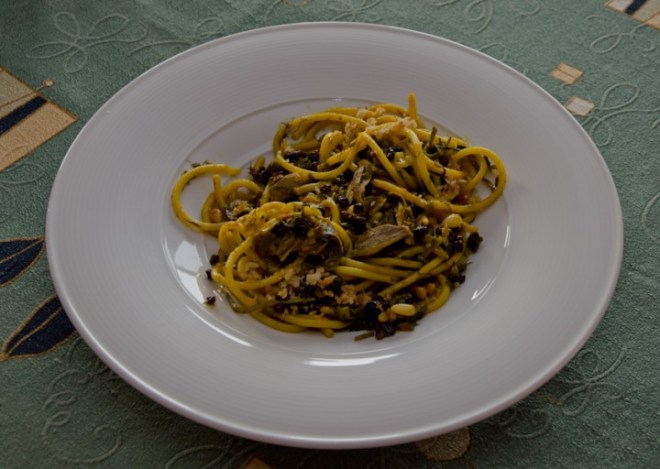
Pasta e fave (broad beans) is a spring-time, Italian, rustic dish.
There are many Italian, regional combinations of pasta e fave, some add chicory or wild fennel, or tomatoes. Guanciale is an Italian cured meat made from pork’s cheek (guancia – cheek) and it is also a favourite flavouring. Thick bacon can be substituted, but somehow this is not produce I associate with fresh spring flavours and I always omit it. In keeping with the theme of spring, on this occasion I added a couple of zucchini. Fresh mint leaves can be added at the time of serving the pasta.
Peas are also in season in spring and the same dish can be prepared with peas or a combination of broad beans and peas.
Depending on which part of Italy you favour, you can add Pecorino or Parmigiano, but once again, I prefer to keep the taste “clean” and the drizzle of extra virgin olive oil, fresh mint and freshly ground black pepper is enough for me.
Short to medium sized pasta that is suitable for zuppa or minestra (soup) is used in this dish and the pasta can be presented with the broad beans, served either wet or dry. You can choose whether to obtain a rather dry or slightly brothy dish – I always like it wet, just as I like a wet pasta e fagioli (borlotti beans).
I like to cook my pasta in with the beans, however, the pasta can be cooked separately, drained and then added to the beans. If this is your preferred method, cook the broad beans for 20-30 minutes, until soft, cook the pasta until al dente, then drain and dress the pasta with the broad beans and the broth.
1.5 kg fresh broad beans
2 spring onions
1 or 2 fresh garlic cloves
½ cup extra virgin olive oil
salt and to taste pepper to taste
2 zucchini (optional)
chopped parsley
1 litre or more of chicken or vegetable broth (or water)
short pasta, a couple of handfuls or more, depending on how much pasta you prefer
your best and fruitiest, extra virgin olive oil to drizzle on top
Heat extra virgin olive oil and sauté the onions and garlic.
Add the shelled beans, zucchini and parsley and sauté briefly. Add broth, season with salt and pepper, cover, and cook over low heat for about 10 minutes. Make sure that the liquid is boiling before adding the pasta. Add more hot broth or water if needed.
When the pasta is , turn off the heat and serve, but remember to drizzle your best extra virgin olive oil on top….it will be very fragrant!
Add more black pepper and/or fresh mint leaves when serving.
Minestra Marinata is a peasant soup from Calabria.
What is Minestra?
Minesta in Italian means soup. But it does not stop there – minestrone is a thick soup and minestrina is a more delicate or thin soup. All minestre (plural) may or may not have pasta (or pastina) or rice or grains added to thicken them.
What is a Zuppa?
Then there is zuppa and this Italian word shares the common root with soupe (French), suppe (German) and sopa (Spanish and Portuguese). These days the differences between a minestra and a zuppa are probably interchangeable and there are always regional and cultural variations (as the Calabrese minestra below), but a zuppa relies on an accompaniment of a slice of bread; usually this is placed in the bowl and the zuppa is ladled on top. The bread soaks up the juice and therefore no pasta, or rice, or grains (barley, wheat) are needed.
Traditionally, a zuppa has a broth base, whereas the liquid in a minesta is more likely to be water and relies on the vegetables, pulses, fish, meat (or smoked meat) for flavour. In modern times, recipes for minestra may include the addition of water, stock or broth as the liquid base .
Beautiful Calabria
So why am I taking such an interest in the specific Calabrese minestra?
During my recent visit to Adelaide, I dined at Minestra, a small home-style eatery in Prospect. I ordered minestra with my pork and veal and eggplant polpette. The minestra was presented less soupy and more like a side dish for the polpette, but it could also be ordered unaccompanied as a one-course dish with a greater quantity of liquid and a more substantial soup-like consistency.
This eatery is notable not only for its daily menu displayed on a blackboard, but also for its flexibility. The menu can feature locally sourced produce, as indicated by the sign inviting customers to bring their own.
Minestra’s owner and head chef is Sandy Cenin, whose surname suggests a northern Italian heritage. His grandmother is Calabrese.
Inspired by Sandy’s minestra, once home in Melbourne, I was determined to conduct some research and to make it.
Calabrese minestra is a traditional peasant dish suited to the region’s agricultural heritage. Unlike other pasta-based dishes, this minestra is made with simple, frugal ingredients. It typically includes wild greens and dried broad beans or borlotti or cannellini. Occasionally, pork is also used. The dish is characterised by its austerity and is not sophisticated or complex. The combination of green vegetables and beans creates a thick, stew-like soup. Variations may include potatoes and pork can be fresh meat ribs or rind. Some recipes also incorporate the rind of grated pecorino cheese for flavour.
In Calabria, as in Sicily, wild foraged greens are highly valued and not solely for necessity. In Australia, we may not be familiar with the range of edible plants available or have access to as many, but we do have some excellent green leafy vegetables that provide contrasting and robust flavours.
Green leafy green vegetables
The Green Leafy Vegetables – different types that could be suitable
A mixture of three or four of seasonal, green, leafy vegetables, is sufficient – I am using endives (or escarole) and chicory, that are both bitter, cime di rapa (a brassica) for the mustard taste and sow thistle that was sold to me as milk thistle and tastes mild and grassy.
I bought this mixture of greens from my regular fruttivendolo at the Queen Victoria Market (see photo below). If I had foraged for dandelions (bitter taste) or wild broccoletii (wild brassica) I would have used these instead of the more conventional chicory, escarole (bitter) or cime di rapa (mustard).
The green leafy vegetables ready to be wilted
There are many brassicas that could be suitable – kohlrabi (root and leaves), cabbage, kale (not Italian, but who cares!), cavolo nero, cauliflower, broccoli, Brussels sprouts (not a Calabrese vegetable)and cabbage.
Wild fennel, amaranth, nettles are also wild greens that could be accessible to you or you may be growing borage in your garden (photo below).
RECIPE for The Minestra MaritatA
Ingredients
I am going to be Italian when I write this recipe. There are no measurements for the ingredients but my photos can give you an indication and it is ‘cucina povera‘- peasant cooking – that is, use what you can get, make it to your taste, add as much liquid as you wish, but keep it thick.
Use a variety of green leafy seasonal vegetables – whatever you can get – go for combinations of taste – bitter, sweet, peppery, grassy, aniseed taste (as in fennel).
Method
Soak, cook pulses (borlotti, cannellini, dried broad beans) … or buy tinned beans if that is what you do. In my photo you will see that i have used black-eyed beans – this is not an Italian bean, but it is what I had on hand at the time and I do not think that my breaking of tradition mattered. Drain the pulses you intend to use. Keep the liquid (broth) in case you want to add it as the liquid for the minestra.
Clean the greens, separate them from any tough stems but keep the softer ones.
Soften the greens – boil them in as much or as little salted water as you cook all your green leafy vegetables. Drain them but reserve some liquid for the minestra. I did not have to discard any because I did not use much water to cook my greens.
Chop garlic ( I used quite a bit), sauté the drained greens, add beans. My ratio was about 2/3 greens and 1/3 beans.
Add chopped chilli at the same time as the garlic if you wish or serve chopped chilli or chilli paste separately (Calabresi a fond of pepper paste).
Add as much liquid as you wish, dish it up, drizzle some extra virgin oil on it and eat it with some good bread.
See recipe for the Sicilian Maccu– another of those peasant soups and this one has even more traditions than the Calabrese minestra.
It is always good to visit Sicily in May 2016 and this time I spent most of my time mainly in South-eastern Sicily. But we did wander elsewhere – distances are not that great.
As usual, the relatives in Ragusa and Augusta made sure that I was well fed, but I do enjoy getting out and about and seeing the changes and trends that are evident in their food culture. I do that here in Australia as well, or for that matter any place I revisit.
Below are some photos of Sicily and links to existing recipes from the blog … more writing and more recipes soon.
Stunning scenery
Acireale
And Granmichele,
A Nature Reserve near Donna Fugata
Antiquity
A very old church in Modica.
Inside this old church that has been a stable for many years.
Area Archeologica di Cava d’Ispica
The old stone walls, some being repaired or rebuilt.
This was one of the workshops offered by La Trobe University as part of the 2013 lecture series. It was held on Saturday 23 March 2013.
The session began with a very interesting lecture on the history of food and feasting in Sicily, Italy and the Mediterranean. Dr Gillian Shepherd is Lecturer in Ancient Mediterranean Studies and Director of the A.D. Trendall Research Centre for Ancient Mediterranean Studies at La Trobe University. During her lecture she focused on the literary and archaeological evidence for food production and consumption in the ancient world.
I accompanied the lecture with a food workshop and cooking demonstration that reflected the ways Sicilian cuisine has been influenced by the dominant cultures of the Mediterranean from ancient times to the modern day, which includes Greek, Roman, Arabic, French and Spanish cultures.
For the workshop I collected some wild greens and the audience was able to see the differences between the wild variety and the cultivated species; wild fennel is one of the ingredients in Pasta Con le Sarde.
Cassata (pan di Spagna/sponge cake, ricotta, nuts, marsala, citrus peel, chocolate and marzipan)
Those of you who live in the UK may have already watched Sicily Unpacked with London based historian Andrew Graham-Dixon and chef Giorgio Locatelli. We have viewed two episodes in Australia and have one to go. I always find great pleasure in seeing Sicily promoted. In these two episodes we have seen some beautiful scenes mainly of Palermo, Noto and Modica and I have included a few of the photos I have to remind you of how beautiful Sicily is.
I have Giorgio Locatelli’s Made In Italy and have enjoyed it. Giorgio’s book on Sicily was released at the same time as mine (Sicilian Seafood Cooking). I have yet to buy his book on Sicily, but I will, as it is always good to compare one’s recipes with someone else’s.
In the two episodes that I have watched Giorgio has cooked three recipes, but although you saw preparing these he did not provide them (a good strategy to motivate you to buy the book).
When I cook I always like to look at more than one recipe of the one dish and then decide how I am going to cook mine. You may wish to do the same.
The three recipes that Giorgio cooked are on my blog and from what I could see they were quite different to mine. To view these recipes on my blog click on the links below. Those of you who have a copy of my book Sicilian Seafood Cooking will find two of these recipes written in greater detail.
Those of you who have been to Ragusa Ibla will recognize these shots. The baroque church is that of San Giuseppe, a much loved saint in Sicily (not as much loved as San Giorgio who is the patron saint of Ragusa and has a church which is much larger Duomo- cuppola in photo above- more beautiful and not far from this one).
March 19 is the Feast of San Giuseppe (Saint Joseph), which in the Northern hemisphere coincides with the spring solstice. This feast day is a major religious celebration in Sicily.
San Giuseppe is the patron saint of pastry cooks and among the many celebratory dishes are special breads shaped in varying shapes and sizes. On this day pulses are also eaten in many parts of Sicily; some of you may be familiar with maccu made with dried fava beans, which is especially common in southeastern Sicily. Several of these present day traditions have developed from very ancient origins – both legumes and wheat are considered to be seeds of life and are metaphorical foods from pre-Christian times.
In many parts of Sicily there are banquets to celebrate the feast of Saint Joseph, which coincides with the end of Lent, a period of fasting in the Catholic liturgy. But it is also a celebration of the end of the fast imposed by nature – this was more so before the days of fast travel and transport or refrigeration when the provisions kept from summer over winter were depleted by this time of the year.
In some communities especially in small villages large altars and tables are built and filled with large quantities of local cuisine: fish dishes, cooked vegetables, breads, many sweets, but no meat is prepared. Once, in many Sicilian towns and villages the food was also shared with the poor.
One of the recipes cooked on this day are the Sfinci di San Giuseppe. The translation to fritters doesnot necessarily sound very appealing, but maybe if I tell you that they are made from the same dough used to make Pâté à Choux or Bigné or creampuffs, you may be more enticed. They are fried rather than baked.
If you have ever made cream puffs you would know that the dough is cooked before being baked. For making the sfinci a little sugar is added to the mixture.
There are many recipes to make Choux Pastry and the following recipe works pretty well:
eggs, 4 large
water,1 cup (230 cc)
unsalted butter, 4 tablespoons (55 g)
salt, a good pinch
plain flour, 1 cup (140 g)
sugar, 1 tablespoon
oil, to fry the batter (I use extra virgin olive oil for everything- but not my best olive oil which I use to dribble on hot food or salads)
Place water, salt and sugar in a saucepan (large enough to hold all of the ingredients) and bring the water to a boil. Add the butter.
Remove the pan from the heat and add the flour all at once. Beat the mixture immediately with a wooden spoon and work quickly. Stir till the dough is smooth – the flour and water will form a ball and no longer stick to the sides of pan. Allow the dough to cool for about 10-15 minutes, but stir it often to allow the steam to escape and to cool at a greater rate.
Add eggs one at a time, stirring each egg completely into the dough before adding the next. (The dough should be pliable but not be runny).
Heat some oil to frying temperature – there should be sufficient oil to nearly cover the level tablespoonfuls of dough, which will be dropped into it.
Fry only a few at the time or the sfinci will broil rather than fry. Turn each sfinci once or twice until they are golden brown and have swelled in size.
Variations:
Some Sicilians eat them warm and coat the sfinci with honey, others use a sprinkling of sugar and cinnamon.
Some allow them to cool, split them open and fill them with pastry cream or with whipped ricotta flavoured with a little sugar and cinnamon. In some parts of Sicily they are called Zeppole.
If you have watched the Inspector Moltabano television series, you will recognize the building that was used as the police station; it is in Ragusa Ibla. To the right of the building you can see the corner of the Chiesa di San Giuseppe (church of). Some of my male Sicilian relatives are posing for the photo. They live in Ragusa.
This is a photo of mature broad beans taken in the Palermo Market. If you were keen, you would extract the beans from the pods, dry them and store them. Now days you would buy them dry.
‘You must try the maccu,’ urged my host as we perused the menu in a small restaurant in the back blocks of Palermo. ‘It’s one of our local specialities.’ A wide, shallow bowl was filled with a drab beige puree enlivened by a spiral of olive oil. I tasted it and in an instant understood that this was minestra di fave, the puree of broad beans that had sustained people throughout the Mediterranean in the 14th and 15th centuries, a dish familiar to me from many culinary manuscripts. The taste was pure, elemental, almost mono-dimensional, but enhanced with the timelessness of tradition. With every spoonful I was connected to civilisations past, from medieval to Roman and even back as far as ancient Greek and Egyptian. And when I harvest my broad beans each spring, the echo of this experience returns.
Barbara Santich, author and culinary historian.
From article in The Australian Weekend magazine: Unexpected delights, compiled by John Lethlean and Necia Wilden, August 03, 2009
I am always thrilled to read anything by Barbara Santich. Her writing is always rich in detail, well researched and a pleasure to read.
Maccu, is a traditional Sicilian very thick soup and in most parts of Sicily it is made of dried fave (broad beans). It is mostly cooked over the winter months and as Barbara informs us , it has been a staple dish for the contadini (peasants) since ancient times.
In some parts of Sicily it is also a celebratory dish cooked at the start of spring. Spring in Sicily has a particular significance for me because March19 was my father’s name day. It is the Feast of San Giuseppe (Saint Joseph); this feast also coincides with the spring solstice and in many parts of Sicily maccu is particularly eaten on this day.
Maccu is a recipe with spring sentiments of renewal, use up the old, celebrate the new. To make maccu, the dried beans of the last season are used before the new harvest begins in spring. Broken spaghetti and any assortment of left over, dry pasta shapes are also added to the soup and particularly in the days when pasta was sold loose, there used to be quite a few pasta casualties. Many of the religious celebrations have pagan origins; the feast of Saint Joseph in the Catholic religion is at the end of Lent, a time traditionally used for fasting, both in the religious sense and over the lean winter season.
Dried fave (broad beans) are the main ingredient. They are light brown and smooth and shaped a little like lima beans. And because they have a very tough skin, they need to be soaked and peeled before cooking. As you would expect, there are local variations in the recipes. In some parts of Sicily a mixture of pulses are used – lentils, beans, chickpeas and some recipes include dried chestnuts. The greater selection of pulses is found in Il grande maccu of San Giuseppe, the grandest soup of them all. Wild fennel is added to most versions – it adds colour and taste. Those of us who do not have this, can use fennel seeds and a few fennel fronds; a little green leaf vegetable like cime di rape, chicory or silver beet (Sicilans would use the wild beets) will also add the green colour. Some recipes include a little chopped celery, others have dried tomatoes (they would be kept under oil over the cold months).
I realize that it is not March, but in Australia we are looking forward to spring which starts in September and writing about maccu now seems appropriate.
This is a recipe for a very simple maccu.
INGREDIENTS
dry broad beans, 500 g (use a variety of other dried pulses if you wish)
wild fennel, one bunch ( or fennel seeds, crushed, 2 teaspoons and fresh fennel fronds)
onion, 1, cut finely
salt and freshly ground pepper to taste
extra virgin olive oil
PROCESSES
Soak the dried broad beans overnight.
Drain them and peel the outer skin off the broad beans.
Cover the legumes with an ample amount of water, add fennel seeds and cook the soup slowly. After about 40 minutes add the onion, fennel (and some small amounts of chopped greens if you wish). Continue to simmer for another 30 minutes. To prevent the pulses from remaining hard, add the seasoning after the pulses are cooked. If you wish to add pasta, add more water, bring to the boil and cook the pasta in the maccu.
Drizzle with generous amounts of extra virgin olive oil and serve (I do this at the table and on individual portions).
In some parts of Sicily, left over maccu is also eaten cold (the pulses solidify).
In the feauture photo the maccu is served with Lolli, a type of hand-made pasta still customary today in the Modica area. I ate this in Trattoria a Punta Ro Vinu in Modica.
Several of my friends are beginning to discover and appreciate the taste of fennel. It is prolific at present in Melbourne and most refreshing eaten raw. It can be cooked – braised, baked, made into a tortino (see recipe in blog tortino di finocchio) and as in this recipe, made into a soup (not a very common way to cook fennel).
Traditionally this recipe should be made with wild fennel and this is how I first tasted this soup.Obviously if this ingredient is not close by, the bulb can be used. If you can collect some wild fennel (make sure it looks healthy, see recipe in blog pasta con le sarde), experiment with this recipe and use both the wild and the cultivated bulb with some of its tender fronds and stalks (choose round, shiny bulbs, as in photo taken in the market of Syracuse).
It is one of the simplest soups to make and when it was first made for me (using wild fennel) all of the vegetables went into a pot with the water and once softened, broken spaghetti were added – soup without pasta is rarely presented. The broken spaghetti were once the way to use them up, by all means use some short, small sout pasta shape.
I am always amazed how Sicilian soups cooked so simply can be so appetising. My relative presented the minestra with a drizzle of the very flavourful oil given to her by a relative in Noto. Maybe the oil is the secret ingredient! Boiled vegetables cooked this way and presented with the water is considered rinfrescante, calming and soothing for the digestive system and very common as the evening meal (Sicilians still eat their main meal at lunch time).
I have intensified the flavours by varying the method of cooking and I sauté the vegetables before adding the liquid, this being a common way to make soup in the north of Italy. I also like to add stock instead of water, but when I cook this version it is no longer traditionally Sicilian.
I also found a version of a recipe for maccu (a very Sicilian soup) made in the Madonie which is very similar but uses wild fennel , dried broadbeans (soaked overnight and peeled) and no potato. The dried broadbeans add a very different taste and as they are floury, also thicken the soup as does the potato.